Categories
BACCA Writers

When Rejection Is Good

image of a rubber-stamped all-caps NO THANKS in red ink.

Image by Gerd Altmann from Pixabay

Last time I blogged here, I described the process of querying my first novel. Now, a few months later, I have news. Has an agent requested the full manuscript? Even better, did the agent love the ms and make me an offer of representation? Even better, was the agent a good fit for me and my work? Even better, did we contract to work together? Even better, did the agent find a publisher who wanted my manuscript? Do we have a publishing contract and a launch date?

Nope. None of those happened. Not yet. Maybe not ever.

But querying has gotten a little bit easier for me.

Why? Two reasons.

Practice, Practice, Practice

Just like doing laundry or playing cards or building flat-pack furniture, our skills and facility improve over time when we keep repeating the process. The first queries I sent out were overwhelmingly difficult for me. Everything about them was hard.

Getting a decent draft of the query letter, for starters, was a long-term project. I have since revised and rewritten it countless times, but just getting it to minimally presentable status took a ton of work. Describing / selling your full-length novel with 150 words? Finding comp titles recently published in the same genre? And, by the way, what is the genre? Literary fiction? Don’t you need an MFA to be eligible to write lit fic? Book club fiction? I worry that I’m not plotty enough for that. Upmarket fiction? Maybe that’s the sweet spot. Then there’s the sentence or two of author bio – where you say enough, not too much, about yourself to sound confident, not meek, and also not arrogant. Also competent and collegial, not supplicating. Also respectful, not sycophantic.

Then there’s the ongoing search for the agents who might entertain receiving your query. On their schedule. Using their preferred document formats. In the genres they declare themselves interested in. Erf. It’s enough to make a person not want to query their novel.

Image by Leopictures from Pixabay

Point is, these skills do get easier with practice. Querying still takes longer than I think it will. I can’t just expect to set aside ten minutes and knock one out (although that’s been possible once or twice). Many of the agents I’m approaching use the online QueryManager portal. In addition to supplying places to paste in (and then reformat) or upload the requisite number of pages or chapters, the bio, comps, sometimes synopsis, and other chunks of text, QueryManager allows its agents to ask questions.

So far, I am finding that no two agents’ QM forms are alike. One agent wanted a profile of the readers I think will be drawn to my book. Another wanted to know how many copies my self-published book sold in its first year. Another wanted my Twitter handle. Another – well, you get the idea. Some of those questions can take a while to answer, and you never know until you’re already mid-query what the surprise questions are going to be, or how challenging they’ll be to answer. I have learned to allow an hour, and never to query when the clock is ticking away before an upcoming appointment.

The Nice Rejection

The second reason why querying has become a little easier is that one of the agents didn’t just ghost-reject me or send a standard no-thanks message. She actually wrote to me, and said that, while my novel wasn’t the right book for her, she’d like to take a look at my next project when it’s ready.

I knew this agent’s response was different, and yet I was acutely aware of my neophyte status in the whole world of querying. Uncertain what to make of it, and cautious about celebrating something I wasn’t sure I understood, I quoted it to a friend who’s farther along in the querying / agenting / publishing journey. I asked her, “On the spectrum of rejections, that’s somewhere in the middle, I think, yes? It definitely feels better than the ghost rejections 12 weeks post-query.”

My friend sent back congratulations, saying, “This is a really good rejection! It means that even though she’s not interested in this book, she likes your writing, and if you had an idea that spoke to her, she’d likely sign you. Print this one out and use it as inspiration.”

Getting that reinforcement from a friend and colleague helped me frame the nice rejection in a way that feels validating. The agent thinks my writing is legit!

The queries I’ve sent out since receiving that nice rejection have felt lighter, easier, more straightforward.

Funny how that works: I gained confidence from being rejected. Who knew?

— A M Carley writes fiction and nonfiction, and is a founding member of BACCA. Through Anne Carley Creative she provides creative coaching and full-service editing to writers and other creative people. Decks of her 52 FLOAT Cards for Writers are available from Amazon. Anne’s writer handbook, FLOAT • Becoming Unstuck for Writers, is available for purchase from central Virginia booksellers, at Bookshop.org, and on Amazon. She’s querying her first novel, and writing her second.

Categories
BACCA Writers

Querying

Although asking literary agents and book publishers to pick your work is a huge part of the writing life, I avoided it for a long time. Over the years, publishers accepted articles I’ve written. Blog hosts published my guest posts. I have published books that other people have written, as well as one that I wrote. I have helped other authors set up their books via their own indie publishing enterprise. I have contributed chapters to published books edited by others. Until recently, though, I hadn’t asked someone else to publish a book that I wrote.

It’s a whole new adventure. Do people enjoy asking strangers to stop, look, read, and love their manuscript? Perhaps. I’m not aware of anyone who reports a fondness for the activity. The conventional wisdom is that querying, as this process is called, is a necessary slog. It can take years of querying one manuscript before an opening appears, and more years – if everything goes well – before that manuscript emerges in print as a new book. Writers swap stories of the long road from query to publication. They curse the agents who turn them down, and then they sometimes curse the agent(s) who work with them.

Agents

Agents also struggle. There’s never enough time. They work on commission, earning money from a manuscript only after they’ve managed to sell it to a publisher. They earn more money when that book becomes successful in the marketplace. This provides incentive to pick winners, not just projects of which they are fond. There’s also the dream of picking the unknown project that becomes the next big thing. But that’s much riskier.

Agents’ time needs to be allocated to growing and strengthening their network of connections to the acquisitions editors at every publishing house and imprint that might one day be a fit for one of their clients. (If you already know them, you have a much greater chance of getting them to agree to take a look at a new project.) But agents’ time also needs to be allocated to working alongside their existing writer clients, negotiating film rights, working with the audiobook narrator, conferring on – if not always able to approve – the cover design of their clients’ next books. But their time also needs to be allocated to reading the new stuff that’s perpetually coming in via new queries from new authors. Most literary agents got into the business because they love reading. From what I hear, though, a busy agent barely has time to think, let alone sit down with a new manuscript from an unknown author.

The lottery

Why do unknown novelists like me even bother? If the system is rigged against the new writer, what’s the reason for slogging away, against the odds, hoping to be the exception? Because deep down we each believe our work is special. Because it’s a rite of passage. Because if you don’t buy the ticket you can’t win the lottery.

photo of a Mexican lottery kiosk, with a handpainted sign, on a city sidewalk

You gotta be in it to win it.
Photo by José Pablo Domínguez on Unsplash

Sometimes it feels as though querying is like buying a ticket and then paying interest on the ticket price. Your carefully polished query letter is the price of the ticket. Rejections are the interest. Stories abound of writers who papered the walls of their room with rejection letters – back when correspondence happened on paper. For a while, I’m told, agents sent replies to querying authors via email, usually in a standard rejection that a lowly office assistant or automated process could issue, occasionally with a more carefully worded note. (I have celebrated heartily with friends who exclaimed, “I got a personalized rejection!”.) Nowadays, many agents explain in their submission guidelines that not hearing from them after a period of time means the query has been rejected.

I knew of one unpublished novelist who didn’t go with the subservient flow. She was an experienced radio journalist, who knew her way around a sentence, and had name recognition among the NPR cognoscenti. When it came time to query her novel, she donned the mantel of a professional, not a supplicant. It worked! She treated the agents as peers, and they responded in kind. She got a modest book deal, and her novel was published to some critical acclaim. This was several years ago now, and the querying process has only gotten more difficult since, but her example still shines for me like a beacon.

Andie Jordan

What am I querying? A novel – my first – about Andie Jordan, a young woman finding her way in the New York City art world of the early 1980s.

Who am I querying? Some agents and some small publishers. From what I can tell, books like mine are slightly more welcome at certain small presses than they’d be at the big corporate publishing houses. As the PRH / Simon & Schuster news last fall indicated, the big five are publicly traded companies responsible to shareholders for profiting from books and other intellectual property. They prefer proven winners – in the form of (already) best-selling authors, popular tropes, celebrities, pop-culture heroes, and themes ripped from the headlines. “Quiet” novels like mine – and I mean that as a compliment – aren’t likely to be their cup of tea. So whether I look for an agent or a publisher, the publisher that would bet on my book is almost certain to be a smaller one.

How am I querying? I write (and rewrite) a query letter. This is a one-page term paper / marketing document that must obey certain guidelines. Some of these guidelines, available online, are specific to each agent or publisher. For example, the periods of time when they are, or will next be, open to queries; the form in which they accept queries – in the body of the email, or attached to an email in 12-point Times New Roman with one-inch margins – or the kinds of projects they want. Others are generally accepted industry standards, like including your book’s title, word count, genre and category, plot, and author bio. Writing and rewriting your query letter is a part-time job, as is updating your research on agents’ and publishers’ open dates, submission rules, schedules, wishlists, and more.

Want to see my “plot paragraph” – the heart of the query letter? Here you go:

Andie Jordan is a talented painter and aspiring writer in 1980s Manhattan. A manager at the cutting-edge New Art Center, she tirelessly supports the arcane artistic visions of a select group of middle-aged white guys – until the job completely takes over her life and she stops painting. Even after she resigns, the Center pulls her in. While she struggles to recover from workaholic burnout, a federal prosecutor questions her in his case against the Center for mishandling public funds. A work friend has a debilitating breakdown; looking into its cause embroils Andie further in Center business. Desperate to leave arts administration behind, she enters journalism grad school, with plans to investigate the intersections of art and money. Her thesis advisor, with secret ties to the Center, criticizes Andie’s tactics. The prosecutor discourages her research, which might jeopardize his case against the Center. Then, out of town to exhibit some new paintings, Andie learns that her ex-boss, who can blackball her from New York galleries, wants her added as a defendant in the criminal case. She despairs of ever breaking free from the Center’s long reach to clear an independent creative path.

#amquerying

I maintain a spreadsheet of agents and small publishers whose expressed interests intersect with what my novel can offer them. So far, everyone I’ve contacted has either said no or has said nothing.

My novel’s working title is Andie Jordan Needs a Life. Why “working title”? Because in the unlikely event Andie gets picked up, a lot will be subject to change, including the title. When it comes to book marketing, everyone knows that we DO judge a book by its cover, as well as by its title (a significant element of said cover). And the publisher of a first-time novelist will have a lot of power and influence – earned over years of experience and marketplace clout – over the debut author. So titles often change. I’ve already changed Andie’s title several times, on my own, and remain open to better ideas.

Will I stop the madness? Very likely. But not yet. I feel as though playing this out is teaching me things I need to understand. I’m learning by doing. I have joined the immense community of writers who dedicate themselves to the process of querying. On a good day, I can feel us cheering one another on. Go, fellow queriers!

— A M Carley writes fiction and nonfiction, and is a founding member of BACCA. Through Anne Carley Creative she provides creative coaching and full-service editing to writers and other creative people. Decks of her 52 FLOAT Cards for Writers are available from Amazon. Anne’s writer handbook, FLOAT • Becoming Unstuck for Writers, is available for purchase from central Virginia booksellers, at Bookshop.org, and on Amazon. She’s querying her first novel, and writing her second.
Categories
BACCA Writers

Critiques and the US Constitution

BACCA’s Origin Story

As described in another page in more detail, the writer group BACCA formed after four of us met in a fiction class at WriterHouse in Charlottesville Virginia.

After the final class session, the four of us wanted to meet again for one more critique session. Then we realized that we all wanted to create an ongoing writer group.

That was ten years ago. Wow – it almost seems impossible that it’s been ten years, but there it is in my 2011 calendar – “writer critique swap” at noon on Saturday the 25th.

Evidence! Proto-BACCA’s first meeting in the author’s 2011 calendar.

We immediately adopted the critique guidelines that had served us well in our writing class. Later, when we created a website for our group – by then we had named ourselves BACCA – we asked permission from Prof. Luke Whisnant, whose guidelines we’d been using, to reproduce them on the website as a resource for other writers. He graciously consented.

At our (pre-pandemic) workshops and in personal emails, we often referred other writers to these guidelines – along with a bundle of other writer group resources.

Changes over Time

Our membership has changed over the years. We now include two founding BACCA writers, another who’s been with us for many years, and one who is a guest member for the duration of her book manuscript. Three other writers were with us for a time, over the years.

Naturally, because of the variety of writers and the passage of time, our critique process has evolved.

A few months ago, we decided to take extra time at our monthly critique session to focus on the guidelines, and see where they might need expanding or refocusing.

Why the Guidelines are Like the US Constitution

I was shocked, when I looked a few months ago at the Whisnant critique guidelines, to see how much I’d added on to them – in my mind. Turns out, the actual guidelines only addressed works of fiction intended for adults, for one thing. Our group has produced, read, and critiqued in many more categories than that.

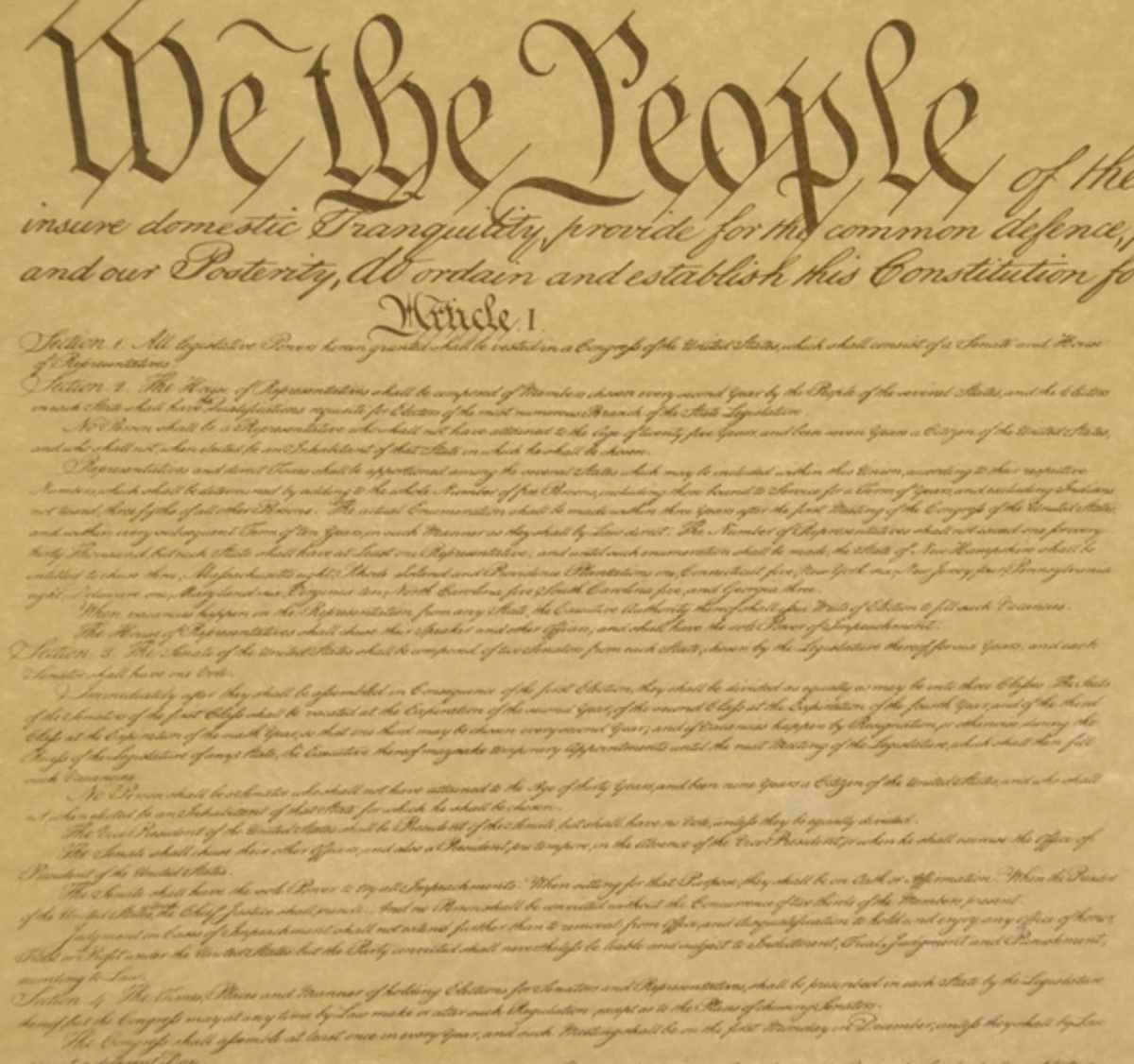
Kind of the like US Constitution, the underlying document had accrued a lot of additional meaning to over the years. But when I casually suggested to a new writer that a look at the guidelines on the BACCA website was all they needed to get up to speed, I had forgotten that none of that extra stuff is actually written down.

A reproduction of the beginning of the US Constitution

The US Constitution is written down.

So we went to work and came up with modifications to address not just adult fiction but also narrative nonfiction (from Carolyn O’Neal), children’s fiction (from Pam Evans), and self-help / instructional manuscripts (from me, A M Carley).

In addition, we now have a wonderful preamble by Noelle Beverly who gives every writer a high-altitude view of the critique process. Her suggestions are thorough, generous, and deeply insightful. You may recall seeing Noelle’s blog post here about this recently, as well.

Amendments Take Time

Also like the US Constitution, making changes to the underlying document requires deliberation and careful thought. Our process is not as glacial as, say, passing the Equal Rights Amendment – waiting since 1972 – but it has taken us several months.

We’ve posted our ratified expanded critique guidelines to the BACCA website. [updated after original blog post]

We really hope that writers find them useful. As Noelle points out in her preamble, preparing critiques benefits the critiquer as well as the critiqued. It’s already been a great experience and opportunity for us to reflect on the key features of an excellent critique.

PS For a brilliant hour all about the importance of the US Constitution, I recommend What the Constitution Means to Me, written and performed by Heidi Schreck.

— A M Carley writes fiction and nonfiction, and is a founding member of BACCA. Through Anne Carley Creative she provides creative coaching and full-service editing to writers and other creative people. Decks of her 52 FLOAT Cards for Writers are available from Amazon. Anne’s writer handbook, FLOAT • Becoming Unstuck for Writers, is available for purchase from central Virginia booksellers, at Bookshop.org, and on Amazon

Categories
BACCA Writers

Fiction or Nonfiction? Dinner or Dessert?

Fiction is a roller coaster

Fiction is fun. Fiction is freedom. 

Fiction creates new worlds and fills these worlds with heroes, villains, comics, romantics. Fills them with humans or monsters or aliens from another dimension.  Fiction can be as wild and unbelievable as the author’s imagination.

Every paragraph is a roller coaster.

Everything is fair game.

Everything is up in the air.

Enjoy the ride and let your imagination soar!


Nonfiction has rules.

Nonfiction takes place in a location the author can and should visit

Creative Nonfiction takes place in a location the author can and should visit, whether it’s the graveyard down the road or a ship in the middle of the ocean. Not to say writing nonfiction can’t be fun, but the author doesn’t have the same freedom to make up worlds or characters. The people and places must be real.

Nonfiction isn’t a roller coaster.

It’s a maze and research is the author’s only map.

Newspaper articles, interviews, books, and (occasionally) Google.

This is how I contrast my experiences writing fiction versus writing nonfiction. First drafts of fiction dance off my keyboard.  Ideas pop into my head. My writing group asks “why did he do that?” about a character and in fiction, I can create the motivation. In nonfiction if I can’t find his motivation in my research, I can’t answer that question.  I can’t make up an actual  person’s motivations for his or her actions.

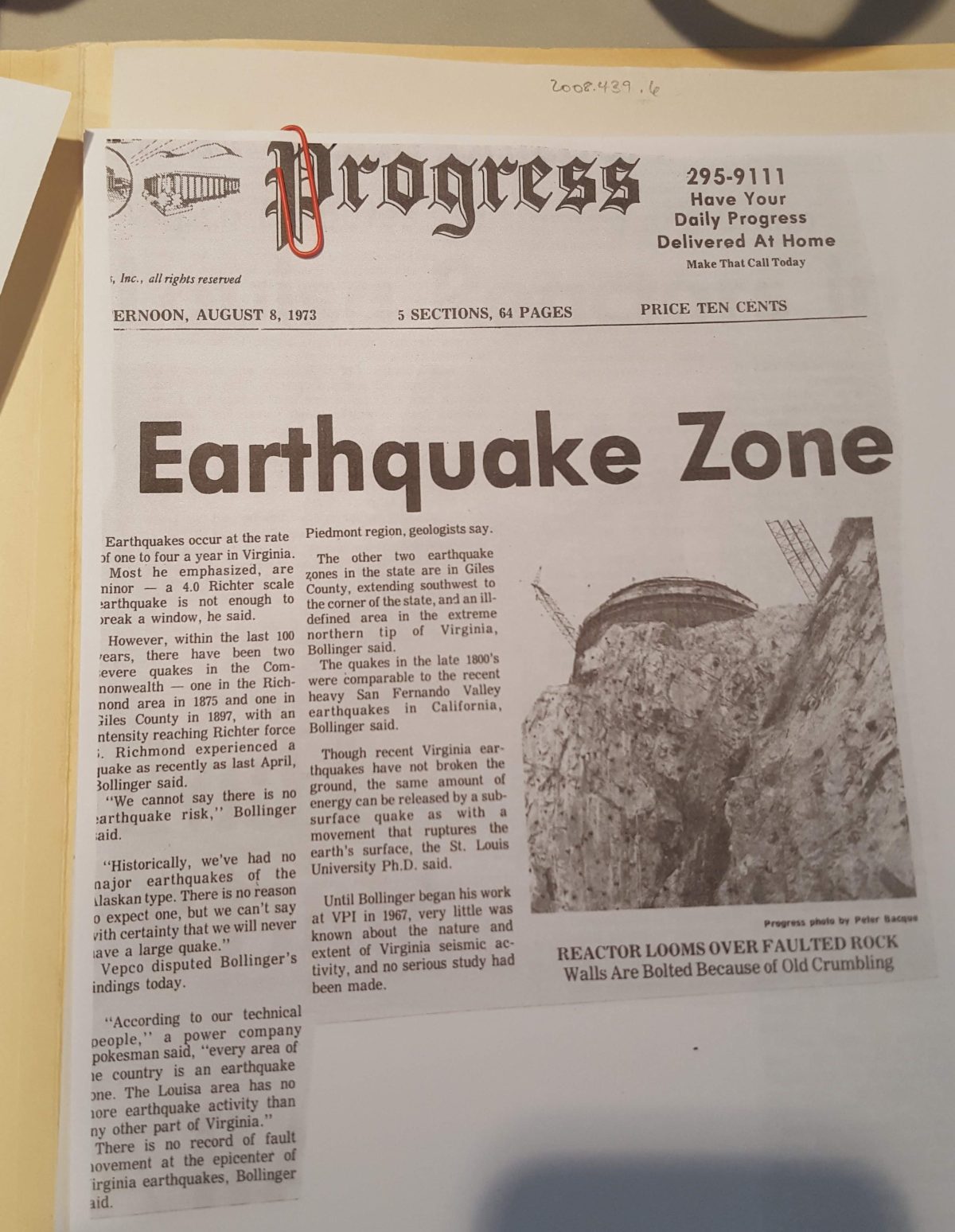
Most of my research comes from newspapers and interviews.

I have been researching a complex, creative nonfiction project for years. 

Set in the late 1960s and early 1970s, this creative nonfiction centers on the man who discovered an earthquake fault under the North Anna Nuclear Power Station in Virginia and ended up with a bullet in his head. 

It’s an exciting story with a thousand twists and turns, just like an intricate maze. 

Am I near the end of the maze or still in the center?  Only careful research will help me find my way.


Which is more satisfying as a writer? Fiction or nonfiction?

That’s like asking what is more satisfying to eat, dinner or dessert.

Why not try both?


Carolyn O’Neal is the author of:

KINGSLEY,

Honey I’m Yours,

Terry and the Monster-Beaters,

THAT WORD: Uterine Cancer from Diagnosis to Recovery.


Carolyn O’Neal was creative consultant for:

Boss of the Outer Banks

Ultimate Obsession

Why did God allow…Lesson from a Local Preacher


Categories
BACCA Writers

A Few Things I’ve Learned About Writing

Reflecting on recent lessons learned, I made this list of highlights, all to do with being a writer.

If…

• If the passive voice were to be used along with conditional or subjunctive or some such mood, and if I were to be given material from a client that happened to include such longwinded and painstakingly constructed language, it might be possible that, as the person being compensated for simplifying the client’s material so that a stranger to the topic might be able to comprehend it, I found myself reducing a lengthy sentence into one declarative statement of few words.

How long?

• Varying the sentence lengths in a long-form piece rocks.

Teacher, teacher!

• My clients and the writers in my writer group are excellent at teaching me how to improve my writing.

• Also, the fictional Emily Starr, protagonist of Lucy Maud Montgomery‘s trilogy, reminds me to keep at it. Emily’s writing career can be a great example of persistence and doggedness, traits that can get the work done, done well, and out the door.

I noticed three copies of my book, FLOAT • Becoming Unstuck for Writers, at a local bookshop last week.

Bookstores

• As rewarding as writing is for its own sake, it is also cool to see a book you wrote on the shelf of a local bookstore. [Hazard of visiting my books at the bookstore: Now I want to read all the other books on the shelf….]

• It’s also even cooler to be paid for books that sold off that shelf.

Funny

• Humor comes in lots of flavors and strengths. It’s often just the ticket (even in nonfunny writing).

An invitation, or a rebuke?

Joy

• Writing can be a pleasure, and a blank page an invitation. When it isn’t, it can be worthwhile to explore why that is. Sometimes even a small change can switch it back into something that feels OK or even good.

Connection

• Writers have a lot to learn from their readers. Sending out the completed book or story or article doesn’t need to be the end of a writer’s (one-sided) connection with readers. Some readers want to know more about – even get acquainted with – the author of that thing they enjoyed reading. And in non-creepy ways.

For me?

Gifts

• Beta readers are generous. When someone volunteers to read your new work before it’s released or published, and then gives you structured, useful feedback about it – that’s pretty much the ideal gift. At least for a writer. Well, online reviews are pretty wonderful, too, now that you mention it.

Like water

• A writer group can make a wannabe writer into a legit one. So can a writing coach. It’s like water on a stone. Slowly, over time, edges are delineated, and rough surfaces polished.

• There’s always more to learn.

— A M Carley writes fiction and nonfiction, and is a founding member of BACCA. Her company, Anne Carley Creative, provides creative coaching and manuscript development services to authors. Her first nonfiction book, FLOAT • Becoming Unstuck for Writers, is available for purchase at Central Virginia booksellers and on Amazon. #becomingunstuck 

Categories
Events

BACCA’s Back! Virginia Festival of the Book 2015

BACCA Literary Is Back at VaBook!

Virginia Festival of the Book 2015Yes, we’re presenting again in 2015, and on PubDay – the best day of the entire festival. Uh-huh. (We’re a bit biased.)

Come spend Saturday morning with us in the James Monroe Room at the Omni Hotel in Downtown Charlottesville, Virginia. We start at 10am on Saturday, 21 March 2015. As I write this, there’s snow on the ground, but odds are overwhelmingly in favor of a charming spring day when you visit with us at the Virginia Festival of the Book.

What will we be doing this year?

Glad you asked. We’re coming to talk about writer groups – how to be in one, and how to find or create one.

When we did our session last time, we chatted with the Festival guests before and after our remarks about writer groups. It was a lot of fun, and good ideas came up. But there was something missing: More interaction with the Festival guests.

So, this time, we’re creating opportunities for Festival guests to meet one another and chat briefly, right in the middle of our session. Visitors to our session may possibly meet the future members of their new writer groups. And everyone will definitely have opportunities to learn more about writer groups, and what they can do to hone writerly and analytical skills. And cat-herding skills. Okay, maybe not that last one.

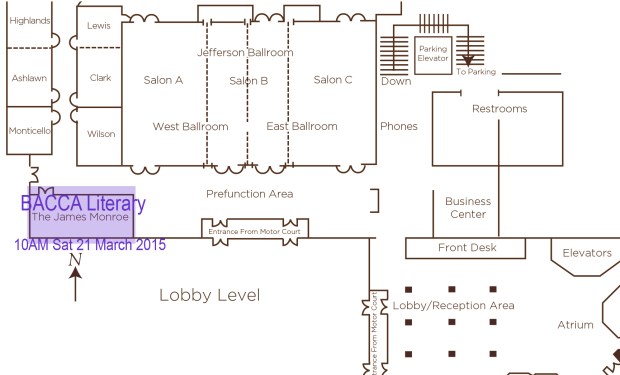
Where is The James Monroe Room at the Omni?

It’s easy to get to. From the hotel’s central atrium, turn toward the ballrooms. Catty-corner to the last ballroom entrance is our room, The James Monroe.

Map showing BACCA session

Shy, Introverted, Both?

Arrgh. So are some of us.

I know, I know. A Festival session with “activities.” The blurb for our session actually includes these words: “BACCA will guide Festival-goers in a fun and educational, hands-on mixer that will break the ice and start the process of building a writing community.”

It’s enough to make you run for the hills, isn’t it? Reconsider, please. Get an extroverted writerly friend to join you, and come join us. We’re gentle, promise. You might enjoy yourself. We look friendly, right?

The members of BACCA Literary
BACCA Literary Founding Members: Carolyn O’Neal, AM Carley, Bethany Joy Carlson, and Claire Elizabeth Cameron, after planning BACCA Literary’s 2015 VaBook session.

— A M Carley writes fiction and nonfiction, and is a founding member of BACCA. She coaches writers via Anne Carley Creative.

Categories
Interview

Variations on a Theme – A M Carley Interviews Elizabeth SaFleur Part Two

a red rose
Elizabeth SaFleur’s avatar is a red rose

The erotic romance writer ‘Elizabeth SaFleur‘ and I sat down this spring. Although we have been acquainted for years, we discovered something new in common – we each are active in a writer group. Elizabeth agreed to answer my questions, which I emailed to her, about how the “cp’s” (critique partners) in her writer’s posse operate. The group differs in many ways from what I’m used to as a writer in BACCA. And yet, both Elizabeth and I benefit greatly from our groups. Just goes to show!

In this, this second part of the interview, Elizabeth shows how crucial the message ‘stop futzing’ can be, explains what to do when all the members of your group use pseudonyms, and looks at the valuable contributions the other writers have made to her progress. In the first half of our interview, we learned how these critique partners began working together, discussed how they exchange work, and discovered the title of Elizabeth’s very first novel (written at age seven). 

AMC  You write under a pseudonym. How has that affected your relationships with the other writers in your group? Have you met face to face? Do you know one another’s real names? Do you think this has an effect on your sense of security in the group? Did you all agree to protect the confidentiality of the group – “What happens in Vegas…” sort of deal?

ESF  I know two of them by their real names. And, a third by her pseudonym only. After about six months, I told them my real name. But, basically we call each other by our pseudonyms just to ensure the anonymity “sticks.”

These writers know what’s at stake, and have to deal with it in their own lives. So I feel 100% safe with them.

In the beginning, we talked a lot about security and privacy. So, it’s been pretty well-drilled that we would never “out” anyone in this group to anyone outside the group. I feel very secure in this group. In fact, they probably understand where I’m coming from regarding anonymity more than my “real life” friends. These writers know what’s at stake, and have to deal with it in their own lives. So I feel 100% safe with these fellow writers.

I’ll meet two of the cps [critique partners] for the first time face-to-face this summer at a romance writer’s conference. I can hardly wait, as I am quite invested in their work and success, and count them as friends.

AMC  What are the ground rules? Do you have guidelines about how to critique, how you structure your comments, how critical to be, etc.? Or have you collectively found your way with these matters? Do you write up formal critiques, or is it more conversational?

ESF  We have no ground rules, except perhaps this: What will make the work better? As I mentioned, we’re self-policed. Generally, we ask each other where we want input – developmentally, line-edits, just another set of eyes, etc. Each person has a unique perspective. For instance, one of our members is a professional editor and published author of sci-fi/fantasy erotic romance. Another writes regency erotic romance as well as contemporary erotica. All three of them are actually published (or it’s imminent). So, I count myself lucky to be working with them.

We have no ground rules, except perhaps this: What will make the work better?

AMC  Is someone the leader, or is it more collaborative? Do you change leadership/administrative roles from time to time?

ESF  There’s no leader, per se. It’s collaborative, where each person contributes where they can. Each one of us has unique contributions to make, not just in the writing craft and critiquing, but in publishing, marketing, social media and all the other things that go along with trying to write books that someone will actually buy. We share the “knowledge wealth” whenever we can.

AMC  Does the group want or have a public identity, collectively?

ESF  Other than calling us the “writerly posse” there’s no name or identity.

We’re completely informal. It doesn’t work like a normal writer’s group, but rather more like four people who thank the stars we found each other.

AMC  Has anyone ever missed a meeting? Not submitted work when it was due? How does that work?

ESF  Since we don’t have meetings, no one’s missed any. LOL Again, we’re completely informal. It doesn’t work like a normal writer’s group, but rather more like four people who thank the stars we found each other. Given what we write (steamy romance), it’s important for writers who see our work, first, not blush from head to toe and, second, understand what we’re trying to do. Not everyone “appreciates” our genre.

AMC  If you could change anything about your writer group as it is now, what would you change?

ESF  If there is anything I could change about my writing life – or this group — is that I’d be engaged full-time. I hope to get there next year. But, in the meantime, I wish I had more time – time to write, time to critique, time to just chat with these authors more.

I wrote my first novel when I was seven: The Mystery of the Bunny. Oh, yeah, a real bestseller!

AMC  Has being in the writer group affected your writing life? Have things happened with your writing career that might not have, otherwise?

ESF  After reading a new opening chapter of one of my books, one of my cps ended her email critique with this line: Now finish the book! There is a strong emphasis in our group to complete the novel. That’s one of the greatest gifts this writing group has given me. I’d still be futzing with the first 50 pages of Lovely – three years later – if this little band of writers hadn’t told me to STOP FUTZING!

Albercht Durer's 'Young Hare"
Does This Bunny Look Mysterious?

AMC  What are the next steps for you in your writing career?

ESF  Later this year I have a short story coming out in a Christmas anthology through Troll River Publications. My first novel, Lovely, is being reviewed by a publisher. Then I have four more books started and plotted in the series. If everything goes as planned, Lovely will be out in January 2015, with the other four novels published thereafter, spaced six weeks apart. After that? Well, I have an idea for a dystopian “vanilla” romance. There is no shortage of ideas! Just time…

AMC  Anything else before we close?

ESF  Thank you for the interview. It was fun to share the immense contributions my writers posse has made to me and my writing. I only hope I’ve adequately returned the favor to them.

Feel free to drop me a line anytime, too. I can be reached through my site or on Twitter @ElizaLoveStory. Happy writing and reading everyone!

AMC  Elizabeth, thanks so much.

— A M Carley is a founding member of BACCA and provides author services at Anne Carley Creative.

Categories
Interview

Variations on a Theme – A M Carley Interviews Elizabeth SaFleur Part One

a red rose
Elizabeth SaFleur’s avatar is a red rose

The erotic romance writer ‘Elizabeth SaFleur’ and I sat down recently. Although we have been acquainted for years, we discovered something new in common – we each are active in a writer group. Elizabeth agreed to answer my questions, which I emailed to her, about how the “cp’s” (critique partners) in her writer’s posse operate. The group differs in many ways from what I’m used to as a writer in BACCA. And yet, both Elizabeth and I benefit greatly from our groups. Just goes to show! In the first half of our interview, Elizabeth tells us how these critique partners began working together, explains how they exchange work, and reveals the title of her very first novel (written at age seven). The second part of the interview discusses how crucial the message ‘stop futzing’ can be, explains what to do when all the members of your group use pseudonyms, and takes a look at the valuable contributions the other writers have made to Elizabeth’s progress.

AMC  First of all, thanks a lot for doing this, Elizabeth. It’s so interesting to compare notes about how various writer groups do what they do.

ESF It is my pleasure!

AMC  What do you write? How long have you been doing it, and how did you begin?

ESF  I write contemporary erotic romance with a very high heat level. Many of my stories include BDSM elements (emphasis on D/s over S/M) that feature alpha heroes and sassy heroines. For years, my characters “talked” to me, asking me to write their stories. After a while they got hard to ignore (especially the Doms. ;-)). When my professional life reached a “satisfaction plateau” (read: I got bored), I started to write down conversations and scenes that came to me. Next thing I knew, I was writing a novel. Now I have a whole series mapped out – The Elite Doms of Washington.

an old-fashioned thermometer
High Heat Level

AMC  How did you meet your writer group members?

ESF  My first critique partner (cp) was found through the Erotic Readers & Writers Association, which has a fantastic, free online writer’s forum. Writers post stories, and other writers will critique them. I had a few flashers (under 200 word) stories published in their gallery. After about six months of posting work and critiquing the work of others, a writer posted she sought someone to critique her novels off-line. Since she writes very similar stories to me, we teamed up. Then, she introduced me to other writers in our genre. Voila! A writer’s posse was born.

AMC  How many of you are in the group? Has the membership stayed the same, or do people come and go? How long have you been together? Does every member send out work for each meeting, or do you rotate on a schedule?

ESF  There are four of us in this “writer’s posse,” which is the only name I’ve ever heard us call our little band of authors. No one has left yet. But, there’s no formal agreement, either. We just help each other out. And honestly I can’t imagine writing without these folks. We’ve been together for about a year. We have no formal schedule, but rather just share work when it’s ready to be critiqued. But, we also know what each person is working on and “nudge” each other when we start falling behind our self-imposed deadlines. We share everything from snippets to whole chapters, from rewrites to the entire novel at once.

AMC  How frequently do you send new material around for critique? Do you limit the word count for material?

ESF  There’s no limit, though each one of us primarily works on about 80K to 100K word novels. An occasional short story is thrown in now and again. I’d say about every other week I’m sent something to read and crit, and they have something of mine. It really keeps things moving!

a police hat with checkered band
This hat is available on ebay in Australia

Our contributions are self-policed. Each person is responsible for ensuring their own writing time isn’t supplanted by critiquing others’ work. But, when we need help, we ask for it. We’re all pretty honest about what we can do. Sometimes, we even help protect the others’ writing time. For instance, one of my cps is on deadline. So, I won’t ask her to do anything new for me right now. Instead, I keep telling her to send me her writing as soon as she can so I can help! When we need time to work on our own material, everyone honors it. So far, it’s been quite balanced.

AMC  Do you meet in real time: on the phone/Skype, or messaging, or online meeting? Or are your interactions time-shifted, using email or other means?

ESF  We do a lot over email, sending documents back and forth. But, we also have phone chats through conference bridges or Google hangout. When one of us suggests numerous edits or developmental shifts, it’s just easier to talk it out.  We also help each other brainstorm when we hit plot roadblocks or feel like we’re losing our “writerly mojo.” I’ve often been talked “off the ledge” by these wonderful cps.

AMC  When you and I first met, years ago, we were both focused on writing songs – lyrics and music. How have you come to write novels?

ESF  I have wanted to be a fiction writer my whole life. I wrote my first novel when I was seven: The Mystery of the Bunny. Oh, yeah, a real bestseller! But, my well-meaning parents and friends told me I should find a “real job.” Back then I was very good at doing what I was told; I had a very successful 30 year public relations career. But as my business grew more successful, I grew less satisfied. So, after turning 50, I decided to go back to my first love – writing.

Find your own writers group or writer’s posse. But, don’t be afraid to share your work outside it, too.

The songwriting was fun. I also tried my hand at screenwriting about ten years ago. But, in the end, my stories demanded to be “born” via full-length novel. Once I started writing in that format, I couldn’t stop. That’s a pretty big clue in my book (no pun intended).

AMC  Have you developed friendships with members of your group, or is it important to you to maintain a separation from the rest of your life?

ESF  I count them as friends. But, we also honor the privacy of each other’s private life. We don’t go into great detail, but we do talk about our pets, our weekend plans and other little things that crop up. I don’t hide things from them, but I also don’t want to burden them with a lot of personal stuff. Our books’ characters’ lives keep us quite busy in that way!

AMC  How has being in your writer group changed your writing? Your attitude about writing? Your identity as a writer and your plans for the future as a writer? For me, being in a writer group – and having a writing deadline to meet – helped me make the time to keep writing, even when the rest of life got hectic. Have you noticed that happening for you?

I don’t think I could have finished my first novel, Lovely, without them.

ESF  I’d say this group has changed my writing tremendously in two ways. First, my writing is better. Without them, I wouldn’t have grown the way I have. You can listen to podcasts, take online courses, reach craft books and more to help your writing. In the end, the only way to get better at writing it by doing it a lot – and having it critiqued in such a way that shows you what you can do better the next time. That’s what these other authors have done for me.

Secondly, I don’t think I could have finished my first novel, Lovely, without them. I might have given up. I knew something was wrong, but couldn’t see it. They could see plot holes, character shifts and other things that can sink a novel. Their generosity in sharing their time and talents helped me not only write better, but finish.

AMC  Do you have any recommendations for other writers out there?

ESF  I do have a few other people outside this group who have reviewed my work. I’d tell other authors to do the same. Find your own writers group or writer’s posse. But, don’t be afraid to share your work outside it, too.  For instance, a gentleman in the UK read one of my earliest drafts of Lovely. It was great to get a man’s perspective – and from someone completely outside my usual set of crit partners.

Feel free to drop me a line anytime, too. I can be reached through my site or on Twitter @ElizaLoveStory. Happy writing and reading everyone!

AMC  Elizabeth, thanks so much.

A M Carley is a founding member of BACCA and provides author services at Anne Carley Creative.

Categories
BACCA Writers

The 5th Annual Hampton Roads Writers Conference – Day Two

September 18, 2013, Virginia Beach, Virginia

Day Two

To read about Day One, click here!

8:30 am:

Bestselling Author Lisa McMann

Lisa McMann
Lisa McMann, Author

Day Two began with introductory remarks by New York Times bestselling author Lisa McMann.

Lisa is the author of the WAKE Trilogy, the VISIONS series, the UNWANTEDS series, and other books with tween and teen characters. She talked about her road to publishing success. She spoke of the joys of balancing a writing career with her life as a wife and mother.

She also spoke of the abuse she faced after becoming an author, such as bad reviews and hateful “fan” mail.

9:45 am:

The First Ten Lines Critique Session

Conference participants (including me) could submit the first ten lines of their manuscript (anonymously, thank goodness) for professional – and public – critique.  The critiquing panel consisted of the three visiting agents – Ethan Vaughan, Jeff Ourvan, and Dawn Dowdle, as well as author Lisa McMann.

Here are a few pointers about submitting to agents:

  • Number one rule for all agents is  FOLLOW SUBMISSION GUIDELINES. Agents are looking for reasons to say “NO,” and incorrect formatting, misspelling the agent’s name, sending attachment when explicitly told not to send attachments are all reason to instantly reject a query letter and sample.
  • Grammar is important. Hire a proofreader, especially if grammar is your weak point.
  • Avoid clichés.
  • Make sure your verbs carry the emotional weight of the story. Stay away from adjectives and adverbs.
  • Avoid lengthy italics. An overuse of italics in a manuscript looks amateurish and is a symptom of unpreparedness.
  • Vary short and long sentences to create tension for the reader.
  • Don’t quote unknown or obscure books. This pulls the reader out of story.

11:00 am:   

Getting Ready for My Very First Pitch to a Literary Agent (Yippee!)

The Hampton Roads Writers Conference offered the opportunity to meet with one of the three visiting literary agents and present a ten-minute pitch. I jumped at the chance. This would be the first time I’d ever met with a real-live literary agent, and obviously, the first time I’d pitched my manuscript. Yes, I’d written query letters and attended agent roundtables at the Virginia Festival of the Book, but this was my first sit-down, face to face meeting. I was meeting with Ethan Vaughan of Kimberley Cameron & Associates. I had only ten minutes with Mr. Vaughan, beginning at 11:15 am., but I was ready.

. . . Or, at least I thought I was ready before I’d attended Chantelle Osman’s Perfecting Your Pitch session  (See day one.).  According to Ms. Osman, I’d done several things wrong. I’d written my pitch (and even made a copy for the agent.  Talk about being overwritten!)  I’d practiced my pitch until I could recite it in my sleep, and I’d even timed it perfectly. If I didn’t pause, it would take eight of my ten minutes, leaving me two minutes for questions and answers.

Wrong!

Wrong!

Wrong!

Ms. Osman explicitly said that pitches shouldn’t sound rehearsed.  Oh well, too late to change it now.

I arrived at the small conference room on the second floor of the Westin Hotel early. One table, two chairs. Mr. Vaughan wasn’t there yet. No one was there. I was his first pitch of the conference. Was that a good omen or bad? The timekeeper – the man who’d tell me when my ten minutes were up – arrived.  He told me I could take a seat but I declined. I wanted Mr. Vaughan to choose which seat he wanted first, and then I’d take the other. I didn’t want to do anything to make him feel uncomfortable. (I felt uncomfortable enough for the both of us. )

Waiting, waiting - photo of a clockface
Waiting, waiting

I watched the clock. 11:00… 11:05… 11:10. I paced the hallway outside the conference room, practicing my new Tai Chi moves. Part the wild horse mane, white crane spreads its wings, needle at sea bottom. 11:12. . . . 11:13. I could hear people coming down the hallway, talking. 11:14  . . . 11:15. I hurried back to the room, notebook with the copies of my pitch in hand, big smile on my face.

Introductions

I eagerly shook Mr. Vaughan’s hand and told him how impressed I was with his literary agency, Kimberley Cameron & Associates, their book list, and their well-known dedication to their authors. Mr. Vaughan enthused about Ms. Cameron’s devotion to her agents and her clients, which I found both heartwarming and endearing.

photo of Ethan Vaughan
Ethan Vaughan, Literary Agent

I glanced at the clock. Eight minutes left! No time for small talk. I plunged in. I read my pitch as fast as I could. Head down, monotone, my mind blank.  AND I MEAN BLANK!

If you’d asked me at that moment what my book was about – the book that I’ve worked on for years, the book I’ve dedicated my life to, the book I’ve dreamed about, the book I’ve given up being with family for — if you’d asked me at that moment, I couldn’t have told you who the main characters were, let alone the plot. I was as stiff as a robot.

I looked up to take a breath and knew I’d made a mistake. My pitch was too long and too detailed.  I’d given him more of a synopsis than a pitch. Mr. Vaughan was very kind. He asked questions and I tried to answer. I told him this was my first pitch ever and I was very nervous. He says I did a good job (proof that literary agents do indeed tell lies) and gave me a few suggestion for the “next time” I pitched to an agent.

I left knowing I wouldn’t get a contract but proud of myself for giving it a shot. I’d met many writers who were too shy to pitch their stories, or too afraid. I was shy and afraid, too, but I learned something very valuable in the process. Mr. Vaughan was polite, considerate and helpful. He gave me suggestions for the next time I pitch my  story, which was a very generous gift, indeed.

— Carolyn O’Neal

Carolyn O’Neal is a co-founder of BACCA Literary

Categories
Events

BACCA Literary at Virginia Festival of the Book 2013!

Before there is a book to publish, before the agent, before the copyeditor, there is the intense process of writing. This session is by writers-in-progress, for writers-in-progress, and focuses on the process of becoming a better writer within a supportive community. Learn from the four members of BACCA Literary, a Charlottesville, VA writer group, how to build your own. Co-sponsored by WriterHouse (Charlottesville), where the members of BACCA first met.

BACCA is:
Claire Cameron PhDA M CarleyBethany Joy CarlsonCarolyn O’Neal.

Come join the four members of BACCA Literary at this FREE event at Virginia Festival of the Book.

We’ll talk about Creating a Great Writing Group.

Mark your calendar!

WHEN:  10am, Saturday 23 March 2013.

WHERE:  The Omni Hotel, on the Downtown Mall in Charlottesville, VA.
Look for the Preston Room, inside The Pointe restaurant (turn Right inside the lobby doors, if you enter from the Downtown Mall).

  • Want to create your own writing group, or find out how to improve the one you’re in now?

  • Want to learn how to get help with your writing project, in a smart, supportive, ongoing environment?

  • Want to spend some time with other writers at a free event on a Saturday morning in a comfortable, windowed room on Publication Day at the Omni in Downtown Charlottesville?

See you there!

P.S.  If you want to tweet about our event, use hashtag #BACCALiterary