Categories
BACCA Writers

Marketing My Book: A first-time author’s journey

Notice something different in the title of this blog than the title of my July entry?  In July, my blog was “Marketing My Self Published Book: A first-time author’s journey.”  A fine title but does being self published really matter anymore?


What’s in a name? that which we call a rose
By any other name would smell as sweet;

-William Shakespeare, Romeo and Juliet, Act 2

If the term self published bothers you, drop it.  You are an indie author.  Your imprint is Create Space or Ingram Publishing Services or whatever publisher puts ink on paper for you.

Part Two:  Book Festivals

All literary festivals have applications to fill out and deadlines to meet.   Be sure to read the rules and guidelines before submitting your book.  If your book doesn’t comply with their requirements but you have your heart set on hobnobbing with the other authors, it’s worth contacting the director.

I had my heart set on being part of the Virginia Festival of the Book.

Kingsley1A2 boy and honeycomb 1
KINGSLEY is available on Amazon.com

Since KINGSLEY wasn’t coming out until November 8th and the Virginia Festival of the Book deadline for submission was October 1st, I asked permission to submit the final draft of my novel instead of the finished product.  I was very fortunate that they agreed.

The sad fact is that most Literary Festivals aren’t welcoming to indie authors.  When they are, they seem to give priority to indie authors living in their state.  This is where doing some legwork before you publish pays off.  I was an active volunteer for many years with the Virginia Festival of the Book, and I’d moderated and participated in panels.  I can’t say for certain that this is why I was accepted but it might have helped.

The Virginia Festival of the Book is a multi-day literary festival in Charlottesville, Virginia. The festival invites authors and publishing experts from all over the country.  Most of the events are free so they draw a good crowd.  The festival is held in March, which means weather can be a factor in its success.  A lovely spring day attracts more attendees.  Rain or snow is a real wet blanket.   My panel was scheduled for a Friday at a popular library.  I was looking forward to it.

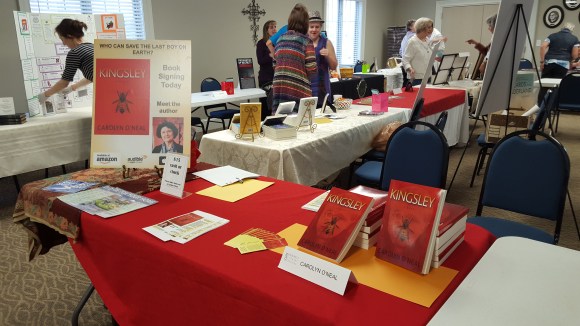
Regardless of whether an author is invited to participate in a panel, they can still rent a table at the Omni Hotel on the last Saturday of the festival to sell their books.  I rented half of a table, which cost $110.  Virginia Festival of the Book 2015

Bottom line: Don’t wait until the last minute to submit your book or to rent a table if your goal is to be part of a book festival.

Once I had advance reader copies of KINGSLEY, I began submitting to other Literary Festivals.  At that time I didn’t realize how slim my chances were of getting in.  Most of the festivals I applied to required several copies of my book, which meant more trips to the post office.  Money going out and none coming in.

I was rewarded for my hard work with acceptance to the Dahlonega Literary Festival in Georgia.  This festival was scheduled for the weekend before the Virginia Festival so March was filling up with opportunities to talk about my book.  I was to be part of a panel that wrote science fiction and fantasy.  I had high hopes so I rented a space for book signings and sales.   It only cost around $35.  Not bad, but attending the festival in Georgia meant renting a hotel and a couple tanks of gas to drive there and back.2016-03-12 08.47.16

Was it worth it?  Not in sales.  But both festivals allowed me to spread the word about KINGSLEY, sharpen my presentation, and focus my pitch.

And as the saying goes,

“How do you get to Carnegie Hall?”

“Practice, practice, practice”?

Next up: Practice makes perfect (or at least better).  Watch for it in  2017

Categories
BACCA Writers

What Sir Salman taught me last week

Free Speech and Writing

So the National Endowment for the Humanities threw its 50th birthday celebration, Human / Ties, in Charlottesville, VA, mid-September 2016. Almost all the events, over a span of several days, were offered free to the public, and I went to a few of them. It was a treat. I ended up feeling chuffed – and sobered – about being a writer myself.

Publicity from UVa on behalf of the NEH and HUMAN/TIES

On the Friday evening, 16 September, at the Paramount Theater – our lovingly refurbished former Vaudeville theater now hosting drama, music, speaking, meetings, large-screen movies, etc. – Sir Salman Rushdie came for a chat. The successful author and teacher, who catapulted to international fame when an Iranian Ayatollah put a bounty on Rushdie’s head in 1989, sat on an elegant chair near the center of the vast Paramount stage. To his right, in a identical chair, his interlocutor, Suketu Mehta, a fellow professor at New York University’s School of Journalism, spoke for several minutes, after which, inserting brief questions from time to time, he let his friend and colleague do most of the speaking, .

Rushdie in 2016. Photo from Wikipedia.

I didn’t know what to expect. I signed up weeks before the event for my free ticket, as soon as I heard about it, on the theory that this was an important occasion and I might be surprised by what I observed and learned. I’m so glad I did that. Turned out to be a worthwhile theory.

Following are some of the nuggets I came away with, from Rushdie’s conversation with Mehta.

FYI: To the best of my knowledge, the quoted material here is accurate. I had a little notebook with me in which I scribbled 😉 Any errors in transcribing are mine.

On Dissidence and Writing

The writer is the voice that nobody owns.

The authoritarians … want to control the narrative.

If you say, ‘no it doesn’t,’ that’s why they want to lock writers up.

These remarks and the narrative around them led me to feel pleased and proud to be one more member of the international clan of writers, dating back from the storytellers in the cave, to the present-day, where we express ourselves through so many means in so many media. It’s a privilege and perhaps a duty, Rushdie implied, to write the truth as we perceive it – and as we choose to communicate it.

On Freedom of Speech

Having lived in the New York area for twenty years, he said, he applied for and received US citizenship. Rushdie emphasized that “the most important thing” in his decision to do so is the existence of the First Amendment to the US Constitution.

Handwritten text that would become the First Amendment
Handwritten text that would become the First Amendment. Courtesy Wikipedia.

After overcoming some discomfort about people in the US being able to say more terrible things about others than they are permitted to, for instance, in England or Germany, he said he gradually came to value more the First Amendment’s wisdom. It favors openness over control. After all, some people will be in power, and they are the ones who’ll say what’s permitted and what isn’t. What if you are on the wrong end of the people in power?

All it says, as adopted in 1791, is this:

Congress shall make no law respecting an establishment of religion, or prohibiting the free exercise thereof; or abridging the freedom of speech, or of the press; or the right of the people peaceably to assemble, and to petition the Government for a redress of grievances.

Here’s some of what Rushdie had to say about the importance of that brief paragraph.

Bad ideas don’t disappear if you forbid them.

I want to know where the assholes are. … [T]hen we’ll know where they live.

Lest we try to believe that censorship can be used for good, in the interests of protecting those segments of a society that are smaller, less recognized, or less vocal, he gave us this heartfelt advice.

Don’t use censorship to defend minorities – it will backfire.

Rushdie was clever, funny, and sincere. His friend, Professor Mehta, conducted the conversation elegantly, with minimal fuss.

I am grateful for the chance to sit there, take notes, and take it all in. All writers can be brave. Some like Rushdie are called on to be publicly, conspicuously, so. That night, he did not let us down. Seated in his chair, under the spotlight, he stood up for all writers.

— A M Carley writes fiction and nonfiction, and is a founding member of BACCA. Anne Carley Creative provides coaching. Her first nonfiction book, Becoming Unstuck: The FLOAT Approach for Writers, is forthcoming in 2016. #becomingunstuck 

Categories
BACCA Writers

158 Queries or, Another Case for the Growth Mindset

“I queried 158 times before I sold my first word.”

I was sitting in a Just Buffalo writing workshop led by Nancy Davidoff Kelton, the author of Finding Mr. Rightstein (Passager, 2016) and Writing from Personal Experience (F+W Media, 2000) and countless personal essays. “158 queries” was part of Nancy’s opening remarks.

The rest of her workshop was useful, personal, and entertaining—even if you don’t count the law firm’s noisy party on the floor below. But “158 queries” is what I needed to hear the most. I walked into the workshop, thinking “I don’t need a writing workshop—I need a query pep talk.” Unlike most of the other workshop participants, I’ve taken writing classes…several. I’ve spent a couple years, in those classes and working with 2 different writing groups, developing control over my voice, so the academic in me doesn’t come out unless invited.

But so far I’ve not developed a successful query process. I think I know my query issues, AKA false beliefs that serve to self-handicap, AKA the fixed mindset when it comes to querying. What’s ridiculous is, when it comes to writing, I’m the queen of growth mindset, which is the idea that if you keep doing something, you will improve. And improving depends on regular practice.

I shouldn’t be surprised by this because the research on mindsets (made famous by Carol Dweck who wrote the book) says that indeed, a person can have a growth mindset in one area and a fixed mindset in another. Here’s what I mean:

My attitudes about querying (Fixed Mindset):
– I query intermittently, not on a regular schedule.
– I, inaccurately, see querying as separate from writing in the sense that I “can’t” make room in my schedule for both at the same time.
– I dread querying because of the (extremely high) chance that I will fail.
– I don’t believe that if I keep doing it, it will pay off (meaning, result in an accepted piece).

My attitudes about writing (Growth Mindset):
+ I write regularly: multiple times per week, if you count academic writing, which I do since it’s my day job.
+ I make time to write in between all my other obligations.
+ I look forward to writing, because I see it as something that I can improve if I do more of it.
+ I believe that if I keep writing, I will end up with a piece I’m satisfied with.

Before Nancy’s “158 queries,” mini-pep-talk, I had been lying to myself. Telling myself that querying is too hard, that it’s not in my skill set because writers aren’t natural marketers, and that if I just keep entering contests I will eventually, miraculously, be found through that process by an agent or publisher who can’t wait to publish eerything I’ve ever written: my books, short stories, personal essays, back files, rough drafts, and even random, lightly polished journal entries (hey a girl can dream).

Ha. Please don’t tell Jane Friedman, or Anne Janzer, who helpfully present more on mindset-as-applied-to-the-writing-life here.

So now I’m trying to stop lying to myself. Querying is difficult, but Nancy did it. 158 times before she had any success. And now she is a grand success. She had, and has, a growth mindset about both writing and querying.

They (people, somewhere) say identifying the problem is half the battle. So here I am, problem identified.

Time to stop writing—for now. I need to go send in a query letter.

Categories
BACCA Writers

Marketing My Self Published Book: A first-time author’s journey

Part One

After spending years writing KINGSLEY, I felt like everyone knew everything about my novel.  Family and friends had heard about it, read excerpts, and even backed my Kickstarter campaign to push KINGSLEY through the final steps of publication.

Kingsley1A2 boy and honeycomb 1
KINGSLEY is available on Amazon.com


A month before KINGSLEY launched, I contacted a local book store to host the launch party.  The date was set, invitations sent, menu planned.  About 50 people attended, filling the small bookstore.

Launch Party
KINGSLEY is available on Amazon.com

Certainly by now, everyone in the world had heard about KINGSLEY, right?

All I had to do was watch the sales numbers to learn the truth.

Over my next few posts, I will lead you through my meandering marketing of KINGSLEY.  My failures, my successes, and what I learned along the way.

Let’s start at the beginning.   I decided to publish KINGSLEY through Amazon (eBook) and Create Space (an Amazon company that prints paperbacks.)  I found both easy to use and cost effective.  Their websites are clear and their technical support is great.  Need help in a hurry?   Create Space gives you the option to input your phone number on their help page and receive an immediate call back.


The upside to using Amazon and Create Space is obvious.  Amazon is the largest book seller in the world!  This meant I could market my novel to the entire world.

Theoretically…

Good luck with that.  It’s hard enough getting people in your town to buy your book, let alone readers in France or Japan to purchase an unknown book by an obscure author written in English.  But at least by using Amazon, readers in other countries have the opportunity to buy my book.

The downside of using Create Space to print your book is that some bookstores, including Barnes and Noble, won’t work with Create Space.   Amazon is their competitor. If you find a way to make a deal with Walmart, Barnes and Noble, or Costco please let me know and I will pass it along!

Now that I’ve told you what you can’t do, stay tuned for ideas on how and where to sell your self-published book.  

Categories
BACCA Writers

Becoming Unstuck for Writers – Two Tools

It happens to most everyone. From time to time, the words just aren’t there. You may have set aside time for writing, you may have a good idea, even a supply of your favorite food and beverages for writing. No matter. You’re just making false starts. It feels bad. You’re stuck.

Becoming unstuck is a topic I’ve given some thought to this year. My book-development clients face down stuckness now and then, as do my fellow BACCA writers, and, oh yeah, I do too. In fact, I’m writing a book about how writers can become unstuck.

Here, I offer you two tools – one larger, and one lower-impact, for your consideration, the next time you feel that stuckness in your vicinity.

The Big Idea

One of the tools I recommend is — dum – ta- dum – dum — The Deadline.

And not a fake deadline that only you need to pay attention to. For this to be effective and more likely to be resistance-proof, you need to set up a deadline where you’re responsible to others. A deliverable to a third party. A date certain. An event. That sort of thing.

Fake deadlines – for instance, putting an event in your Google calendar – can be persuaded to postpone themselves. Don’t ask me how I know this, but it’s super-easy to grab one of those quiet little fake deadlines and slide it over a day or two. Or month. The possibilities are limitless, really.

Courtesy Pixabay
Courtesy Pixabay

To make the deadline strategy work for you, do yourself a real favor. Make a plan with someone else, someone you respect. Make a solid promise to them. Did the odds just increase greatly that you’ll deliver something good, and on time?

Here’s a not-so-random illustration of how this can operate: I’d been planning and drafting this book for a while. And maybe I’d been sliding over my self-imposed soft deadline dates in my online calendar once or twice. No one would know the difference, I told myself….

Now, I’m leading a workshop on the topic next month at Andi Cumbo-Floyd‘s writer’s retreat in Virginia’s Blue Ridge mountains. And when I agreed in March to do this, I committed to having in hand a beta version of the book in time for a late-July event. See how that works? It’s simple and powerful. (And check out this retreat!)

The Littler Idea

Sometimes, all it takes is a walk around the block.

Do this for real, on ‘shank’s mare‘ (as my dad used to put it), or more virtually (standing up and stretching, your favorite deep breathing routine, a journaling break, and so on). A simple refreshing change brings you back to the same place, only it’s so barely recognizable that it has become a different place.

Ah, words don’t do justice to the beautiful simplicity of this concept. Check out the illustration to get a clearer idea of how brilliantly this can work.

(Courtesy MediaGiphy.com)

Here’s to becoming unstuck.

May all your stuckness be resolved. May you scratch your right ear and get on with your work.

— A M Carley writes fiction and nonfiction, and is a founding member of BACCA. Anne Carley Creative helps writers. Her first nonfiction book, FLOAT: Becoming Unstuck for Writers, is forthcoming in 2016.

Categories
BACCA Writers

How One Little Idea Turned into $70,000 for Books

My how-to guide Crowdfunding for Authors is coming out in October. It’s based on three years of experience at The Artist’s Partner, working with authors who have used Kickstarter and Indiegogo to finance their publishing projects. Since 2013 these authors have raised $73,972 for novels, memoirs, children’s books, and more. And it all grew from one little idea five years ago.

author mosaic

Read more about these crowdfunded authors below.

It began when BACCA decided to periodically incorporate the “biz” of writing into our critique meetings. At our first such “biz” discussion, I floated the idea of teaching an eBook publishing class. I received an enthusiastic response, and some useful suggestions. I submitted a proposal, and was teaching my first “eBook DIY” class at WriterHouse in the spring of 2012.

It was in a subsequent class that author Stefan Bechtel (Roar of the Heavens, Mr. Hornaday’s War) was a student. He was then writing the memoir of retired action bowler Bob Perry. Bob is a quintessential New Jersey hustler, so in retrospect it’s no surprise that he and Stefan were the first to suggest that maybe this “Kickstarter thing” could be used to fund their book. They hired me to orchestrate the campaign, and in September of 2013 we raised $6,945 for what was then titled Bowling for the Mob. By the following April it had been picked up by Rodale Press for a sizable contract, national distribution, and a makeover that included the title change to Redemption Alley.

By the fall of the next year I was guiding four crowdfunding campaigns simultaneously. I was onto something! It’s been a steep learning curve, with many mistakes and victories along the way. Crowdfunding books is hard – only 29.5% make it. That makes me all the more proud of my authors’ success rate of 97%. Here are what I’ve observed are the top five reasons for their impressive levels of success:

  1. Great cover design purchased prior to the campaign. People judge a book by its cover – even on Kickstarter.
  2. Firm commitments of 40% of their fundraising target locked down prior to campaign launch. Only 29% of books succeed – but 97% of books that cross the 40%-funded threshold succeed.
  3. Email and social media lists right-sized to cover the additional 60%. There’s too much math involved to explain “right-sized” here in this post, but suffice to say: these authors had, or developed, good connections with their prospective readers during the 3-12 months prior to their campaigns.
  4. Photos of their faces. Many (introverted) writers hate this, but people respond to faces. It’s called Facebook.
  5. Commitment to the process. Crowdfunding is a marathon, not a sprint. These authors put in the training, and then ran their best race.

crowdfunding for authors draft coverI’m thrilled to be publishing the guidebook that helped these authors to crowdfund their books, because you can crowdfund your book, too. Crowdfunding for Authors is itself available for preorder on Indiegogo, and will be released on Amazon in October.

Bethany Joy Carlson

Here are the amazing authors who have raised over $70,000 with The Artist’s Partner since 2013!

Organized as follows: Author / Platform – Title (availability).

Zack Bonnie / Indiegogo – Dead, Insane, or In Jail: Overwritten (Coming fall 2016)
Marc Boston / Kickstarter – The Girl Who Carried Too Much Stuff (Amazon)
Ramgiri Braun / Indiegogo – HeartSourcing (Amazon)
Lizzy Duncan, B. Cunningham, G. Jackson / Kickstarter – Camila’s Lemonade Stand (Amazon)
Jenny Edmondson / Kickstarter – GroomsDay (Amazon)
Mary Buford Hitz / Kickstarter – Riding to Camille (Audible)
Peter Kalifornsky and Katherine McNamara / Indiegogo– From the First Beginning, When the Animals Were Talking (iTunes)
Priya Mahadevan / Kickstarter – Princesses Only Wear Putta-Puttas (Amazon)
Belinda Miller / Did not fund – published anyway! – Above the Stars (Amazon)
Carolyn O’Neal / Kickstarter – Kingsley (Amazon)
Bob Perry and Stefan Bechtel / Kickstarter – Redemption Alley (Amazon)


Categories
BACCA Writers

Publishing: Where Art joins Business

by Carolyn O’Neal

UPDATE:  Celebrate Earth Day with KINGSLEY!  


Enter for the chance to win a copy, shipped to your doorstep, for FREE.

goodreads-icon-150x150

https://www.goodreads.com/giveaway/show/182002-kingsley


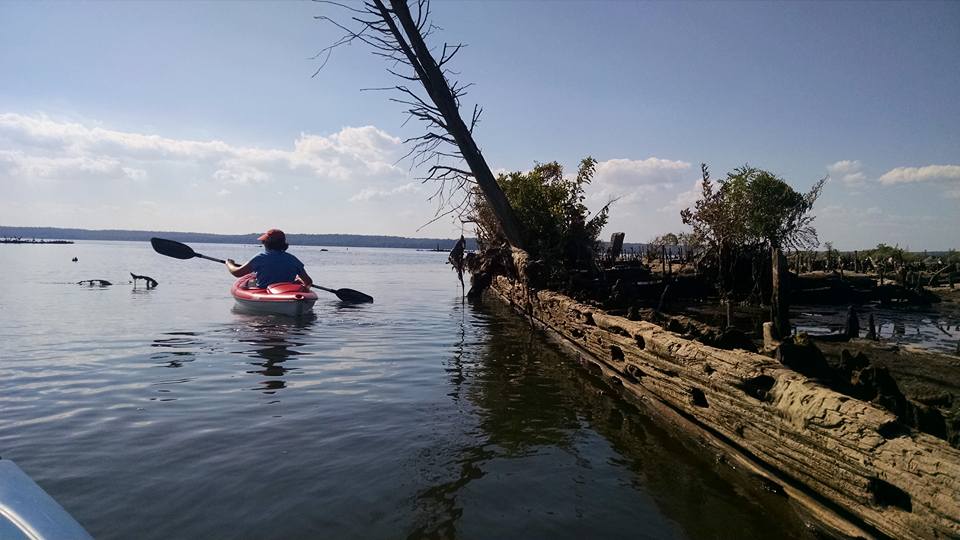
Writing a novel is a long, meandering journey, more akin to kayaking  unexplored waterways than jetting to a known destination. Carolyn Kayaking Writing KINGSLEY took years.

Plot and character.

Revising and editing.

Critiquing chapters with my writing groups and sifting through their suggestions.


A thoroughly enjoyable adventure from start to finish.

That was writing.

Publishing is a very different adventure.

Publishing is where art and business join …  and I knew I needed help.

Let me back up a bit.  It was clear from the first time I met Bethany Carlson that she was a rare talent.  Not only did she have the rich imagination of an author but she also had a practical head for business.  I remember one writing group meeting several years ago in which I prophetically told her she should go into publishing.  That’s why I take partial credit for the success of her company, The Artist’s Partner.

The Artist’s Partner is a coach for artists becoming entrepreneurs. We provide crowdfunding consulting, and have helped artists raise over $90,000 for their creative projects through Kickstarter and Indiegogo.

We work with arts companies and non-profits, authors, musicians, filmmakers, theater production companies, crafts persons, and other artists who seek to raise funds to professionally produce and distribute their own work.


One of her first Kickstarter campaigns was for  Bob Perry’s biography Bowling for the Mob.  Not only was his Kickstarter campaign a stunning success –  complete with a professionally produced video to entice backers – but his book, now renamed Redemption Alley, How I Lived To Bowl Another Frame – was  picked up by Rodale Books!

I had seen Bethany’s work ethic and her insightfulness.  I had seen her honesty, her deep patience, and her eternal optimism.  These were the qualities I needed if I intended to go from private writer to public author.  When I felt ready to publish KINGSLEY, I contacted Bethany.

Bethany Joy Carlson
Bethany Joy Carlson

First thing she did was establish a clear timeline.

Bethany guided me through how to launch a successful Kickstarter campaign.  We discussed the intense prep work needed, then blocked out the time  for editing and cover design, and then we set a target date for proofing the final drafts, distributing the books to my Kickstarter backers, and finally, publication.

As I began prepping for the campaign, Bethany set up a meeting with local director Michael Duni to shoot my promotional video.

My Kickstarter campaign ran one month, raised over $5000, and presold close to 100 copies.  Even more important, the campaign spread the word and built excitement.

KINGSLEY was coming!

Bethany put me in contact with Graphic Artist Mayapriya  Long of Bookwrights  to discuss the cover.  Honestly, that may have been the best part of the entire process.  Here are a few of the iterations…

Cover design


KINGSLEY is available on Amazon.com
Final cover for KINGSLEY. Now available on Amazon.com

She contacted copy editor Betsy Ballenger for the final review and then, KINGSLEY hit the presses!

The launch party for KINGSLEY was held on November 8, 2015 at Over the Moon Bookstore.Over THe moon Logo

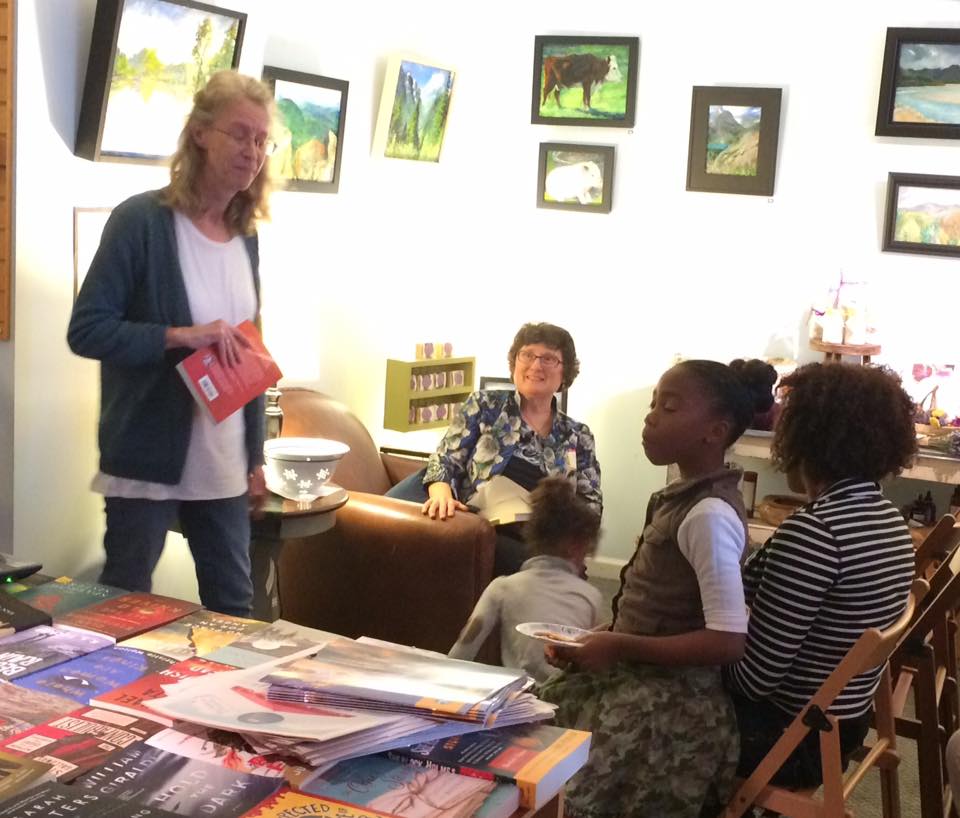
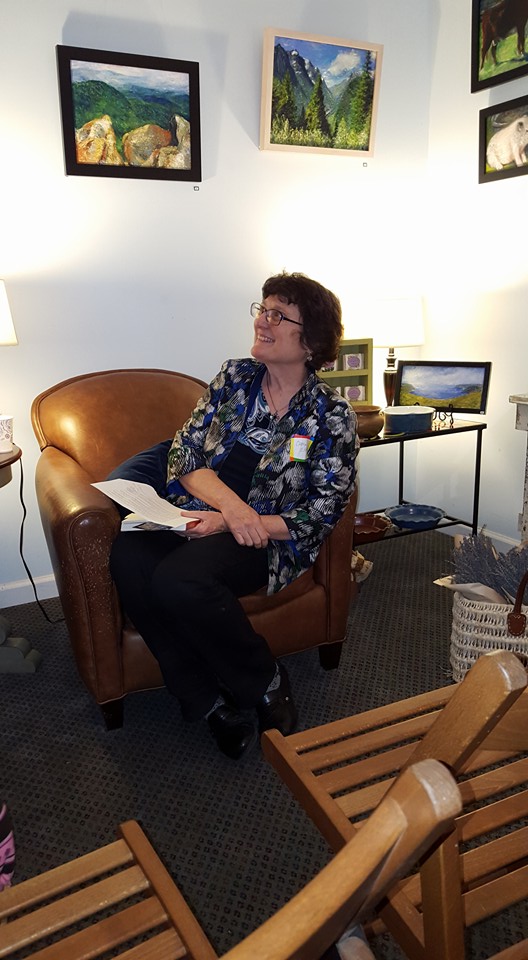
It was a huge success and a wonderful experience!  Here are some fun photos from the launch:

11214270_949560598449455_2219504517921639436_n20151108_16151212219531_1062431593767435_3872466266559842479_n20151108_16535612208694_949693998436115_1437400485545441089_n


Categories
BACCA Writers Events

BACCA Literary Is At It Again

BACCA Literary just can’t stop organizing these mixers for writers. This time, it’s an evening session at Downtown Charlottesville, VA’s Central Library at 201 East Market Street, one block up from the Downtown Mall. (We’ve done ’em before, at the Virginia Festival of the Book, and the Virginia Writers Club Annual Symposium.)

Free Session! Free Parking!

Local writers are welcome to attend free of charge. Parking is validated for nearby garages, too!

Here’s the flyer that Reference Librarian Hayley Tompkins just sent us. She’ll be there on Wednesday, 7 October, 2015, at 7pm, to welcome participants to our session.

BACCA Literary welcomes area writers to a mixer on Wed 7 Oct 2015 at 7pm in downtown Charlottesville, VA
BACCA Literary welcomes writers to a get-acquainted mixer on Wed 7 Oct 2015 at 7pm in downtown Charlottesville, VA. The Central Library is at 201 East Market Street.

Arrive a few minutes early to get yourself situated!

We hope to see you there.

— Bethany, Carolyn, and Anne

Categories
BACCA Writers

Getting Your Book (Cover) On 21st Century TV

How do you get from only an idea for a book cover, to one that was recently requested for use on the set of Grace and Frankie, a popular new Netflix TV series?

This happened to Sue Mangum and me for our book, Braver Than You Believe: True Stories of Losing Love and Finding Self, which just celebrated its 2nd birthday. We found that like good writing, creating an attention-getting cover is a process that unfolds over time. It helped that Sue knew the artist she wanted to work with: artist Amy Michelle, based in Atlanta. She also knew she wanted an image of a heart being sewn up.

Here’s the first try, from early April, 2013: painting by Amy MichelleSue and I were both excited about the potential, but we felt the last word in the title, “Believe” was too separate, making the title look at first glance like “Braver Than You.” Sue requested a change, and by the end of May, we were pleased as pink lemonade with this: painting by Amy Michelle, May 2013In the meantime, I was taking an eBook DIY class with Bethany Carlson of The Artist’s Partner I learned about the importance of bold colors, readable fonts, and having a cover pop out even as a thumbnail-sized image. For a class assignment, I mocked something up, and chose the red, white, and grey colors from Amy Michelle’s work. Those colors echo the themes of grief and romance from our book.

If we had offered a teaser free e-download, we could have used this…
cover draft by C E Cameron…but we decided to just go forward and publish the book on Aug. 10, 2013.

The last step for the official cover was deciding about the font for the subtitle and author names. Sue and I emailed back and forth, and considered several options including the infamous Comic Sans, which some design enthusiasts actually want to ban.

We eventually decided on Calibri, a font that is now Microsoft Word’s default for new documents. Why? Because it works. Combined with the emotive, hand-lettering of our book’s main title, the Calibri choice was simple, modern, and professional.

Here’s the final cover…

final cover, copyright Sue Mangum and C E Cameron

…And here’s where the work paid off: A month ago, I received a request through our self-publisher (Amazon’s CreateSpace), from Act One Script Clearance. Script clearance is necessary whenever a production team creates a set, using books, posters, or other products that are copyrighted. Act One staff were seeking books that looked like plausible reading for the characters played by Lily Tomlin and Jane Fonda on Grace and Frankie. In the show, these women are left by their husbands, when the husbands decide they are gay and fall in love with each other.

When I asked how they found our book, I learned that the production team searched Amazon for books their characters might be reading during a time of great turmoil. And while I’m sure our book’s title was key in the search, an attractive cover didn’t hurt. In fact, the cover was the main copyrighted work requested for use in the show. The production team sought permission to show it throughout the season, on bookshelves or coffee tables. It is now a part of this season’s permanent set.

Hollywood, here we come!

Claire Cameron is an educational psychologist at the University at Buffalo (SUNY), and aspiring science writer. Her dream is to write about human development, health, and science in a way that everyone will want to read.

Categories
BACCA Writers

Things I’ve Learned About Writing From Teaching Math

“Who would like to show their process on the board?”

joke This is a question I ask many times a week. I teach Algebra and Precalculus at Renaissance School. I love it.

One of the challenges I have teaching at a school like Renaissance, which is for high aptitude students in Arts, Humanities, and Sciences, is that some of my students have almost a spooky natural facility with math – but many of the artists, actors, humanitarians, photographers, and musicians have developed something close to a phobia of it by the time they’ve gotten to high school. Since math is a required subject for graduation no matter the track of their studies, one way or another, we’ve got to make it to the end of the year.

My main goal is for every student to finish the class with confidence. They don’t need to be a wiz; I just want them to be able to tell themselves, “I can do this.”

paranormaldistributionSo I focus on process, not outcomes. Getting the right answer the fastest doesn’t accrue any brownie points in my class. Instead, I encourage students to come up to the board and show their thought process. Like I often say, “There’s more than one path from here to the MudHouse.” And I often add, while they’re nervously approaching the board for the first time, “We’re all on the same team. We’ve got your back. Let’s get through this problem together.”

So, it was a HUGE thrill about two months into the school year when one of my most math-phobic students said, “Ms. Carlson, can I show my process on the board for problem 37? I’m getting stuck and I don’t know what to do next.” Yes. Yes you can.

find_x_lolNow that the school year is coming to a close, I’ve almost worked myself out of a job. The students work together in groups. The quick ones race ahead, learn the new formulas, and teach them to their peers. Everyone is going to be wrapping up the year with confidence. With a process for solving problems.

Which, finally, brings me back to what teaching math has taught me about writing. I’m not sure I appreciated it fully in the beginning, but one of the things that has made BACCA a great writing group for the last four years is the feeling that we’re all on the same team. We’re not competing with one another; we have different skills and aptitudes; we work together to give candid feedback and solve problems. We, too, focus on process, not outcomes. Naturally, we all harbor dreams of seeing this or that work published. But our esteem in the eyes of each other is based in the work we do in the small ways each month, not the grand finale.

Writing may be a solitary exercise, but improving as a writer is a team effort. Just like math.

Bethany Joy Carlson is a founding member of BACCA, a WriterHouse Board Member, and owner of The Artist’s Partner.