Categories
BACCA Writers

Critiques in the Classroom

I want my students to feel our writing critiques have launched their work to the next level. At its best, competition in the classroom raises everyone’s game.  But it’s easy to cross the line from healthy challenge to catty, snarky, and mean. When I teach a workshop, channeling that energy in a positive direction is one of my top priorities.

Matt Groening’s Simpsons courtesy of simpsons.wikia.com

Instructor Mantras for Great Classroom Critiques

As the teacher, I set the tone.  I want a positive, honest, challenging, listening environment with firm boundaries.   These are my instructor mantras.

  • I believe in each work.” I may imagine a long road between a current draft and publication.  But if I treat a student’s work like it’s hopeless, the whole class will pick up on that vibe and amplify it. The goal is not perfection, but getting the current draft to the next level. The fact is, every work can improve.
  • I say what I mean.”  Balancing the previous mantra, I don’t do my students any favors if the workshop turns into a mutual back patting session.  I don’t beat around the bush.  I call out the things I see that are working and the things that need work.
  • I ask questions about what I don’t understand.” Assumption is the mother of all, ahem, screw-ups.  Just because I’m the instructor, I don’t need to pretend I know it all.  When presented with something unfamiliar or unclear, I ask questions.
  • I listen carefully.” I should probably move this mantra to the number one spot, because as the teacher, I want to TALK.  Boring.  Belittling.  Discouraging.  I need to listen to my students first, and talk last.  I listen attentively so that I can return to emphasize students’ important contributions by name, and only then fill in any gaps that haven’t already covered.
  • I stop behavior that doesn’t belong in my class.” Especially with adult students, it’s tempting to cop out and think ‘we’re all grown ups here’, and let the class devolve into Lord of the Flies. Instead, when one of my students starts in with destructive criticism or wanders into a ranting monologue, I politely interrupt with, “Interesting point, Sally, but we’re getting off track. Let’s you and I talk about that offline after class.”

Classroom Rules for Great Critiques

Luke Whisnant’s ‘Responding to Other People’s Fiction’ is my handbook for setting critique ground rules, whether the writing is strictly fiction or not.  I repeat the headlines before each critique session.  Most people need to hear something three times to register it and ten times to memorize it, so it is not overkill to provide gentle reminders at the start of each workshop.

  • Start with what’s working.  Every piece has something that’s working for it.  We start there to encourage one another.
  • Continue with what needs work.  We’re not here to congratulate each other.  We’re here to improve.  Let’s get specific about what needs work.
  • Phrase with “I think”.  Our critiques are opinions, not facts.  We offer them thoughtfully, we listen to them carefully. In the end, it is up to the writer to decide what to do with our opinions.
  • Avoid “I liked…” or “I didn’t like…” This isn’t about tastes in reading material.  We are here to help each other with the craft, not share what we read in our free time.
  • The critiquers talk firstThe writer benefits most from unfiltered critiques.  The writer gets time at the end to respond.

I have found variations on these ground rules to be helpful in other creative and collaborative environments: Brainstorming about starting a business. Rehearsing for a play.  Setting strategic goals for an organization.  Co-writing a manuscript.  But for me they are particularly rewarding when I get that enthusiastic email from a student, thankful for the rekindled energy they have for their work, excited about how much it has improved, and ready to tackle the job of taking their draft to the next level.

If you are interested in more information on constructive critiques in the classroom, please contact bethanyjoycarlson at hotmail dot com.

Bethany Carlson

Categories
BACCA Writers

Maya for Writers

Several ancient schools of thought, originating thousands of years ago in India and in China, tell us that when you give something a name, you cut it off from the great swirling unknowable unknown that we call the universe, the mystery, darkness within darkness, or the nature of reality. Of course, those are all names, so it becomes impossible to write about the underlying nothing, since the moment we use words, we confine the thing that is too big for words.

Austin Guevara bokeh lights pexels-photo-237898
Pulling focus to create uncertainty. Photo credit Austin Guevara pexels-photo-237898

How do creative artists, including writers, manage that paradox? On the one hand, the writer’s tools are words. On the other, in order to touch the universal, we must abandon words, abandon thinking altogether, in fact.

Leaving Thought Behind

This is why, for example, forms of meditation recommend that we ‘just be,’ focusing on breath, and briefly acknowledging and then dismissing thoughts as soon as they appear. In this context, thoughts are sometimes compared to clouds in the sky, waves on the surface of a deep ocean, or cars passing by on the road. They come and go, and have no meaning.

A teacher recently posed the problem, “Describe to me last week – without using words.” He concluded that the task was impossible, because there is no ‘last week’ without words and symbols. Ideas, relative positions in time, in fact the notion of time itself, are all constructs. All Maya.

Image of smoke rising in a vortex
The illusion of smoke. Photo credit Rafael Guajardo pexels-photo-604672

Maya, a Sanskrit word sometimes translated as illusion, has multiple, nuanced meanings. In Western popular-culture shorthand, maya has come to mean the shared trance that we unknowingly, collectively agree to, so that we can function in the modern world. Buying into the trance of maya, we pay our bills, go to our jobs, drive in traffic, give birthday gifts, vote for politicians, accept the names of things, and in countless other ways entertain the culturally accepted method of viewing the world. Underneath maya, though, is that limitless unknowable everything. Is being free from maya the goal of those seeking enlightenment?

My first response to the teacher’s question about communicating ‘last week’ without words, was to imagine a kind of interpretive dance, or a quickly drawn image that somehow elicited in the viewer an intuitive grasp – somehow – of the notion of ‘last week.’

Maya for Writers

Assuming for the moment that a dancer or artist might be able to do that, what does the writer do, faced with this challenge? Even the most artful, obscure poem uses words, does it not? And words, unavoidably, conjure up in each one of us our previous uses, memories, knowledge, and responses to them. In fact, words have richness and power because of all our associations with them. This is true for the writer and for the reader.

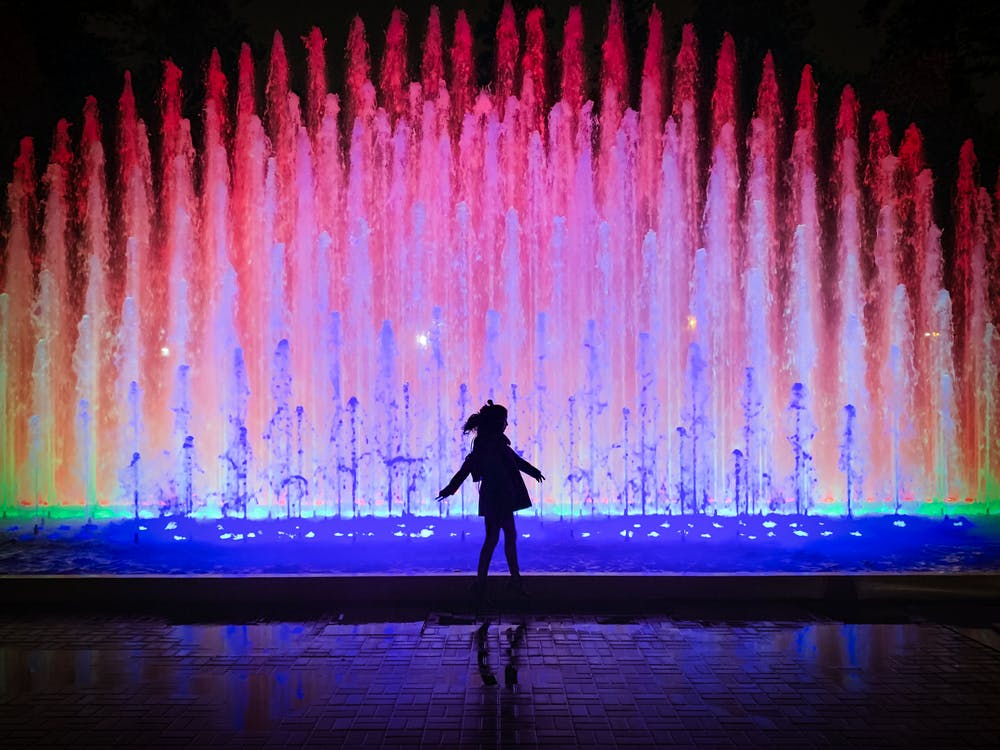
fountain pexels-photo-3822110
The magic of a child and an illuminated fountain. Photo credit Darren Lawrence pexels-photo-3822110

If writers cannot possibly escape maya in our work, can we use our shared unreality for good? Do we use language – our creative tools – in ways that can shift that shared maya, for a moment, into a slightly new light? Do we apply metaphors and similes? Do we arrange words in unexpected sequences to permit the reader a brief glimpse of something beyond the words, into the unknowable?

— A M Carley writes fiction and nonfiction, and is a founding member of BACCA. Through Anne Carley Creative she provides creative coaching and full-service editing to writers and other creative people. Decks of her 52 FLOAT Cards for Writers are available from Amazon. Anne’s writer handbook, FLOAT • Becoming Unstuck for Writers, is available for purchase from central Virginia booksellers, at Bookshop.org, and on Amazon.

Categories
BACCA Writers

Things I’ve Learned About Writing From Teaching Math

“Who would like to show their process on the board?”

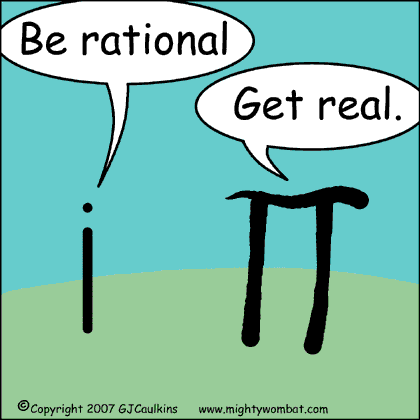
joke This is a question I ask many times a week. I teach Algebra and Precalculus at Renaissance School. I love it.

One of the challenges I have teaching at a school like Renaissance, which is for high aptitude students in Arts, Humanities, and Sciences, is that some of my students have almost a spooky natural facility with math – but many of the artists, actors, humanitarians, photographers, and musicians have developed something close to a phobia of it by the time they’ve gotten to high school. Since math is a required subject for graduation no matter the track of their studies, one way or another, we’ve got to make it to the end of the year.

My main goal is for every student to finish the class with confidence. They don’t need to be a wiz; I just want them to be able to tell themselves, “I can do this.”

paranormaldistributionSo I focus on process, not outcomes. Getting the right answer the fastest doesn’t accrue any brownie points in my class. Instead, I encourage students to come up to the board and show their thought process. Like I often say, “There’s more than one path from here to the MudHouse.” And I often add, while they’re nervously approaching the board for the first time, “We’re all on the same team. We’ve got your back. Let’s get through this problem together.”

So, it was a HUGE thrill about two months into the school year when one of my most math-phobic students said, “Ms. Carlson, can I show my process on the board for problem 37? I’m getting stuck and I don’t know what to do next.” Yes. Yes you can.

find_x_lolNow that the school year is coming to a close, I’ve almost worked myself out of a job. The students work together in groups. The quick ones race ahead, learn the new formulas, and teach them to their peers. Everyone is going to be wrapping up the year with confidence. With a process for solving problems.

Which, finally, brings me back to what teaching math has taught me about writing. I’m not sure I appreciated it fully in the beginning, but one of the things that has made BACCA a great writing group for the last four years is the feeling that we’re all on the same team. We’re not competing with one another; we have different skills and aptitudes; we work together to give candid feedback and solve problems. We, too, focus on process, not outcomes. Naturally, we all harbor dreams of seeing this or that work published. But our esteem in the eyes of each other is based in the work we do in the small ways each month, not the grand finale.

Writing may be a solitary exercise, but improving as a writer is a team effort. Just like math.

Bethany Joy Carlson is a founding member of BACCA, a WriterHouse Board Member, and owner of The Artist’s Partner.