Categories
BACCA Writers

Good Tools: The Elegant No

The word "no" spelled out using pieces of jewelry.

Writers need to know how to say No. In creative (and other) circles, there are magic words that have power, carry weight, move us forward. They aren’t a secret; we know them well.

Please. Thank you. Tell me more. Yes. No.

More so than the others, Yes and No shape our lives. Our time, energy, and other resources flow according to when we say Yes and how often we say No. For some people, No seems easy, a default answer they were either equipped or born with. For some of us (me!), No is hard. Some of us are trained to be accommodating, to say Yes first and figure out how to follow through later—all so we can be liked and considered useful, so we can help out the collective. As I’ve gotten older, and my time tighter, this Yes-first strategy has become impossible. Always offering Yes in place of a necessary No threatens the integrity of the rest of my life: my creative work (the first to be cut for time), my relationships, and eventually my health. If I want to function well, the collective is going to have to do without me, at least some of the time.

Cobbling Together a No

So, how is it done? If you aren’t born with or taught No, how do you find one in yourself? How do you employ this important tool well? First, I have to know my own heart and what I really want. I have to have a realistic conception of my schedule and my capacity. I have to know if I even have the adequate skills to accomplish what is being asked of me. (I had a terrible job once, where I had to fail hard to prove to my manager that I really can’t decorate cakes. It’s simply not in me. Good—that’s something I don’t ever need to say Yes to in the future!) Even more importantly, I have to keep a firm grip on my creative goals. When I perpetually support the projects of others at the expense of my own, I become the most bitter and angry version of myself—and of no benefit to anyone. So, I’m finding No by gathering together some important pieces of myself: intuition, self-knowledge, realism, and sometimes my stubbornness, my ability to resist.

How to Say No: Travel Light.

Simple, elegant, sufficient, the word No carries enough weight all on its own. Tacking on elaborate explanations, pity parties, or a string of apologies weakens and bleeds No of its power and energy.

No is precise, clear. It’s a light ship that will get you quickly, cleanly on to what you need to do. If you begin to tack on extra cargo to NoI feel so bad, I wish, maybe—your streamlined conveyance to freedom gets weighed down, stuck in the muck. Or possibly waylaid, hijacked, commandeered to the land of unintentional Yes. No good. Best to keep it light, simple, and straightforward.

Hone the Skill

A safe, low stakes opportunity to employ the No tool is a rare find. Recently, I had this opportunity. From another room in my parents’ home, I heard my mother answer the door. After just a few seconds, I knew she wasn’t talking to a friend or neighbor, but a pushy solicitor trying to convince her that she needed home security. He was young, full of energy, and had obviously been trained to never take no for an answer. (I still pray he doesn’t carry that skill over into his personal relationships.)

My mother was trapped. He had no intention of releasing her from his well-rehearsed sales rhetoric. To let the young salesman know that he had not found easy prey, but, in fact, a very well-protected house, I stepped to my mother’s side. As he shifted his barrage of warnings and promises in my direction, I began wielding the magic word—No—over and over again. I used it politely and firmly. In a calm voice, I said No at least a dozen times. Somewhere in the middle of this volley, I realized I had a choice. I could steam up, get mad and rude with him, or I could seize a rare chance to practice. For the next few minutes, I said No until it felt natural, comfortable, easy—almost fun. The young man’s training held strong. In the end, I had to use an additional magic word to release all of us from the encounter.

“No. Goodbye,” I said, and shut the door.

My heart still beating quickly from doing new work, I looked at my mother and we both laughed. Then we moved on with the rest of our day! In retrospect, I would only do one thing differently. I would invite my mother to practice, too.

Magic words open doors. No might feel like a door slam, but it opens another door too, as long as we don’t get stuck on the threshold, feeling guilty, replaying what-ifs and imagined consequences for saying what we want. For the person who says it, No has a hidden Yes on its obverse side. When I’ve said No to what I can’t or won’t do, I’ve said Yes to other wonderful things—time for discovery and rest, the opportunity to generate ideas and make good work—the treasures of a creative life.


Noelle Beverly writes poetry and prose, supports local writers in the surrounding community, and is a member of the BACCA Literary groupPhoto by author.

Categories
BACCA Writers

Maybe I just have a bad memory

I don’t understand memoir. How do people remember enough details about their childhoods to write a book.

How do memoirists know their memories aren’t lying to them?

Unlike much of nonfiction, most of our personal memories can’t be fact checked. I can look up what day in 1968 the construction of the North Anna Nuclear Power Plant was announced. I can fact check that date against regional newspapers from that era. I can explore the life of local hero Spurgeon Moss by talking to people who knew him. I can fact check these memories by visiting the Louisa County Historical Society.

But memoir is different.


Let’s say I wanted to write about my childhood. Let’s say I wanted to write about my experiences playing the flute in my elementary school band. I clearly remember that I chose the flute because “flute” and “drums” were the only two instruments I knew how to spell.

Clarinet? Saxophone? Sixty years later and I still have to spell check them.


I was a terrible musician.

My recollections are that I had a decidedly negative impact on my elementary school band. The only part I really liked was the uniform. I have a vague memory of being part of a marching parade.

I wore my uniform and played my flute. I only knew how to play one song: The Marine’s Hymn.

“From the Halls of Montezuma
To the shores of Tripoli;
We fight our country’s battles
In the air, on land, and sea…”


Have you ever heard a flute played horribly? It sounds like a rusty car door squeaking open and closed. I most certainly had no idea where the Halls of Montezuma or the shores of Tripoli were or why the US Marine Corp was fighting in either location.

Both, in fact, are fascination historical events worth a well-researched narrative nonfiction!

Categories
BACCA Writers

Is It Time for You to Clean House as a Writer?

I’m not citing the way many of us procrastinate by cleaning. For most writers, there will come a time when many of the groups and activities that helped you get started will get in your way. Balance will be key. Focus on the writing itself.

First, what you already know…

Helping new writers get a start is big business. Once you end up on a mailing list, you’ll hear from marketers encouraging you to invest in various classes, platforms, and software. You’ll also be courted by established writers who supplement or make their living by editing, teaching classes, and speaking events. Recommendations on books to help you with your writing will be abundant. As a discerning consumer, find the groups and products you need in this moment and let them go when the moment has passed.

As your skills and confidence grow, the very groups which gave you an inspiring start can block your path forward. As an example, the mixed genre writing group you loved and learned from early on may be holding you back as you home in on your creative style. Find a group with more established writers that know your genre well. Assess and find what you need for the stage you’re in. The right support at the right moment will keep you inspired and help grow your craft.

Joining groups to learn and network is useful, but over time, the focus needs to be on your work. Put other activities aside. At least for a time, unless you are a hobbyist, and your interest lies in comradery more than the actual writing. There’s nothing wrong with making that choice, but it is a choice you could be making unwittingly.

If you’re serious about writing, don’t be shy about leaving a group which no longer works for you, even if it was helpful at the start. Those connections may become helpful again, especially if you were a strong contributor to the group. Leave or take a leave of absence on good terms. Thanks so much, but my time is limited, and I need to use it to write. Any writer will understand. If they don’t, they aren’t there to support you. Your time and focus are precious.

Networking is important, but not more important than developing your craft. Book promotion is important, but it comes after you have a book to promote. Many writers rush to query before their work is ready or worry about marketing before they have a product to sell. There’s always time for networking and marketing after the writing is done. In today’s viral world, it’s easy to put the cart before the horse. The best way to become and author is to write, as often as possible. The rest will fall into place.

Take stock and clear away anything impeding your writing.

Unsubscribe! Are you deleting emails from organizations you once dealt with, but now you don’t even read their emails or posts? Stop wasting time and cluttering your mind and inbox.

Turn off notifications for email and social media. Check in on your terms. Don’t let these businesses break your focus when writing.

Leave groups which no longer feed your creativity. You can always join again.

If chores distract you at home, write somewhere else—a library or a coffee shop.

A couple hours of thoughtful cleaning will reward you with new-found writing time!

By Pamela Evans

Pamela Evans is an author and award-winning educator, early childhood specialist, and director of educational programs. As a consultant for preschools and music programs, Pamela specializes in curricula for young families. A life-long learner, Pamela enjoys sharing and fostering a love for the natural world, the educational benefits of story-telling, and an appreciation of music and the arts with students, parents, teachers, and fellow authors.

Categories
BACCA Writers

Worthy Work

by Noelle Beverly

A bookshelf of notebooks
a fraction of the notebooks I’ve filled with ponderings, queries, and ideas…

Why bother writing today? What is all this effort for? Why should I keep filling and making books?

These questions have been slinking in and curling up in my mind lately. In an era when it feels like all light and joy and freedom are getting speedily sucked out of this nation and the world, my insistence on making space for a creative practice seems frivolous and selfish, not to mention exhausting.

Still, I keep plodding on. Deadlines push me forward. A company of writer-friends, who encourage and commiserate, pull me through the jungle of doubt. And, on most days, I like what I do when I manage to do it. It feels better to make something than to wallow and worry.

I’m learning to be content with this—writing for my own satisfaction and delight. I would love to find a home for my books, perhaps an audience, but those goals can’t be the why of why I write. Right now, I don’t really have much extra time and energy to keep questing after an agent or publisher, but I’m trying not to let that stop me from moving my projects forward. I’ve found some inspiration for this predicament in an interesting place (or rather, time) …1925.

I’m fortunate to have an interesting day job working at a local history museum, and some colleagues and I recently put together an exhibit that looks back 100 years to 1925. Although the exhibit focuses on social life, the artifacts and stories we’re featuring point to a strong sub-theme: exuberant, irrepressible creative expression. One artifact in particular speaks to this: the Mayo Bass Scrapbook.

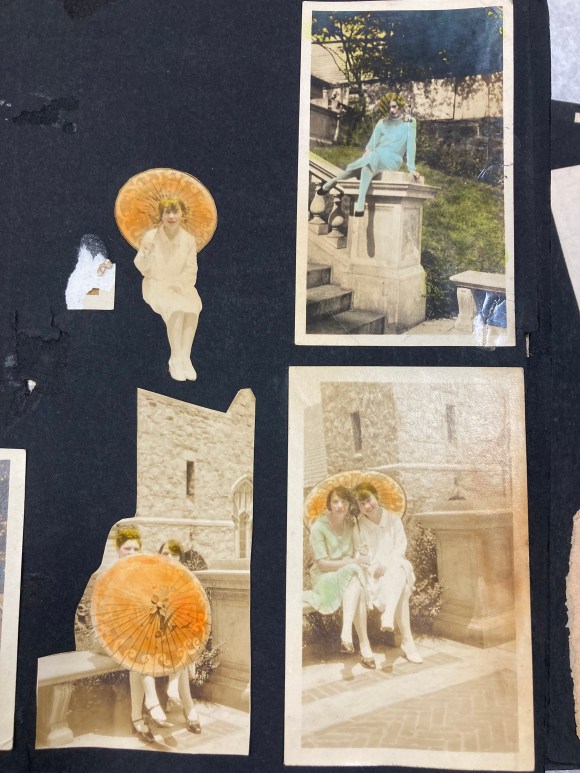
  • Scrapbook page from the 1920s with hand-tinted photos of a woman with a parasol
  • Scrapbook page from the 1920s, with stamps, cut out post marks, and a photo
  • Scrapbook page from the 1920s with notes and cut out images
  • Scrapbook page from the 1920s, including cigarette butts
  • a scrapbook page from the 1920s, including an image of a woman working a math problem on a chalkboard

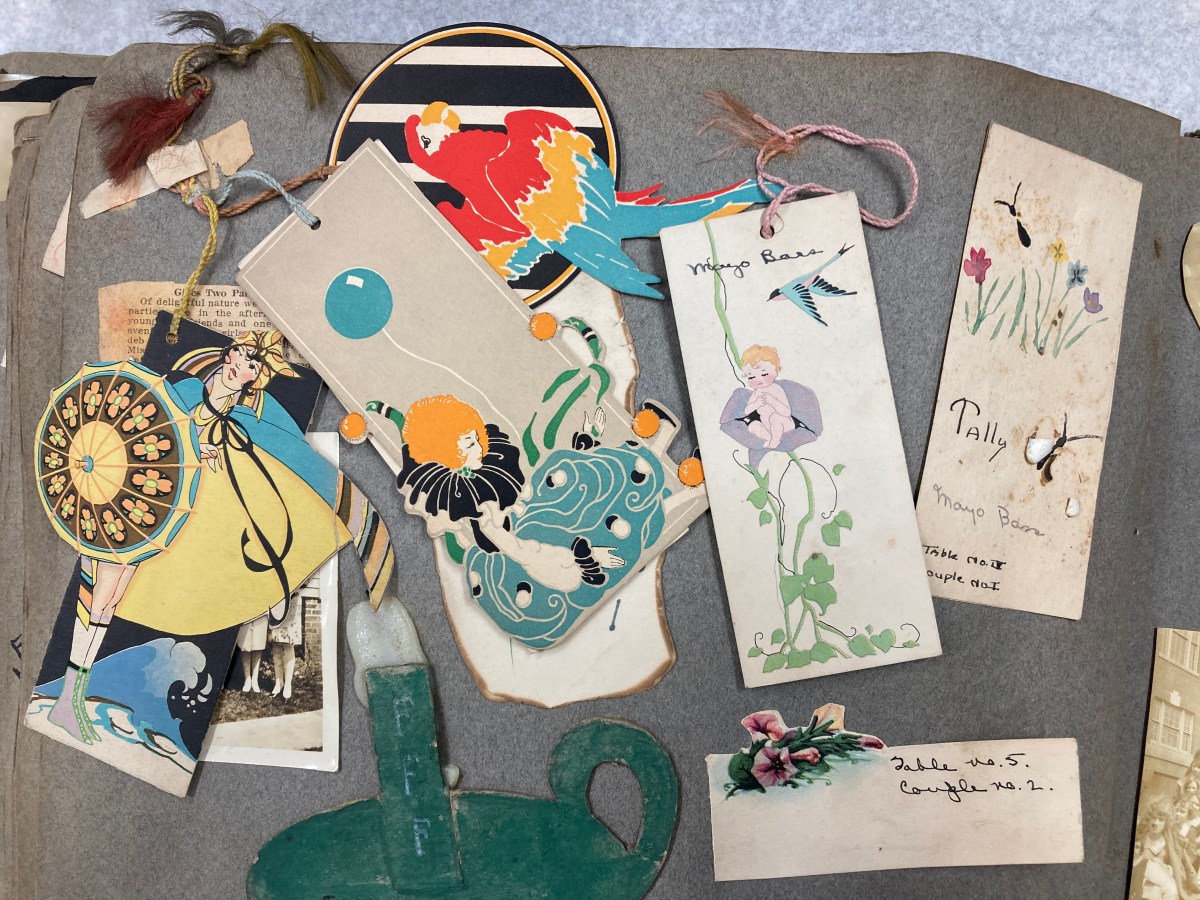
Lynchburg native, Mayo Leola Bass, was a young teenage girl still in high school when she began collecting the various papers and pieces that floated into her life and assembling those bits into a scrapbook. She mingled hand-tinted photographs with bright-colored bridge cards, programs, invitations, and party favors. She pasted letters and newspaper articles next to cut out post marks, and dance tickets. One page is filled with the stubs of cigarettes, with the name of each smoker carefully noted beside it. Comprised of ephemera—scraps literally intended to disappear—the scrapbook still has value and meaning 100 years later. It speaks.

The pieces Mayo Bass selected and saved could have just as easily ended up in the trash bin. I imagine someone might have even told her so. But she chose to save them and the result is remarkable. Pages and pages of seemingly inconsequential bits and pieces, which together add up to so much more—a provocative, funny, and informative record of a life. Thanks to this artifact, I feel like I know something about the young woman who created it, as well as the essence and flavor of that time she lived in and that place.

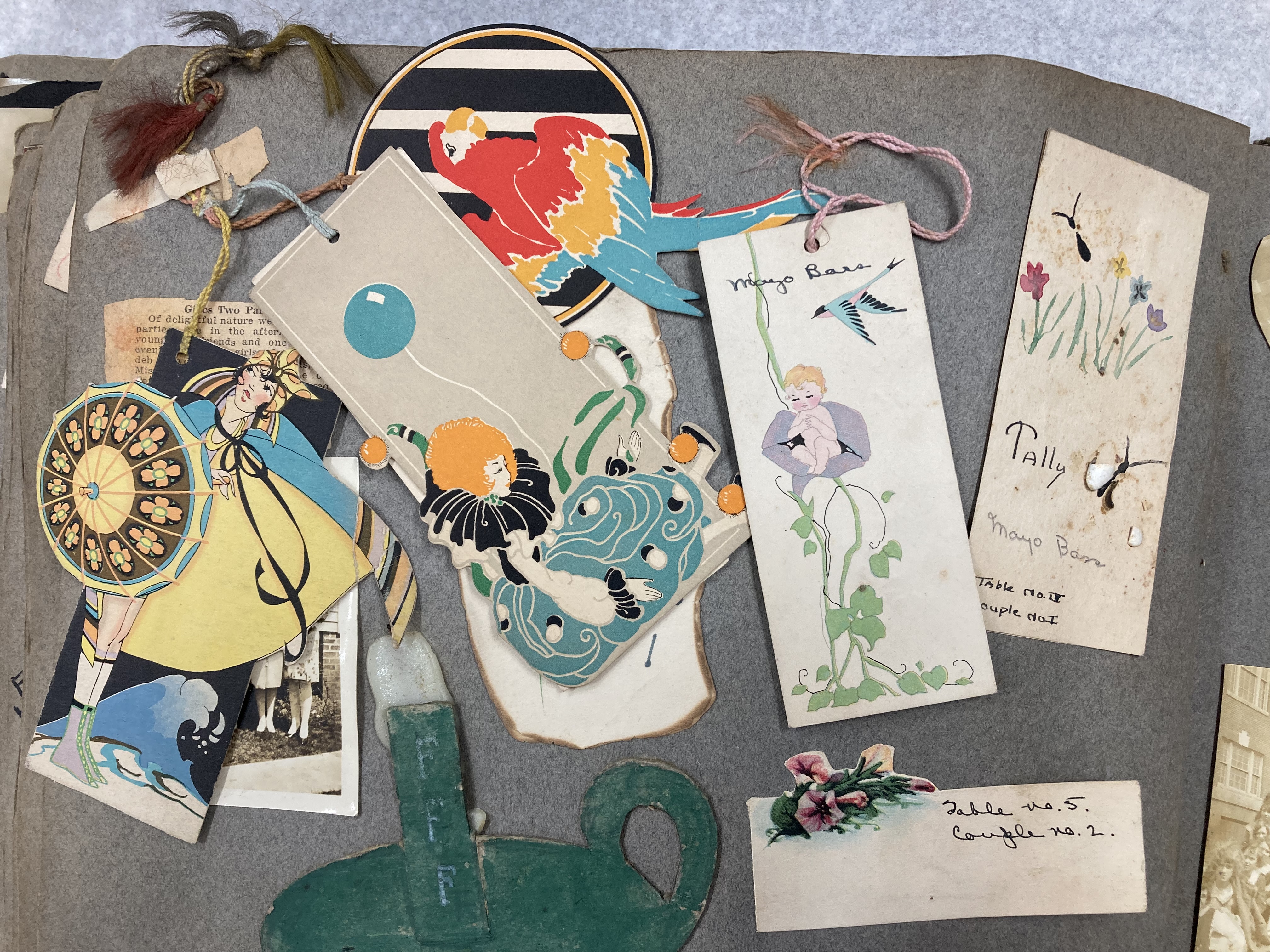
Mayo Bass Scrapbook page, featuring bridge cards and place cards.
A page from the Mayo Bass Scrapbook, ca. 1925, courtesy of the Lynchburg Museum

The Mayo Bass Scrapbook, in my opinion, is a piece of art as much as an historical artifact. It is an artfully made collage of the concerns and delights of a young woman living in the 1920s. My guess—Mayo Bass never dreamed anyone would see her creation that way. She likely made it solely for her own satisfaction. Perhaps, also for her daughters to peruse and enjoy one day. But for it to end up on display in a museum as the touchstone for an entire exhibit 100 years later? I bet she would have flicked the ash off her cigarette and laughed at the idea.

Mayo Bass didn’t know the future of her scrapbook or how it would be valued or perceived. This thought encourages me. It also encourages me to think of her cutting and pasting, creating an enchanting object, all just to suit herself. We don’t know the future of our creative work. But if one person finds delight in it, even if it is the artist herself, I think that’s enough. To make something beautiful, or provocative, or funny, even just to please ourselves, is worthy work.

The Mayo Bass Scrapbook will be on display at the Lynchburg Museum, 901 Court Street, through March 31, 2025.


Noelle Beverly writes poetry and prose, supports local writers in the surrounding community, and is a member of the BACCA Literary groupPhotos by author.

Categories
BACCA Writers

What Spooks a Writer?

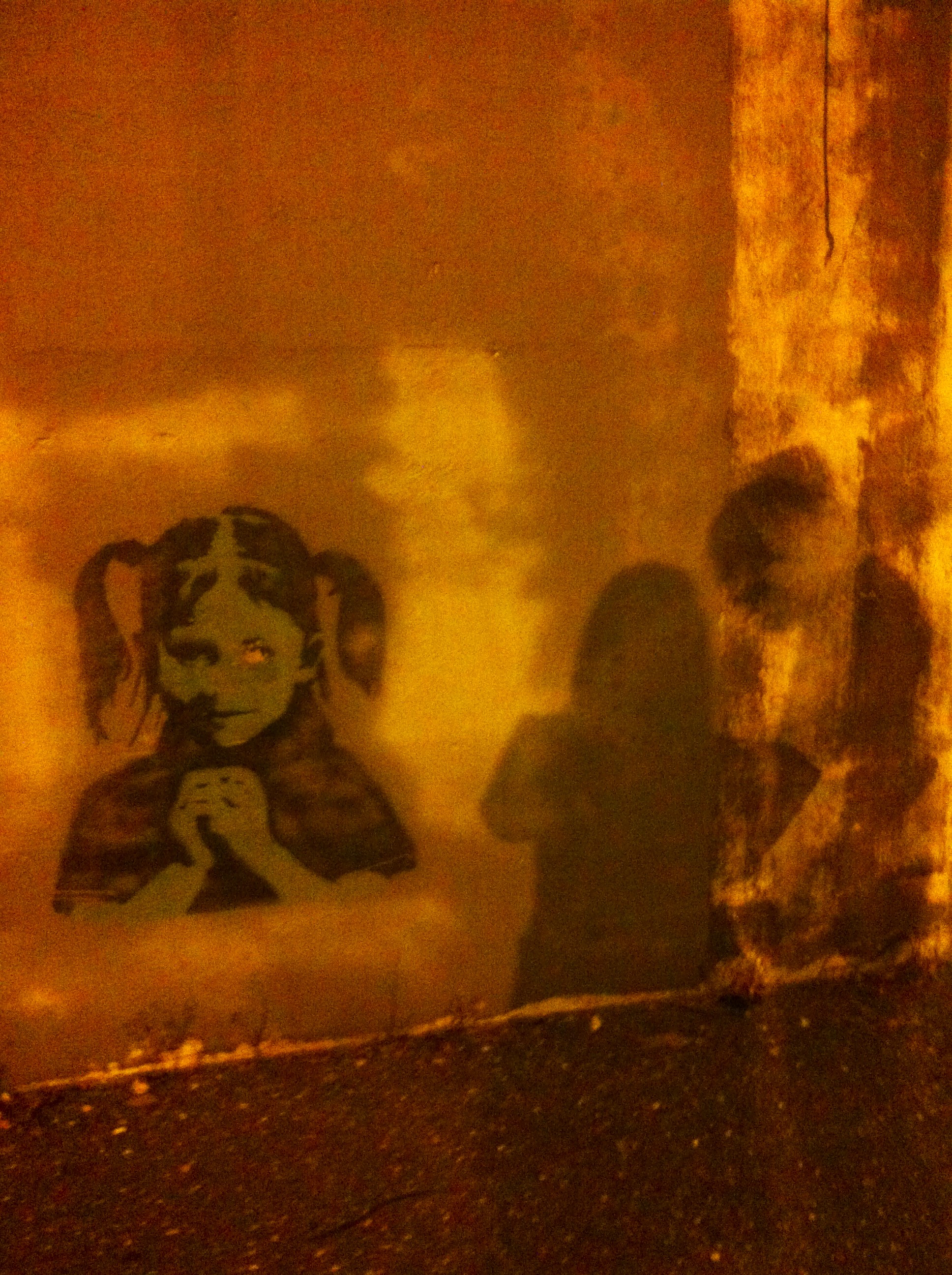
shadows and graffiti of a spooky girl with pigtails
Graffiti, shadows; Downtown Lynchburg; ca. 2018

It’s time to face my fears. There’s something about this time of year that inspires me to confront them—those monsters that are nipping at my ankles and threatening to tear apart my creative work.

When I think of the traditional fears that haunt and beleaguer writers, a few boogeymen jump to mind:

Fear of rejection. Fear of deadlines. Fear of the blank page.

Though formidable, for me these phenomena have lost their boo—not because I have extraordinary courage, but because I’ve had time to study them more closely.

At this point, after submitting my work and searching for agents for the last two decades, rejection is an old (annoying) acquaintance. It used to derail me, but now I find I’m inoculated to the word “no.” Rejection is unpleasant, but it can’t paralyze me anymore. After facing dozens and dozens of deadlines, I’ve learned that they’re tools for making progress. As I’ve explored here, even the ultimate deadline, death, can drive us to finish what we’ve started and meet our goals. As for the blank page, well, that’s where all my ideas are born. Anything can happen on a blank page, so now when I stare at a fresh sheet of paper I just feel excited.

Even though I’ve faced some fears, there are still a few things that scare me. It’s time to get out the flashlight and have a look at what’s lurking beneath the bed.

doorknocker with a face

Fear of The Knock at the Door

Time is the most contested of my resources. In this era of my life, interruptions, even emergencies, are a constant reality. If I want to produce anything, creative time has to be prioritized, pried out, and protected with ferocity. When I’m chasing down an elusive idea or image, any interruption, even a friendly one, can derail this somewhat fragile process. So, when I’m in my studio enjoying one of those rare hours that I’ve set aside for creative work, I find myself bracing for the knock at the door.

Fear of Godzilla’s little brother

I bet you know him, that kid on the playground that came along and kicked your tower down before you’d even finished building it. Writers are prone to this little monster, too. Sharing work before it’s ready is dangerous business. Feedback, if carefully crafted and delivered, is essential for writers. However, thoughtful critique is a very different creature from carelessly formed criticism. Godzilla’s little brother has no interest in helping you make your writing better, he just wants to topple your work mid-progress, flog your ideas before they’ve fully taken shape, and tear your project apart without taking any time to understand it.

Fear of Creativity Vampires

These folk can be hard to spot sometimes; they are very good with disguises. They might take the form of a family member, a friend, a coworker. But, there is a foolproof way to know if you have one in your life—after you spend time with a creativity vampire, you feel depleted and devoid of ideas. Your time, your energy, are spent fixing their problems, jumping to their aid, maybe even propping up their fragile egos. This time and energy (which could have been channeled into your creative work) flows in one direction only—straight to the vampire. If you need help or encouragement, you won’t get it from one of them.

a ripped sticker of two faces
Found art; Asheville; ca. 2022

Fear of The Poacher

Finding inspiration in another writer’s work is natural. Imitation can be a wonderful learning tool, but on occasion, I’ve encountered a person who takes it a step too far. This person is The Poacher—a person who lets someone else do the heavy lifting of creation and then reaps some of the rewards. They recognize a good idea, steal it, then make a quick replica and pass it off as their own. I identified my first Poacher in eighth grade art class after she ripped off the central governing idea of an image I’d been working on in my sketchbook. Looking at her “version” of my idea, I felt disappointed and deflated. Good ideas require time, energy, and often a unique point of view. Sure, there may be nothing new under the sun, but if you manage to generate something that feels fresh, seeing it immediately duplicated by someone else feels like a sucker punch or a theft.

Why Look for Monsters?

Well, now I can see what I’m fighting. Monsters that lurk in the dark often seem bigger than they really are. Shining a light on them brings clarity and definition. When I look over the list I’ve created, it’s clear that my fears all point back to the same problem—I need stronger boundaries around my creative work. I need to find ways to protect my time. I need to make sure that the people in my inner circle are trustworthy and respectful. Easy to say…much harder to do. Still, it feels better to know than to sit, afraid, in the dark.

Dangers to creative expression hunker in every corner. I might be vulnerable to some that others are not. Have you looked at what lurks in the shadows lately? What haunts you and your creative work?


Noelle Beverly writes poetry and prose, interprets local history at the Lynchburg Museum, and is a member of the BACCA Literary groupPhotos by author.

Categories
BACCA Writers

Keeping the bits and pieces

Every beekeeper has experienced opening up their hives and finding their honeybees have built honeycomb in the wrong place. Some beekeepers call this burr comb.

Image provided by Carolyn O’Neal


Beekeepers want even and smooth comb built on the frames we provide for the bees.

Image provided by Carolyn O’Neal

Building comb is hard work for honeybees. It requires tremendous resources and efforts to produce wax. Then they have to festoon together to mold the wax into the hexagon shape of beautiful honeycomb. Honeybees literally work themselves to death building comb and filling it with nectar and pollen.

What do beekeepers do with wax found in the wrong places? Clean, fresh beeswax is valuable! We keep it! We use it to coat honeybee frames for the following spring, or make candles, or polish furniture. There are so many uses for beeswax.

It’s a little like that great paragraph you wrote that just doesn’t fit. Maybe it belongs elsewhere in the story. Maybe it belongs in a different story.

Keep it! Don’t throw away your hard work. Just like building comb for honeybees, writing a good paragraph requires effort and is worth saving.

AI Generated image.
Categories
BACCA Writers

Mind-Expanding Writing Strategies

One thing that I love about “writing in community” is the accountability. Expanding the group of people who can give constructive feedback about our writing makes it a less lonely activity. Writing groups, partners, or teams help cheer us on when we’re stuck. And deadlines for those groups help us keep going even when – like at the end of Daylight Savings Time – we’d like to curl up on the couch instead of sticking to our writing goals. Here are some other mind-expanding* strategies that keep me writing.

1. Writing is an opportunity to be mindful

angkor_thom_image
The author captured this peaceful face beyond the doorways on an October 2013 visit to Angkor Thom, Cambodia

I recently learned the term productive procrastination, which means doing something that seems productive, to avoid doing The Thing that you should be doing – in this case, writing. Ever notice that when you sit down for your daily dose of writing, the dirty dishes or laundry start calling to you? Or for some reason it’s a good time to do your banking?

Even chores can seem compelling if you’ve been out of the writing habit for a while. So: next time this happens, expand your awareness to include this tendency. In other words, simply try to notice, to consciously register, when your mind tries to convince you that something else is more important than your writing. At first, you may still end up avoiding your writing. But after a while of noticing, you can change that habit (your brain is actually re-wiring itself). Now when I catch myself beginning to productively procrastinate, I’m usually able to override the impulse and keep on writing. Sometimes it helps to write down the item on a to-do list so I don’t forget. I just say to myself “You’re writing now, you can do that later.” And it’s true!

2.  Think outside the screen

In this age of electronic devices, sometimes I forget about writing strategies beyond my laptop screen. But interacting with a paper draft is different than on a computer or tablet. I find reading and editing on paper an especially important strategy when I’m working on chapters – or really, anything longer than a couple of pages. When I read on the page, I notice more easily if a sentence needs to be moved up or down, or I can see a whole section that can be edited out. Do you find it difficult to order the action in a novel or short story? Consider cutting up pieces of text and moving things around.

You can also use outlines however they work for you. For example, try outlining after you start writing, or make an outline of what you’ve written. This will show you the entire story and things that are out of place might pop.

3. Writing is part of the learning process

DSCF2278
One of many colorful Buddhas in a park in the Cambodian Cultural Village of Siem Reap. He might be saying “Don’t worry. Be happy. Just write. Then edit.”

I used to have a concept that I would understand something fully and then write it down. But I’ve learned that for me, writing is how I figure things out. In other words, I’ve broadened my definition of “writing” to include “writing to learn,” in addition to “writing to teach” (or explain, describe, or entertain). I’m not so hesitant anymore to start writing even if I don’t know where it might lead.

4. Expect to edit

Learning is a process. We are all in that process. Even experts write “crappy drafts.” Which is why another thing that’s just part of writing is editing. And to truly open a piece up to its possibilities, some parts of yourself may need to be uninvited from the editing part of the process. For example, the “that’s not good enough yet” voice and the “everything I do is perfect” voice do not belong in the editing room with you. Banish those voices and you will have more room to think.

*Credit to the great wordsmith, A M Carley.

— CE Cameron

Categories
BACCA Writers

On Writing the Truth

A layered image, looking through the window into the interior of a house built in the 1790s. Image shows interior view, reflection of outside, and silhouette of the photographer.
Creating layers… through the window of the Miller-Claytor House, the oldest surviving house in Lynchburg, built ca. 1790.

I never thought I’d enjoy being forced to write the truth. Fiction is my first love, and even within that genre, I especially love exploring the blurred edge between the real and the mythic. But I’ve been working for a museum and as part of that work, writing and telling true stories about people that lived, places that exist, events that unfolded. Even though there are limitations that come with sticking to the truth, I’m finding history writing to be a powerful way to communicate some of the themes I care about.

I’ve written here about the creative potential of form—how limits can push or propel a writer into a greater set of ideas, a more rigorous or intense result that full freedom might not have prompted. Writing to share history is something like writing within a form. There are parameters and a set of facts that cannot be embroidered or mislaid. But within those boundaries, and using some of the same skills I employ in my creative projects, I find so much potential.

Every story, true or not, is more effective if it achieves an arc: a provocative beginning, an intense middle, and a satisfying or stunning end. Interpreting history seems to be about finding the perfect arrangement of truths to achieve this shape. Without a shape holding them together, facts can be difficult to hold onto. In this process of arrangement, my perspective is essential. Every interpretation conveyed through a different storyteller is unique. Even while tethered to the truth, as I frame anecdotes, layer details, find connections, and create subtle shifts in focus, I make a story my own.

Finally, working with true stories is satisfying because I see it making a tangible difference. At the museum, we are committed to finding narratives that have been forgotten or written over, stories of the marginalized that, until lately, have remained untold. I’m seeing these stories reach an audience in real time as I give guided walking tours, or put together themed exhibits.

As much as I’ve enjoyed this experience, I’m not abandoning my first love. In fact, I’m longing to dive back into my own invented worlds now more than ever. While sharing history, I’m allowed to provoke but not predict. I can make connections between people or objects or places in the past, but I can’t leap forward and apply those connections to the precarious future.

To warn, to predict, to leap intuitively to what might come next—this is the purview of the poet, the inventor of worlds. There will always be a need to look at and learn from the past, but there is also the need for a different kind of storyteller, too, a need for those writers on the frontier, looking forward, bringing powerful truths back from what they foresee.


Noelle Beverly writes poetry and prose, interprets local history at the Lynchburg Museum, and is a member of the BACCA Literary groupPhoto by author.
Categories
BACCA Writers

How Do We Know if it’s Time to Shelve a Writing Project?

I have a difficult relationship with completion.

I can spot about six different half-finished crochet projects from my desk. It took me nearly ten years to complete my bachelor’s degree because I kept changing majors—and schools. And, for the past many years, I’ve been wrestling with a memoir.

Recently, I’ve been considering shelving that writing project.

A close up of a burgundy ball of yarn with two crochet hooks stuck through it.

Is it time to unravel that “sweater” or just set down the hooks for awhile? Image by Olliss via Unsplash

There are several reasons I’m contemplating letting that project go. Much of the story deals with trauma, and it’s tricky to sit in that energy while trying to also enjoy and balance the demands of my current life. Also, one of the primary reasons I was writing was to try to understand why a family tragedy occurred, and in the process of regular old living, it became clearer to me. And, in the past few years, I found an alternate way of creating resources that might be of service to people who’ve experienced sibling loss, which was one of my initial motivators to complete this memoir. Last but not least, I’ve been writing about this topic for decades. I’m curious to see what else might bubble up on the page.  

But what about completion? What about the countless hours I spent writing and revising? What about stick-to-itiveness?

One thing I love about crocheting is that the stakes are low. If I mess up partway through a project, or get bored with it, it doesn’t really matter if I rip the stitches out or start a new project. As a recovering perfectionist, there aren’t very many places in my life where I let myself off the hook (pun intended) so easily, but crochet is one of them. The meditative state I enter when my hands are busy making something with the yarn and hook is a worthy pursuit, regardless of whether it results in a blanket.

Writing is an art, but I choose to not see it only as a commodity. Writing has been a survival tool for me. It’s how I attempt to make order from the chaos. It’s often how I learn what I’m feeling. Writing helps me frame and understand parts of my life that otherwise seem disparate.

Besides, one of the best parts of writing, to me, is the magic that happens when we show up to the page and we tap into something outside of our own minds.

From that perspective, all those hours I spent on that memoir weren’t wasted.

In the time I spent on my memoir, I grieved. I remembered. I made sense of. I tinkered.

I’ve also been doing a whole lot of living in between. I’ve been raising two kids and nurturing an almost 20-year marriage. I was able to be present and helpful through my dad’s illness and death. We have a dog and a mortgage, and I exercise on the regular. From this little list, perhaps I’m not actually a quitter.  

Completion isn’t the same as commitment.

Maybe writing doesn’t need to be that different from crochet—it’s not the end of the world when I have to rip out stitches or trash the sweater project because it ends up looking more like an oven mitt. Maybe there’s freedom there. Curiosity. Openness.  

But. There’s still one thread of the memoir that I can’t quite let go of. It’s about the amazing women who shepherded me through losing my brother, and how they basically taught me how to connect, get through the tough stuff and live a rich life. I’d like to find a way to tell it, though I’m not yet sure what that might look like. I’m looking forward to giving the story some space, letting go of the vision I had of it in my head, and seeing what might take shape.


Lynn Shattuck grew up in a Southeast Alaskan rainforest and is now a Maine-based writer. She’s a columnist at Elephant Journal, where she writes about grief, parenting and wellness. Her essays have been featured in Human Parts, Al JazeeraP.S. I Love YouThe FixViceFabric, and Mind Body Green

Categories
BACCA Writers

2023: Balancing Time

Inner workings of 1850s-era clock at the Old Court House in Lynchburg, Virginia.
Inner workings of 1850s-era clock at Old Court House, Lynchburg, Virginia.

Two tools have rescued me over and over this year: a timer and a notebook. Sometimes the simplest, most humble tools are also the most powerful.

Like just about everyone else, I’m taking inventory. 2023 is winding down; 2024 is about to start ticking away. Whether or not you subscribe to human constructs like calendars and clock time, late December is as good a time as any to assess and track what happened.

When I look back over the last year, especially with regard to my writing practice, I realize that the real challenge has been time. Balancing all the facets of my life—relationships, work, rest, exercise, and creative projects—has been much more difficult over the last 12 to 18 months. I’ve met most of my deadlines (eventually). I’ve created successful content for work, written important chapters for the end of my novel, and I even tried a few new things, like writing in a new genre. But there have also been flops and failures. Ideas that never got off the ground. Lackluster paragraphs and plot lines. Instances of neglect, when I didn’t live up to my promises. These are the moments that return to mind most often—especially in the wee hours.

I know that moving forward, however slowly, is the best recovery. Keep going and hone in on what’s working. It didn’t surprise me at all when I realized that the best creative tools I used this year also helped me to make good use of my time.

What can you do in an hour?

The first tool is very straightforward: set a timer and write for an hour. I learned this strategy from Jerry Seinfeld in his interview with Tim Ferriss. It sounds too simple—even inadequate. Creative work is made through dramatic power moves, right? Eureka moments and feverish all-nighters. Not necessarily. I was shocked to realize how many paragraphs and pages accumulated in just one hour of writing. If I could manage one hour of writing for three days in a row, or five, meeting a deadline suddenly became easy. Ideally, this hour would consist of sixty consecutive, uninterrupted minutes, but my life doesn’t work that way right now. So, if internal or external forces interrupted my work, I simply stopped the timer and then resumed as soon as I could.

I think that the time constraint is one reason this works. It introduces a sense of urgency, an energy, that can be very powerful. If I have all the time in the world (by some miracle), I will take all the time in the world, meandering through the writing process. Knowing I have only one hour helps me focus and get more done quickly.

I also used the timed-hour tool to set limits for certain projects: favors and side jobs, last-minute requests to rescue someone else from their procrastination-induced emergencies. I could easily lose oceans of time in situations like this. But if I limited this kind of work to an hour, I found that I met an obligation adequately enough without sacrificing too much of my own time.

A safe place for now…

The other powerful tool I used this year is an old friend: morning pages (from Julia Cameron’s The Artist’s Way). Cameron’s prescription is to start every day with three, handwritten pages, scribbled as quickly as possible. This practice is meant to flush out useless mind detritus and limber up language skills before the real writing begins. The writing that results from this has no expectations attached to it—it doesn’t need to be polished or brilliant. An added advantage: the notebook is always ready to receive (no warming up or turning on required), and it travels easily.

I’ve used the morning pages strategy for years and found it to be very effective—and versatile. It’s not just a trash pile for me, although I use it to still circular thoughts and sequester worries or guilt-inducing feelings. These notebooks have also become a sanctuary for wild exploration, brain storms, idea generation. Sometimes, I ask a question and keep writing until the answer inevitably comes. I record dreams in them and track changes in my mood, my health, my relationships. For my writing projects, I can use morning pages to work out narrative arcs, flesh out characters, identify themes and record bits of dialog that I’ll incorporate into chapters later. So, the morning pages notebook is a safe place to get a few things down quickly. A place where ideas can live—for now—until I find the time to polish and position them to the best advantage.

Finally, morning pages are a place where, without interruption or correction, I can fully express a thought, following it to full completion. How often do we have the chance to speak without being diverted, distracted, or otherwise cut off? How many good ideas, great lines, or amazing new projects have perished in that moment of interruption? Maybe we all need to create a safe space for those thoughts to grow and develop.

Are you looking back over 2023 and making plans for 2024? Have you tried something new in your creative practice that worked? Do you have strategies or tools that never let you down? In the final moments of this year and in the first moments of the next, I hope that we all find good tools and make time for our creative work. Cheers, and Happy New Year!


Noelle Beverly writes poetry and prose, supports local writers in the surrounding community, and is a member of the BACCA Literary group. Photo by the author.