The Library of Virginia in Richmond celebrates two-hundred years of service this year. The on-line access to databases and eBooks offered by the library has been invaluable to my research. Newspaper articles provide facts and opinions from multiple points of view, the foundation of my narrative nonfiction.
Library of Virginia screenshot by Carolyn O’Neal
If newspaper articles do the heavy lifting for my research about the discovery of the earthquake fault under the North Anna Nuclear Power Plant, the heart of this story comes from talking to the people who were there: interviewing people by phone or in person who knew the participants or saw the geology. I’ve had opportunities to speak to professional geologists who visited the North Anna. I’ve spoken friends of Dr. Funkhouser and to Mr. Moss’s daughter. But arguably the most insightful interview I’ve ever conducted came about because two wonderful people shared stories about Doc Funkhouser with their daughter. They told her about the brilliant and colorful geology professor they knew in the early 1970s.
A few months ago, I received a message from a young woman who told me her parents knew both Dr. Funkhouser and the man convicted of murdering him. I immediately scheduled a lunch meeting with the young woman and her parents. The meeting was a windfall for my research. Both parents were well informed on the issues surrounding nuclear energy and had fabulously detailed memories of Doc and his murderer. Here’s the kicker. These wonderful people might never have seen my blog posts about North Anna or Dr. Funkhouser without their daughter. And their daughter wouldn’t have realized the significance of what she’d stumbled upon had they not told her stories of their youth.
Tell your stories! Share your history! Facts and opinion only go far in bringing the past to life. We need to hear it from the people who were there!
Carolyn O’Neal and her great niece, sharing stories.
After years of research. After running chapter after chapter through the critiques at BACCA Literary. After switching back and forth between Microsoft Word and Scrivener. After all of that the first draft of my narrative nonfiction about John W. Funkhouser, H. Spurgeon Moss, June Allen and the discovery of the earthquake fault running under the North Anna Nuclear Power Plant in Louisa County, Virginia is finally finished.
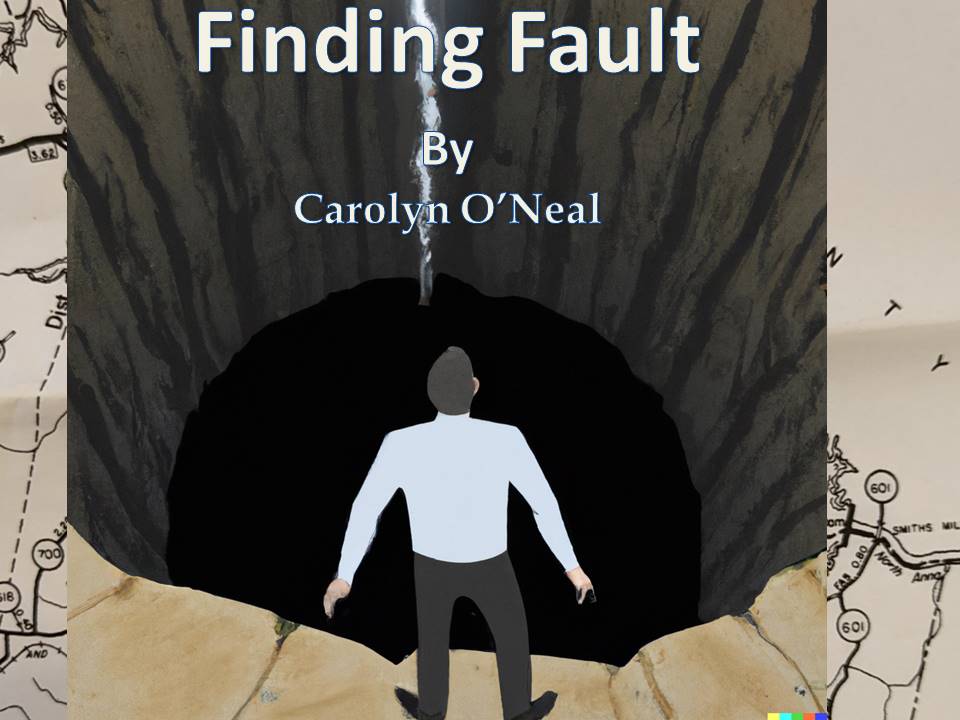
Tentatively entitled Finding Fault, the manuscript is currently in the hands of my Alpha reader and hopefully will soon be in the hands of several Beta readers.
What is an Alpha reader and what is a Beta reader? According to Reedsy.com, an Alpha reader is the first person who reads and provides feedback on the completed manuscript. Alphas are often spouses or close friends — in my case the Alpha reader is my husband.
In contrast, a Betareader is the author’s first test audience. You might say they are quality control at the earliest stage of the publishing process. Beta readers are not professional editors and usually read manuscripts for free. They aren’t friends or relatives, but they are people who have an interest in the genre or subject matter. They aren’t expected to polish the manuscript, yet they play an important role in helping the author improve her work by pointing out errors, plot holes, inconsistencies, or unclear passages. Often authors give Beta readers a few questions to help them provide feedback on the manuscript.
Here are a few suggestions for a nonfiction manuscript: Does each scene flow naturally into the next? Did you feel there were any areas that skipped over information? What’s your favorite part and why? Did you have a least favorite part? What is it and why?
K.M. Weiland of the Helping Writers Become Authors website suggests setting ground rules to guide the Beta reader: 1. Be Very Clear on what you are asking your Beta readers to do. Do you want them to simply read the book over and offer a general opinion at the end such as whether they like or dislike the manuscript? Do you want them to offer a running commentary on what works and what doesn’t? Do you want them to note typos? It is also incumbent upon the author to be clear about their wishes.
Nothing is worse for a Beta reader than spending weeks thoroughly editing a piece only to realize the author was hoping for something more lightweight.
2. How to Mark Suggested Changes Discuss the best way for the Beta reader to mark suggested changes in your manuscript. Track Changes is a good option as long as both parties have access to Microsoft Word. Another option is to put the manuscript into a Google Doc. Ask the Beta reader what works best for them.
3. Agree on a Reasonable Deadline This one is important for both the author and the Beta reader. Depending on the length of the manuscript (mine is currently about 70,000 words) and the depth of the edit, Beta reading can represent a significant time investment. Together the author and Beta reader should realistically assess how much time the Beta reader can put into the project. Set a date for the Beta reader to return manuscript with any mark ups or suggestions for the author. Be reasonable and flexible.
Bottom Line: Remember that most Beta readers are doing this because they love reading and are interested in the subject of your manuscript. Thank them for whatever contribution they make to your publishing process.
The date was Wednesday, March 20, 1974. The place was the Louisa County Courthouse. The event was a hearing to determine whether the geologic fault running beneath the nuclear reactors at the North Anna nuclear power plant was safe. The existence of a fault wasn’t in question. Neither was whether Vepco purposely hid the existence of the fault from the AEC and from the public for three years. At issue was the age of the fault and the likelihood that it was currently active (or could be reactivated) and could jeopardize the four proposed nuclear reactors enough to flood the surrounding cities, towns, and farms with radiation.
The three-man Atomic Energy Commission Safety and Licensing Board had set up the hearing in Louisa County to listen to testimony from Vepco personnel, paid experts, upset landowners, and concerned scientists. Neither Chairman John B. Farmokides nor the other two men on the board, R. B. Briggs, a nuclear safety engineer from Oak Ridge National Laboratory, and Lester Kornblith, Jr. an Atomic Energy Commission engineer, had any idea the hearing would go on for twelve long days when Chairman Farmokides called the hearing to order. (The Central Virginian, April 6, 1974, AEC Panel Concludes Twelve Day Hearing)
Most of those testifying were male. All three board members were male. All the Vepco personnel as well as their subcontractors were male. All the lawyers representing the AEC, Vepco, the state of Virginia, and the North Anna Environmental Coalition were male. It’s possible that on some days the only woman in the entire Courthouse was June Allen. Forty-two year old June Allen most embodied the North Anna Environmental Coalition yet it’s more than likely every man in the room thought she would soon give up. They probably thought she’d return to cooking or cleaning or whatever middle-aged women from Charlottesville did in 1974. What could one lone woman and a handful of cock-eyed environmentalists do to halt Vepco’s plans to build one of the largest nuclear power plant in the world? How could this middle-aged schoolmarm stand up to the combined might of the Atomic Energy Commission and largest taxpaying corporation in the state?
What neither Vepco nor the Atomic Energy Commission knew was that June Allen had never been content to watch injustice from the sidelines. She wasn’t about to scurry back to Charlottesville. What neither Vepco nor the Atomic Energy Commission knew was that June Allen had a history of advocating for the most vulnerable members of society against the most intractable foes.
Uphill battles & seemingly lost causes didn’t discourage June Allen. They spurred her on.
In the 1960 United States census, over one fifth of the population was living below the poverty line. In 1962, social critic Michael Harrington estimated there were between 40,000,000 and 50,000,000 relatively invisible poor people: Unskilled workers, migrant farm workers, minorities, people for whom work was sporadic, demeaning, and demoralizing. They were without adequate housing, education, and medical care. (American Social Policy in the 1960’s and 1970’s, by Jerry D. Marx, Ph.D., M.S.W., University of New Hampshire) Civil rights leader, Martin Luther King, Jr., explaining the cause of the 1965 riots in the Watts section of Los Angeles, focused on the poor in a land of plenty:
“I believe what happened in Los Angeles was of grave national significance. What we witnessed in the Watts area was the beginning of a stirring of a deprived people in a society who had been by-passed by the progress of the previous decade. I would minimize the racial significance and point to the fact that these were the rumblings of discontent from the ‘have-nots’ within the midst of an affluent society.”
(On 17 August 1965, Martin Luther King arrived in Los Angeles in the aftermath of the riots. His experiences over the next several days reinforced his growing conviction that the Southern Christian Leadership Conference (SCLC) should move north and lead a movement to address the growing problems facing black people in the nation’s urban areas. The Martin Luther King, Jr. Research and Education Institute, Stanford University)
In January 1964, President Lyndon Johnson declared “unconditional war” on poverty. As Johnson put it in his 1964 State of the Union address, “Our aim is not only to relieve the symptoms of poverty, but to cure it and, above all, to prevent it.” His efforts resulted in the Food Stamp Act of 1964, the Economic Opportunity Act of 1964 (which established the Job Corps, the VISTA program, the federal work-study program and a number of other initiatives), and, most importantly to millions of disadvantaged children, the Elementary and Secondary Education Act. (Washington Post, January 8, 2014, Everything you need to know about the war on poverty By Dylan Matthews)
Title I of the Elementary and Secondary Education Act was created to distribute federal funds to school districts that had a high percentage of students from low-income families. It was designed to close the skills gap in reading, writing, and mathematics between children from low-income households who attend urban or rural school systems and children from the middle-class who attend suburban school systems. Title III of the Elementary and Secondary Education Act supported special education and became the basis of the Education of the Handicapped Act. (Elementary and Secondary Education Act of 1965 by Catherine A. Paul) School districts all over the country rushed to find educators and administrators capable of implementing the massive intricacies of the Elementary and Secondary Education Act.
In January 1966, June Allen became the first fulltime coordinator of Albemarle County’s Elementary and Secondary Education Act programs making her one of President Johnson’s unsung heroes of his war on poverty. Born in 1932, June Stone Allen was a native New Englander. She was Phi Beta Kappa from the University of Vermont. She had a Master’s Degree in Music Education from the University of Arizona and graduate work in English at Harvard. Before moving to Albemarle County, she taught high school English in Phoenix and Tucson, Arizona. She came to Charlottesville in 1963 when her husband, Dr. Phillip Allen, joined the University of Virginia medical school faculty. Before being recruited to implement President Johnson’s Elementary and Secondary Education Act in Albemarle County, Mrs. Allen taught music at the Trinity Program in Charlottesville and at Head Start. In 1965 she taped “Patterns in Music,” a series of fifth-grade music lessons for WCVE, the Richmond educational television station.
As the first fulltime coordinator of Albemarle County’s Elementary and Secondary Education Act programs, June Allen started several of Title I and Title III programs including “Summer Skills,” “Greenwood Grows,” “Prime Time,” and “Candid Classroom,” but it was in the two language programs she designed that her gifts as an educator shined: “Language Lift” and “SP-EAR”
“Language Lift” was designed to stimulate oral language and reasoning ability. The premise for this combination was that both were essential for success in reading, especially for disadvantaged children. The program was widely admired and was recognized by the Office of Education as “outstanding.” (There was no mention in the source article of whether the “Office of Education” was a local, statewide, or federal Department of Education.) Two reporters from the Charlottesville newspaper The Daily Progress won prizes in writing for their pieces about the “Language Lift” program.
Like “Language Lift,” the “SP-EAR” program was a joint effort between the city of Charlottesville and Albemarle County. “SP-EAR” focused on the “hearing handicapped and the speech impaired” with particular attention on oral language.
In 2021, Albemarle County has Title I programs in 6 elementary schools. Funds support reading and math instruction through teachers, teaching assistants, instructional materials, professional development, and program support for over 300 students in the county. (From Albemarle County Schools website https://www.k12albemarle.org/our-departments/instruction/title-i)
After years of fighting in President Johnson’s war on poverty, taking on Vepco must not have seemed nearly as daunting. A month before the Atomic Energy Commission’s Safety and Licensing Board hearing began, Richmond Times Dispatch reporter Jean Purcell interviewed June Allen. This same insightful reporter had interviewed Louisa County High School Councilor Mr. H. Spurgeon Moss as rising waters from the dammed North Anna River threatened to cut across his driveway and strand him in his home. As with her article about Mr. Moss, reporter Jean Purcell saw the David versus Goliath battle shaping up as another dedicated educator tangled with Vepco and their billion dollar nuclear power plant. Modern eyes may read Jean Purcell’s description of June Allen in the February, 1974 interview as too flowery, even condescending, but in 1974, one professional woman interviewing another professional woman was certainly a rarity in Virginia and perhaps a rarity throughout the world:
“Willowy and gentle, a poet and a musician, June Allen’s interest had been largely in the fields of music and language arts, and in developing language teaching techniques for disadvantaged children.
But she can be aggressive without being abrasive, courteous without taking on the qualities of a Uriah Heep. Her birth and upbringing in a puritanical environment in New England have fused in her a strong streak of what she considers the rightness of things.
Membership in Phi Beta Kappa attests her academic achievements. As a friend said of her recently, “I never cease to be amazed by her basic intelligence, her articulation and her smoothness.”
All those qualities have been useful—more than that, necessary—in her work with the North Anna Environmental Coalition to block construction of the power plant as it is now planned.
In preparation for a March 20 [1974] hearing on the safety of the North Anna site in light of the geologic fault, Mrs. Allen and others in the coalition are hard at work.
‘I think it is a matter of survival. I genuinely do. We are developing something that has the power to destroy us,’ she said.”
(Richmond Times Dispatch, February 25, 1974, Atomic Power Plant Foe is an Unlikely Adversary by Jean Purcell)
June Allen and the North Anna Environmental Coalition had reason to distrust Vepco. They had reason to be wary of the Atomic Energy Commission as the hearings began. Far too many voices echoed the sentiment that the AEC had already decided to support Vepco long before the hearings began. Rumors rippled through the Courthouse that the AEC would give Vepco permission to continue building the North Anna nuclear power plant regardless of what was uncovered regarding the earthquake fault under the nuclear reactors.
Author’s Note: I’ve found very few articles about June Allen and nothing on her life after leaving Virginia (other than her obituary). If you knew June Allen or any member of the North Anna Environmental Coalition, please leave a message below. I’d like to learn more.
Albemarle County, Virginia, is located about thirty miles west of Louisa County (site of the North Anna Nuclear Power Plant.) In the middle of the 726 square-mile county is Charlottesville and the University of Virginia. Albemarle County is where President Thomas Jefferson built his famous mansion Monticello, and President James Monroe built his less famous mansion Highland.
Headline image of two workmen atop the North Anna Dam courtesy of The Central Virginian Newspaper






 BACCA Literary