Categories
BACCA Writers

Frida Kahlo – Art and Artist

photograph of Frida Kahlo in traditional Mexican garb with a flower hair adornment, seated on a white floral bench against a green background with white flowers.
Frida on White Bench, New York (detail), 1939, Nickolas Muray (American, born Hungary, 1892–1965), Carbon pigment print. Private Collection ©️ Nickolas Muray Photo Archives, Licensed by Nickolas Muray Photo Archives

If you have the time and resources, I recommend exploring the haunting exhibit, Frida: Beyond the Myth, currently on offer at the Virginia Museum of Fine Arts in Richmond, Virginia. Open through September 28, 2025, this exhibit presents paintings, drawings and mixed-media art pieces by Frida Kahlo, as well as photographs of the artist taken by intimate friends and professional photographers, including Lola Alvarez Bravo, Imogen Cunningham, Julien Levy, Dora Maar, and Nickolas Muray. This thoughtfully constructed VMFA exhibit invited me to consider multiple questions about Kahlo’s work and life.

I’ve always found Frida Kahlo fascinating—inspiring in a difficult, even dark way. She found solace in her art, a respite from the excruciating, ever-present pain she endured after surviving a terrible, near-fatal bus accident. I’ve seen her work in person before, but this time her pain was outshined by her commitment to making art in spite of her pain, using whatever tools necessary to create from a reclined position on her bed post-surgery. Some might assume she was an artist because of her pain, but it’s clear that Frida Kahlo created through all the colors of her emotions—joy, rage, bliss, boredom, and pain. As much as pain is visible in her work, so are her passions, her preoccupations, and her love.

In Kahlo’s work, her own face is the most visible, repeated image, self exposure the most predominant theme. Not only did she incorporate her image into numerous works, but friends, family, lovers, and other artists were inspired to photograph her face as well. The many iterations of her own visage, the multiple versions of self that she propelled onto canvas or paper, or allowed to be captured in a photographer’s frame dominate this exhibit as well.

Kahlo-themed selfie station, Frida: Beyond the Myth Exhibit, VMFA

After seeing so many shades of expression, so many of her moods, it’s tempting to believe that I understand something about her. In the days after I explored this exhibit, however, I began to wonder if she really exposed her true self in these works of art. Had she surrendered herself to be the subject of art and disappeared into it? Or had she transformed herself into art outside of canvas and film? Early on, she adopted the practice of wearing traditional Tehuana clothing, braiding her hair, and adorning herself with Mesoamerican jewelry, essentially creating an intentional, stylized projection of herself that honored her Mexican heritage. Perhaps she was the art, and every photograph, every painting represented a brief, still-frame capture of the living art she had become.

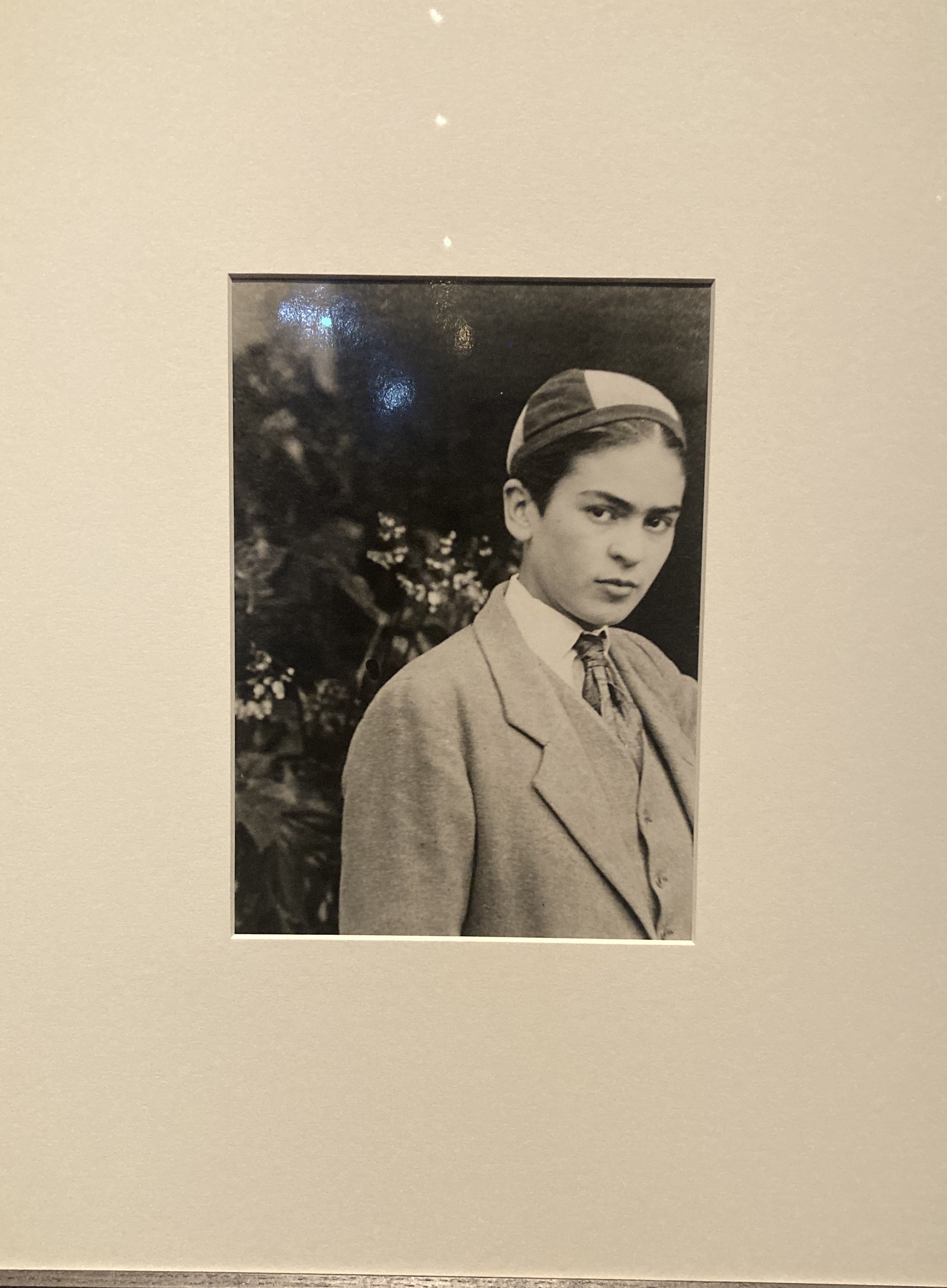
Frida Kahlo’s first photographer was Guillermo Kahlo, her father. The opening pieces in the Frida: Beyond the Myth exhibit are his photographs, in which she poses, sometimes solo, sometimes with others, dressed as a boy. It seems that Frida Kahlo learned early on to redress the power dynamic between artist and muse, creator and subject, by first taking on a persona—becoming art and then allowing herself to be framed.

Experiencing these works by Kahlo and others in person gave me so much to consider about what it means to create and live a full life as an artist. The thoughts I’ve shared here barely scratch the surface. Co-curated by Dr. Agustin Arteaga and Sue Canterbury, Frida: Beyond the Myth is showing at the VMFA in Richmond through September 28, 2025.


Noelle Beverly writes poetry and prose, supports local writers in the surrounding community, and is a member of the BACCA Literary group.

Categories
BACCA Writers

Good Tools: The Elegant No

The word "no" spelled out using pieces of jewelry.

Writers need to know how to say No. In creative (and other) circles, there are magic words that have power, carry weight, move us forward. They aren’t a secret; we know them well.

Please. Thank you. Tell me more. Yes. No.

More so than the others, Yes and No shape our lives. Our time, energy, and other resources flow according to when we say Yes and how often we say No. For some people, No seems easy, a default answer they were either equipped or born with. For some of us (me!), No is hard. Some of us are trained to be accommodating, to say Yes first and figure out how to follow through later—all so we can be liked and considered useful, so we can help out the collective. As I’ve gotten older, and my time tighter, this Yes-first strategy has become impossible. Always offering Yes in place of a necessary No threatens the integrity of the rest of my life: my creative work (the first to be cut for time), my relationships, and eventually my health. If I want to function well, the collective is going to have to do without me, at least some of the time.

Cobbling Together a No

So, how is it done? If you aren’t born with or taught No, how do you find one in yourself? How do you employ this important tool well? First, I have to know my own heart and what I really want. I have to have a realistic conception of my schedule and my capacity. I have to know if I even have the adequate skills to accomplish what is being asked of me. (I had a terrible job once, where I had to fail hard to prove to my manager that I really can’t decorate cakes. It’s simply not in me. Good—that’s something I don’t ever need to say Yes to in the future!) Even more importantly, I have to keep a firm grip on my creative goals. When I perpetually support the projects of others at the expense of my own, I become the most bitter and angry version of myself—and of no benefit to anyone. So, I’m finding No by gathering together some important pieces of myself: intuition, self-knowledge, realism, and sometimes my stubbornness, my ability to resist.

How to Say No: Travel Light.

Simple, elegant, sufficient, the word No carries enough weight all on its own. Tacking on elaborate explanations, pity parties, or a string of apologies weakens and bleeds No of its power and energy.

No is precise, clear. It’s a light ship that will get you quickly, cleanly on to what you need to do. If you begin to tack on extra cargo to NoI feel so bad, I wish, maybe—your streamlined conveyance to freedom gets weighed down, stuck in the muck. Or possibly waylaid, hijacked, commandeered to the land of unintentional Yes. No good. Best to keep it light, simple, and straightforward.

Hone the Skill

A safe, low stakes opportunity to employ the No tool is a rare find. Recently, I had this opportunity. From another room in my parents’ home, I heard my mother answer the door. After just a few seconds, I knew she wasn’t talking to a friend or neighbor, but a pushy solicitor trying to convince her that she needed home security. He was young, full of energy, and had obviously been trained to never take no for an answer. (I still pray he doesn’t carry that skill over into his personal relationships.)

My mother was trapped. He had no intention of releasing her from his well-rehearsed sales rhetoric. To let the young salesman know that he had not found easy prey, but, in fact, a very well-protected house, I stepped to my mother’s side. As he shifted his barrage of warnings and promises in my direction, I began wielding the magic word—No—over and over again. I used it politely and firmly. In a calm voice, I said No at least a dozen times. Somewhere in the middle of this volley, I realized I had a choice. I could steam up, get mad and rude with him, or I could seize a rare chance to practice. For the next few minutes, I said No until it felt natural, comfortable, easy—almost fun. The young man’s training held strong. In the end, I had to use an additional magic word to release all of us from the encounter.

“No. Goodbye,” I said, and shut the door.

My heart still beating quickly from doing new work, I looked at my mother and we both laughed. Then we moved on with the rest of our day! In retrospect, I would only do one thing differently. I would invite my mother to practice, too.

Magic words open doors. No might feel like a door slam, but it opens another door too, as long as we don’t get stuck on the threshold, feeling guilty, replaying what-ifs and imagined consequences for saying what we want. For the person who says it, No has a hidden Yes on its obverse side. When I’ve said No to what I can’t or won’t do, I’ve said Yes to other wonderful things—time for discovery and rest, the opportunity to generate ideas and make good work—the treasures of a creative life.


Noelle Beverly writes poetry and prose, supports local writers in the surrounding community, and is a member of the BACCA Literary groupPhoto by author.

Categories
BACCA Writers

Worthy Work

by Noelle Beverly

A bookshelf of notebooks
a fraction of the notebooks I’ve filled with ponderings, queries, and ideas…

Why bother writing today? What is all this effort for? Why should I keep filling and making books?

These questions have been slinking in and curling up in my mind lately. In an era when it feels like all light and joy and freedom are getting speedily sucked out of this nation and the world, my insistence on making space for a creative practice seems frivolous and selfish, not to mention exhausting.

Still, I keep plodding on. Deadlines push me forward. A company of writer-friends, who encourage and commiserate, pull me through the jungle of doubt. And, on most days, I like what I do when I manage to do it. It feels better to make something than to wallow and worry.

I’m learning to be content with this—writing for my own satisfaction and delight. I would love to find a home for my books, perhaps an audience, but those goals can’t be the why of why I write. Right now, I don’t really have much extra time and energy to keep questing after an agent or publisher, but I’m trying not to let that stop me from moving my projects forward. I’ve found some inspiration for this predicament in an interesting place (or rather, time) …1925.

I’m fortunate to have an interesting day job working at a local history museum, and some colleagues and I recently put together an exhibit that looks back 100 years to 1925. Although the exhibit focuses on social life, the artifacts and stories we’re featuring point to a strong sub-theme: exuberant, irrepressible creative expression. One artifact in particular speaks to this: the Mayo Bass Scrapbook.

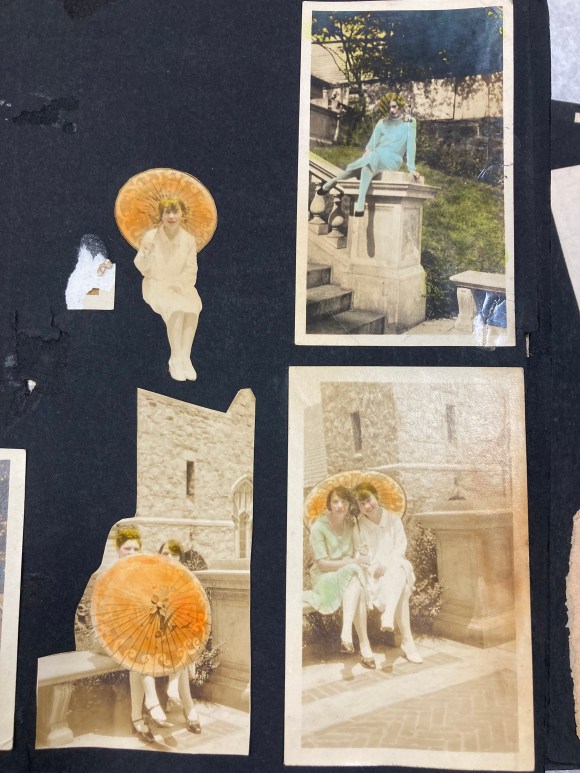
  • Scrapbook page from the 1920s with hand-tinted photos of a woman with a parasol
  • Scrapbook page from the 1920s, with stamps, cut out post marks, and a photo
  • Scrapbook page from the 1920s with notes and cut out images
  • Scrapbook page from the 1920s, including cigarette butts
  • a scrapbook page from the 1920s, including an image of a woman working a math problem on a chalkboard

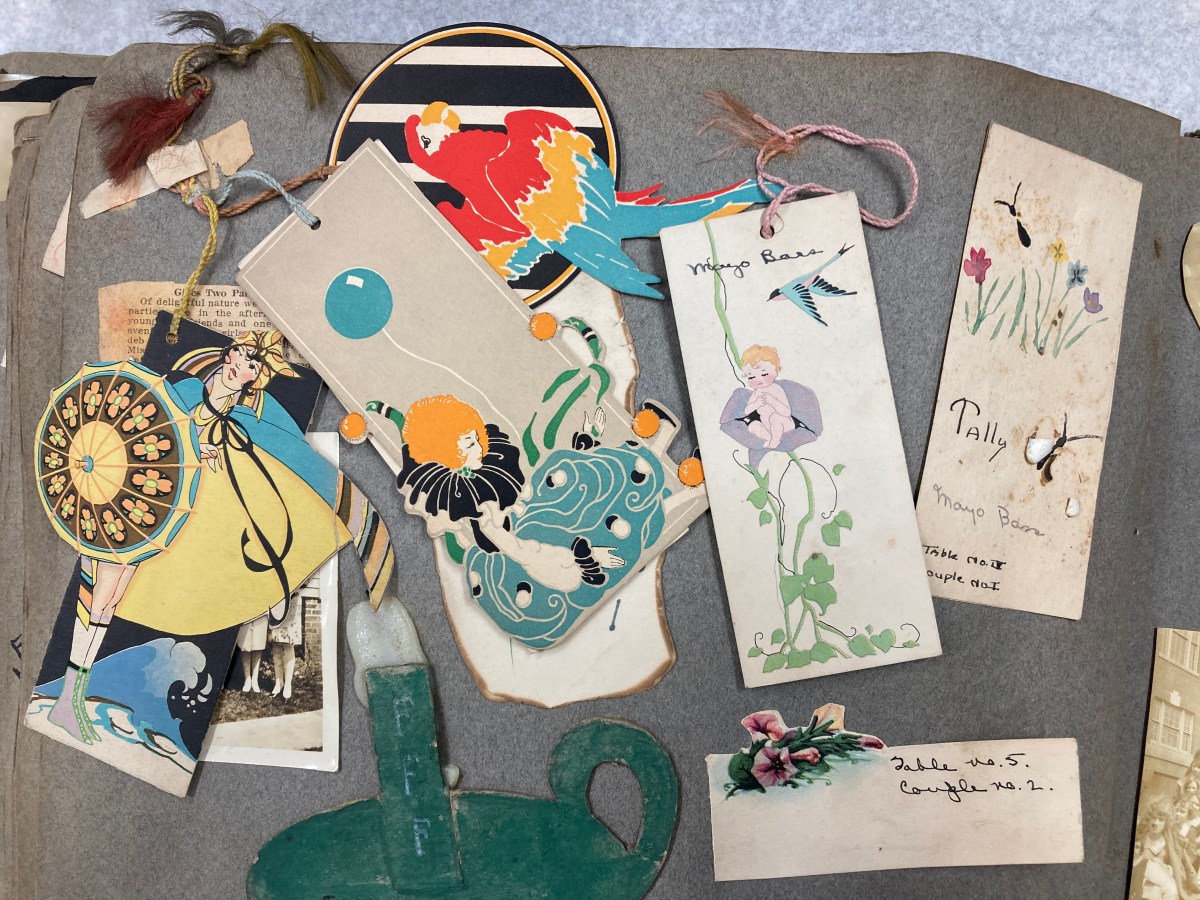
Lynchburg native, Mayo Leola Bass, was a young teenage girl still in high school when she began collecting the various papers and pieces that floated into her life and assembling those bits into a scrapbook. She mingled hand-tinted photographs with bright-colored bridge cards, programs, invitations, and party favors. She pasted letters and newspaper articles next to cut out post marks, and dance tickets. One page is filled with the stubs of cigarettes, with the name of each smoker carefully noted beside it. Comprised of ephemera—scraps literally intended to disappear—the scrapbook still has value and meaning 100 years later. It speaks.

The pieces Mayo Bass selected and saved could have just as easily ended up in the trash bin. I imagine someone might have even told her so. But she chose to save them and the result is remarkable. Pages and pages of seemingly inconsequential bits and pieces, which together add up to so much more—a provocative, funny, and informative record of a life. Thanks to this artifact, I feel like I know something about the young woman who created it, as well as the essence and flavor of that time she lived in and that place.

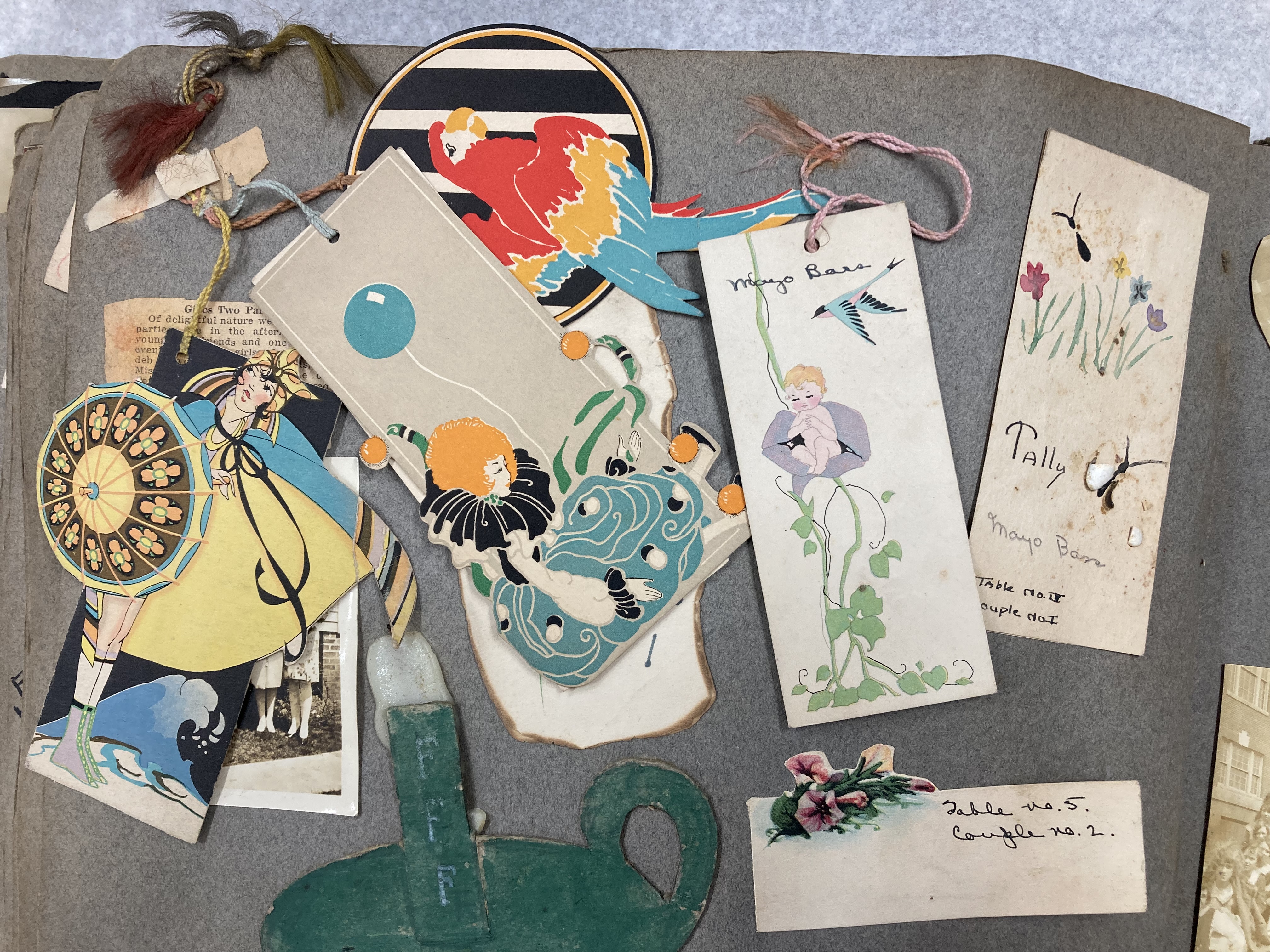
Mayo Bass Scrapbook page, featuring bridge cards and place cards.
A page from the Mayo Bass Scrapbook, ca. 1925, courtesy of the Lynchburg Museum

The Mayo Bass Scrapbook, in my opinion, is a piece of art as much as an historical artifact. It is an artfully made collage of the concerns and delights of a young woman living in the 1920s. My guess—Mayo Bass never dreamed anyone would see her creation that way. She likely made it solely for her own satisfaction. Perhaps, also for her daughters to peruse and enjoy one day. But for it to end up on display in a museum as the touchstone for an entire exhibit 100 years later? I bet she would have flicked the ash off her cigarette and laughed at the idea.

Mayo Bass didn’t know the future of her scrapbook or how it would be valued or perceived. This thought encourages me. It also encourages me to think of her cutting and pasting, creating an enchanting object, all just to suit herself. We don’t know the future of our creative work. But if one person finds delight in it, even if it is the artist herself, I think that’s enough. To make something beautiful, or provocative, or funny, even just to please ourselves, is worthy work.

The Mayo Bass Scrapbook will be on display at the Lynchburg Museum, 901 Court Street, through March 31, 2025.


Noelle Beverly writes poetry and prose, supports local writers in the surrounding community, and is a member of the BACCA Literary groupPhotos by author.

Categories
BACCA Writers

What Spooks a Writer?

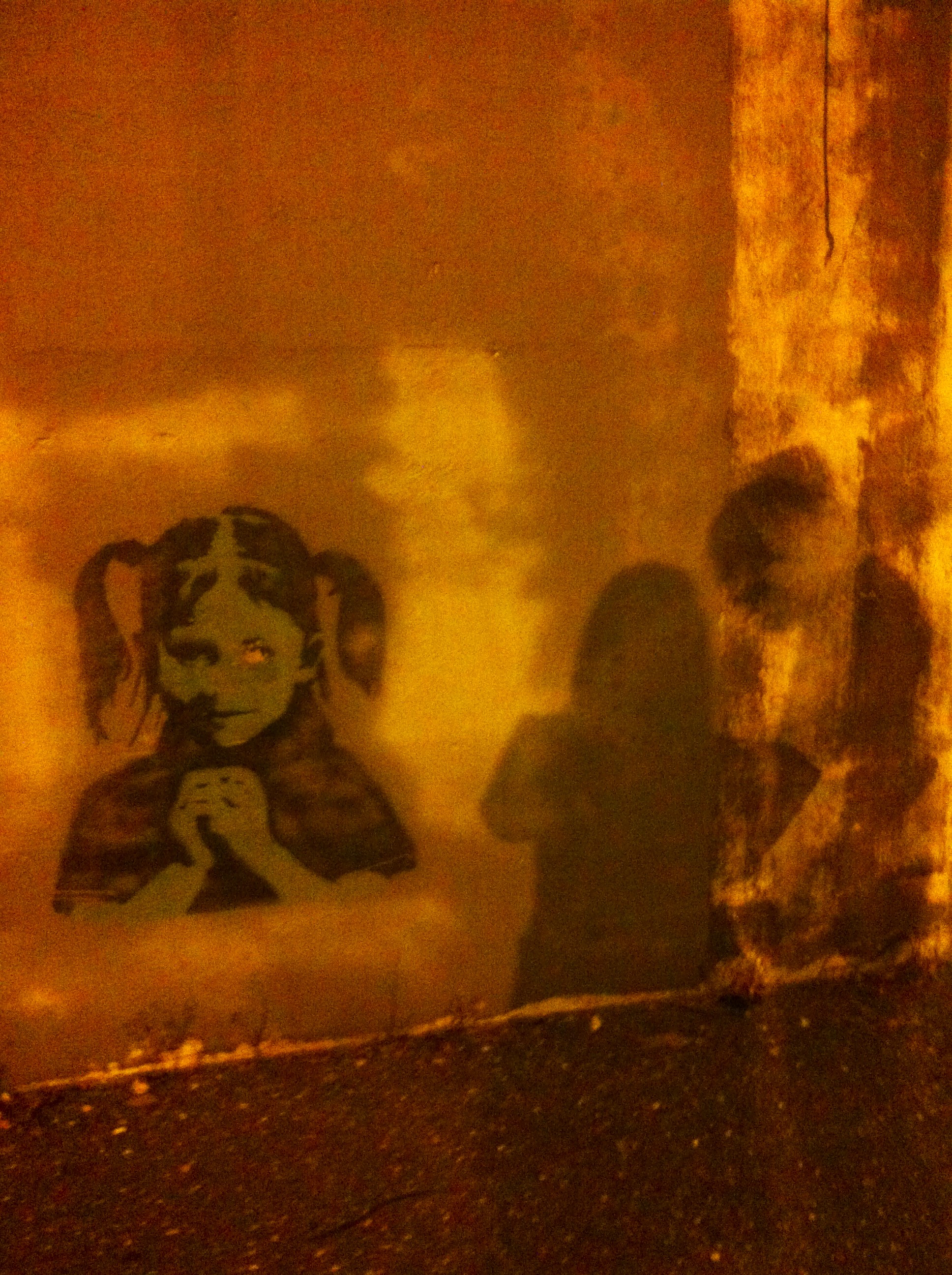
shadows and graffiti of a spooky girl with pigtails
Graffiti, shadows; Downtown Lynchburg; ca. 2018

It’s time to face my fears. There’s something about this time of year that inspires me to confront them—those monsters that are nipping at my ankles and threatening to tear apart my creative work.

When I think of the traditional fears that haunt and beleaguer writers, a few boogeymen jump to mind:

Fear of rejection. Fear of deadlines. Fear of the blank page.

Though formidable, for me these phenomena have lost their boo—not because I have extraordinary courage, but because I’ve had time to study them more closely.

At this point, after submitting my work and searching for agents for the last two decades, rejection is an old (annoying) acquaintance. It used to derail me, but now I find I’m inoculated to the word “no.” Rejection is unpleasant, but it can’t paralyze me anymore. After facing dozens and dozens of deadlines, I’ve learned that they’re tools for making progress. As I’ve explored here, even the ultimate deadline, death, can drive us to finish what we’ve started and meet our goals. As for the blank page, well, that’s where all my ideas are born. Anything can happen on a blank page, so now when I stare at a fresh sheet of paper I just feel excited.

Even though I’ve faced some fears, there are still a few things that scare me. It’s time to get out the flashlight and have a look at what’s lurking beneath the bed.

doorknocker with a face

Fear of The Knock at the Door

Time is the most contested of my resources. In this era of my life, interruptions, even emergencies, are a constant reality. If I want to produce anything, creative time has to be prioritized, pried out, and protected with ferocity. When I’m chasing down an elusive idea or image, any interruption, even a friendly one, can derail this somewhat fragile process. So, when I’m in my studio enjoying one of those rare hours that I’ve set aside for creative work, I find myself bracing for the knock at the door.

Fear of Godzilla’s little brother

I bet you know him, that kid on the playground that came along and kicked your tower down before you’d even finished building it. Writers are prone to this little monster, too. Sharing work before it’s ready is dangerous business. Feedback, if carefully crafted and delivered, is essential for writers. However, thoughtful critique is a very different creature from carelessly formed criticism. Godzilla’s little brother has no interest in helping you make your writing better, he just wants to topple your work mid-progress, flog your ideas before they’ve fully taken shape, and tear your project apart without taking any time to understand it.

Fear of Creativity Vampires

These folk can be hard to spot sometimes; they are very good with disguises. They might take the form of a family member, a friend, a coworker. But, there is a foolproof way to know if you have one in your life—after you spend time with a creativity vampire, you feel depleted and devoid of ideas. Your time, your energy, are spent fixing their problems, jumping to their aid, maybe even propping up their fragile egos. This time and energy (which could have been channeled into your creative work) flows in one direction only—straight to the vampire. If you need help or encouragement, you won’t get it from one of them.

a ripped sticker of two faces
Found art; Asheville; ca. 2022

Fear of The Poacher

Finding inspiration in another writer’s work is natural. Imitation can be a wonderful learning tool, but on occasion, I’ve encountered a person who takes it a step too far. This person is The Poacher—a person who lets someone else do the heavy lifting of creation and then reaps some of the rewards. They recognize a good idea, steal it, then make a quick replica and pass it off as their own. I identified my first Poacher in eighth grade art class after she ripped off the central governing idea of an image I’d been working on in my sketchbook. Looking at her “version” of my idea, I felt disappointed and deflated. Good ideas require time, energy, and often a unique point of view. Sure, there may be nothing new under the sun, but if you manage to generate something that feels fresh, seeing it immediately duplicated by someone else feels like a sucker punch or a theft.

Why Look for Monsters?

Well, now I can see what I’m fighting. Monsters that lurk in the dark often seem bigger than they really are. Shining a light on them brings clarity and definition. When I look over the list I’ve created, it’s clear that my fears all point back to the same problem—I need stronger boundaries around my creative work. I need to find ways to protect my time. I need to make sure that the people in my inner circle are trustworthy and respectful. Easy to say…much harder to do. Still, it feels better to know than to sit, afraid, in the dark.

Dangers to creative expression hunker in every corner. I might be vulnerable to some that others are not. Have you looked at what lurks in the shadows lately? What haunts you and your creative work?


Noelle Beverly writes poetry and prose, interprets local history at the Lynchburg Museum, and is a member of the BACCA Literary groupPhotos by author.

Categories
BACCA Writers

On Writing the Truth

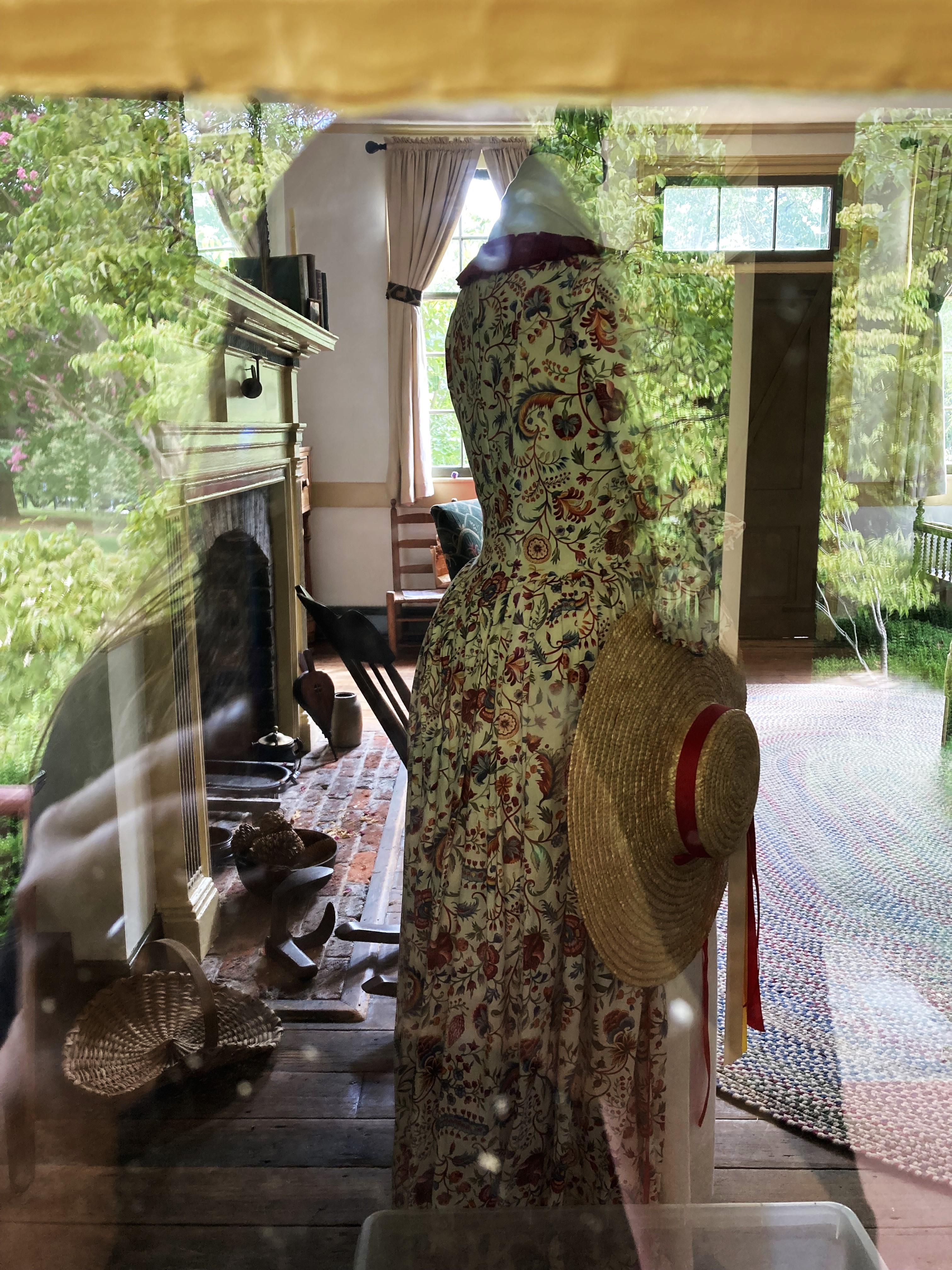
A layered image, looking through the window into the interior of a house built in the 1790s. Image shows interior view, reflection of outside, and silhouette of the photographer.
Creating layers… through the window of the Miller-Claytor House, the oldest surviving house in Lynchburg, built ca. 1790.

I never thought I’d enjoy being forced to write the truth. Fiction is my first love, and even within that genre, I especially love exploring the blurred edge between the real and the mythic. But I’ve been working for a museum and as part of that work, writing and telling true stories about people that lived, places that exist, events that unfolded. Even though there are limitations that come with sticking to the truth, I’m finding history writing to be a powerful way to communicate some of the themes I care about.

I’ve written here about the creative potential of form—how limits can push or propel a writer into a greater set of ideas, a more rigorous or intense result that full freedom might not have prompted. Writing to share history is something like writing within a form. There are parameters and a set of facts that cannot be embroidered or mislaid. But within those boundaries, and using some of the same skills I employ in my creative projects, I find so much potential.

Every story, true or not, is more effective if it achieves an arc: a provocative beginning, an intense middle, and a satisfying or stunning end. Interpreting history seems to be about finding the perfect arrangement of truths to achieve this shape. Without a shape holding them together, facts can be difficult to hold onto. In this process of arrangement, my perspective is essential. Every interpretation conveyed through a different storyteller is unique. Even while tethered to the truth, as I frame anecdotes, layer details, find connections, and create subtle shifts in focus, I make a story my own.

Finally, working with true stories is satisfying because I see it making a tangible difference. At the museum, we are committed to finding narratives that have been forgotten or written over, stories of the marginalized that, until lately, have remained untold. I’m seeing these stories reach an audience in real time as I give guided walking tours, or put together themed exhibits.

As much as I’ve enjoyed this experience, I’m not abandoning my first love. In fact, I’m longing to dive back into my own invented worlds now more than ever. While sharing history, I’m allowed to provoke but not predict. I can make connections between people or objects or places in the past, but I can’t leap forward and apply those connections to the precarious future.

To warn, to predict, to leap intuitively to what might come next—this is the purview of the poet, the inventor of worlds. There will always be a need to look at and learn from the past, but there is also the need for a different kind of storyteller, too, a need for those writers on the frontier, looking forward, bringing powerful truths back from what they foresee.


Noelle Beverly writes poetry and prose, interprets local history at the Lynchburg Museum, and is a member of the BACCA Literary groupPhoto by author.

Categories
BACCA Writers

2023: Balancing Time

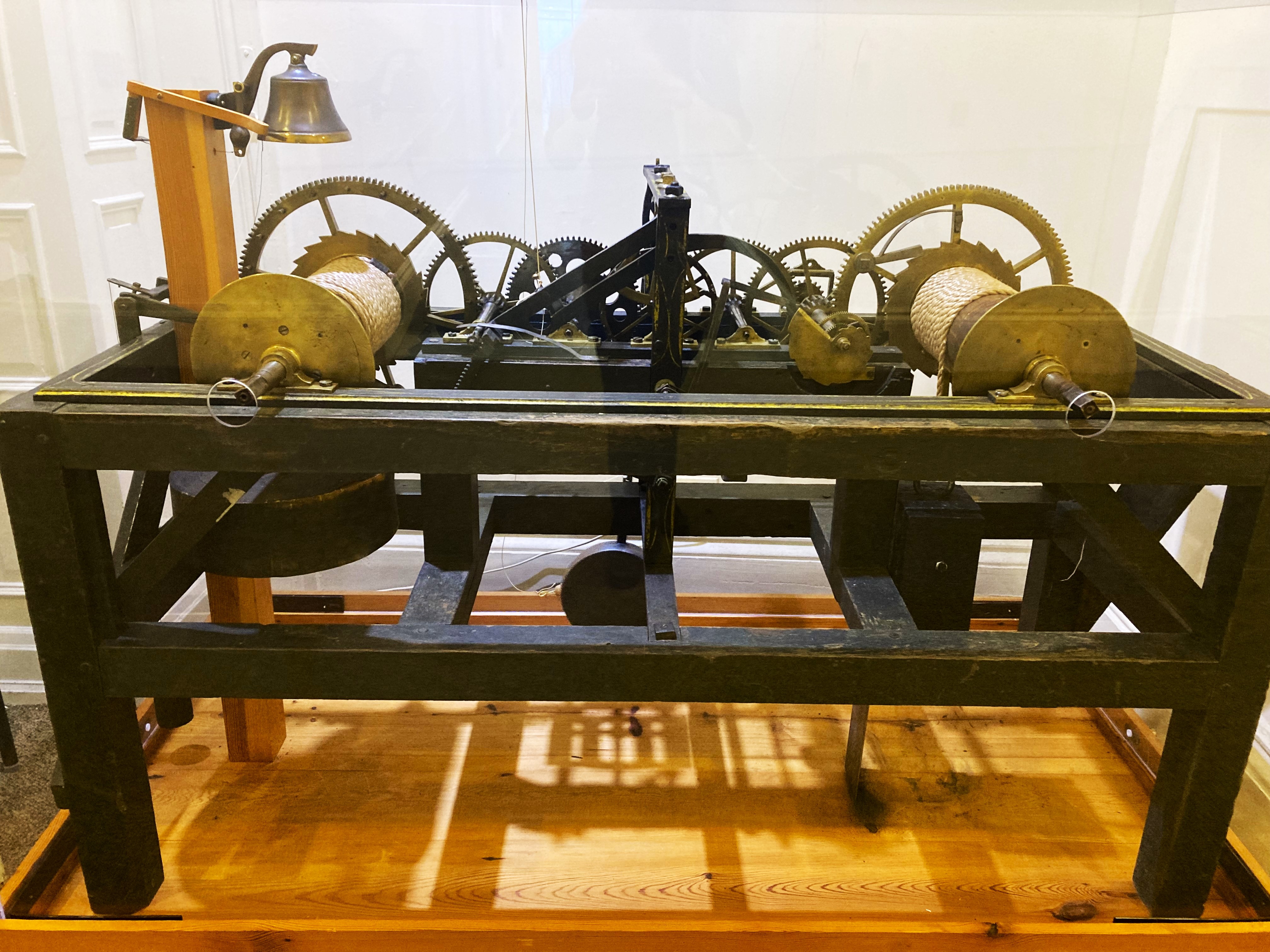
Inner workings of 1850s-era clock at the Old Court House in Lynchburg, Virginia.
Inner workings of 1850s-era clock at Old Court House, Lynchburg, Virginia.

Two tools have rescued me over and over this year: a timer and a notebook. Sometimes the simplest, most humble tools are also the most powerful.

Like just about everyone else, I’m taking inventory. 2023 is winding down; 2024 is about to start ticking away. Whether or not you subscribe to human constructs like calendars and clock time, late December is as good a time as any to assess and track what happened.

When I look back over the last year, especially with regard to my writing practice, I realize that the real challenge has been time. Balancing all the facets of my life—relationships, work, rest, exercise, and creative projects—has been much more difficult over the last 12 to 18 months. I’ve met most of my deadlines (eventually). I’ve created successful content for work, written important chapters for the end of my novel, and I even tried a few new things, like writing in a new genre. But there have also been flops and failures. Ideas that never got off the ground. Lackluster paragraphs and plot lines. Instances of neglect, when I didn’t live up to my promises. These are the moments that return to mind most often—especially in the wee hours.

I know that moving forward, however slowly, is the best recovery. Keep going and hone in on what’s working. It didn’t surprise me at all when I realized that the best creative tools I used this year also helped me to make good use of my time.

What can you do in an hour?

The first tool is very straightforward: set a timer and write for an hour. I learned this strategy from Jerry Seinfeld in his interview with Tim Ferriss. It sounds too simple—even inadequate. Creative work is made through dramatic power moves, right? Eureka moments and feverish all-nighters. Not necessarily. I was shocked to realize how many paragraphs and pages accumulated in just one hour of writing. If I could manage one hour of writing for three days in a row, or five, meeting a deadline suddenly became easy. Ideally, this hour would consist of sixty consecutive, uninterrupted minutes, but my life doesn’t work that way right now. So, if internal or external forces interrupted my work, I simply stopped the timer and then resumed as soon as I could.

I think that the time constraint is one reason this works. It introduces a sense of urgency, an energy, that can be very powerful. If I have all the time in the world (by some miracle), I will take all the time in the world, meandering through the writing process. Knowing I have only one hour helps me focus and get more done quickly.

I also used the timed-hour tool to set limits for certain projects: favors and side jobs, last-minute requests to rescue someone else from their procrastination-induced emergencies. I could easily lose oceans of time in situations like this. But if I limited this kind of work to an hour, I found that I met an obligation adequately enough without sacrificing too much of my own time.

A safe place for now…

The other powerful tool I used this year is an old friend: morning pages (from Julia Cameron’s The Artist’s Way). Cameron’s prescription is to start every day with three, handwritten pages, scribbled as quickly as possible. This practice is meant to flush out useless mind detritus and limber up language skills before the real writing begins. The writing that results from this has no expectations attached to it—it doesn’t need to be polished or brilliant. An added advantage: the notebook is always ready to receive (no warming up or turning on required), and it travels easily.

I’ve used the morning pages strategy for years and found it to be very effective—and versatile. It’s not just a trash pile for me, although I use it to still circular thoughts and sequester worries or guilt-inducing feelings. These notebooks have also become a sanctuary for wild exploration, brain storms, idea generation. Sometimes, I ask a question and keep writing until the answer inevitably comes. I record dreams in them and track changes in my mood, my health, my relationships. For my writing projects, I can use morning pages to work out narrative arcs, flesh out characters, identify themes and record bits of dialog that I’ll incorporate into chapters later. So, the morning pages notebook is a safe place to get a few things down quickly. A place where ideas can live—for now—until I find the time to polish and position them to the best advantage.

Finally, morning pages are a place where, without interruption or correction, I can fully express a thought, following it to full completion. How often do we have the chance to speak without being diverted, distracted, or otherwise cut off? How many good ideas, great lines, or amazing new projects have perished in that moment of interruption? Maybe we all need to create a safe space for those thoughts to grow and develop.

Are you looking back over 2023 and making plans for 2024? Have you tried something new in your creative practice that worked? Do you have strategies or tools that never let you down? In the final moments of this year and in the first moments of the next, I hope that we all find good tools and make time for our creative work. Cheers, and Happy New Year!


Noelle Beverly writes poetry and prose, supports local writers in the surrounding community, and is a member of the BACCA Literary group. Photo by the author.

Categories
BACCA Writers

Good Tools: The Lateral Leap

Silhouette of a child leaping.

Photo by @bedneyimages from Freepik

If I really want to make forward progress, I might have to move to the side. I don’t mean step aside, as in bow out or leave. I’m referring to a strategic lateral, or sideways, shift. Sometimes, I find I can change the limitations of my world with a strong leap—out of one way of thinking and into another.

You know those scenes in a movie where the protagonist is desperately trying to run away from some huge thing barreling behind him? A boulder, a train, a troll? Do you also find yourself yelling at that protagonist? Just jump to the side, for the love of all things good and holy, jump to the side!! Or is that just me? If dude would just think (while he’s running for his life) and make a quick leap to one side or the other, the huge thing would barrel on in its track. Big things don’t pivot easily or quickly—but we can!

For years now, I’ve thought of the lateral shift as one of the most powerful tools that any person can acquire and develop. It is the quickest and most joyful way to something fresh, original, unexpected. We have other terms for this. The epiphany. The eureka moment.

Sometimes these moments happen so quickly that we think it’s an accident, or a twist of fate, or divine intervention that brought us there. But our minds, I believe, love to leap. If we let them. I think kids do this naturally and all the time. They play with big ideas, allow them to collide together. They see endless potential in every facet of the world they encounter. They transform the everyday (cardboard box, abandoned shack, pretty rock) into powerful possibility (a ship, a mansion, a jewel). They do this for the sake of joy and play.

As we grow up, maybe we abandon this practice because we think we have to stay in our lanes, follow the prescribed track to the big prize. Pay our dues and all that. I don’t think we really forget, however, how important it is make the lateral leap. How often are we asked to “think out of the box” to come up with a solution? Yep, the lateral shift is so old that there are cliched phrases built around it and it’s so powerful and valued that we hear those phrases all the time.

Transformed wine cages.

Three ways of looking at a wine cage. Photo by author.

What does a lateral shift look like in practical terms? Never one thing—that’s the beauty of it. A lateral shift idea is often simple, but always fresh. Like opening a door that wasn’t there before. It might be finding an alternate use for an every day object. Finding a different route to the same old destination. Or using space in an innovative way. Or making use of a pocket of time that seemed empty or wasted before.

In a great narrative, the lateral leap is a twist so good that you never could have seen it coming the first time around. A regular twist might be that, out of all the suspects, the murderer is the most innocent-looking one. A really good twist (with some lateral work going on behind it) is that all the suspects collaborated to commit a crime—no one is innocent.

I think of it as an elegant swerve. A simple solution that no one thought of before because they were only thinking in one direction, with all of their prejudices and preconceived ideas left unchallenged.

I’ve been pursuing lateral thinking ever since I discovered the “two minute mystery,” a misnomer since solving one might take an afternoon unless you have at least one smart friend working on it with you.

A woman walks into a bar and asks for a glass of water. The bartender pulls out a gun. The woman says “thank you,” and leaves. What happened?

If you know, you know. The answer is the easiest thing. It’s just…getting there. It requires a leap to the side. (I don’t believe in offering spoilers or giving answers away, but if you want to work on this mystery with me, leave a comment below.) The solution to these puzzles often comes after you’ve been chipping away at it with yes or no questions for some time. But not as part of a logical progression forward (necessarily). It’s usually a little sideways leap that gets you there. A moment when you confront certain assumptions that you’ve been harboring—and decide to let them go so you can step into broader possibilities.

I’m honing my lateral thinking skills right now for the sake of my current protagonist—Vi, a brilliant 9 ½ -year-old, who lives in a house that is like a giant puzzle box. In some ways this story has been easy to write. I can hear the characters talking to each other, so dialog almost writes itself. Other scenes, where I have to get Vi into a part of the house that she’s never discovered before, are much more challenging. To help her find a secret corridor or hidden panel, I really have to labor. I have to think about architecture (not my field) and physics (also not). Then, I’m sweating…until I remember that maybe I could just leap.


Noelle Beverly writes poetry and prose, supports local writers in the surrounding community, and is a member of the BACCA Literary group.

Categories
BACCA Writers

Also Look for the Good

In critique, recognizing (and acknowledging) the strengths of a piece of writing might be as necessary as pointing out what needs work. I firmly believe that a truly useful critique has to offer a balance of both encouraging words and helpful suggestions. Tempting as it may be to jump straight into problem-solving mode when approaching another person’s work, openly appreciating what’s working well can have benefits for everyone involved.

In recent weeks, I’ve found myself in a critique situation (outside of BACCA), where, beyond a vague comment or two about beautiful writing, very little mention was made about the good aspects of what I had written. Since the meeting was with freelance clients, this situation left me in a bind. Had nothing I wrote really resonated? I had thoroughly researched my subject. I had spent an extensive amount of time and energy honing voice, tone, themes, and dramatic arcs. I had done the work and delivered it all on time. My clients even seemed positive about my work—in the abstract. When it came to specifics, though, they only spoke of renovation, not preservation.

It wasn’t that anyone present was harsh or mean—not at all. In fact, many of the suggestions they made were fair and all were delivered kindly. Still, the experience felt lopsided. So, I left that meeting feeling disappointed, exhausted, and more than a little confused about my next steps forward. If I had a clearer idea about what parts they appreciated maybe the changes they wanted wouldn’t have seemed like such a daunting task.

While there’s little I can do now about that experience, it did inspire me to compile a list of arguments in favor of looking for the good in a writer’s work. Who knows? Maybe it can help a reader or a writer in the future…

So. Why should we tell a writer what’s working well?

  1. FYI! Positive feedback lets the writer know that something good actually came across. Duh, Noelle. (I know.) But, seriously sometimes the writer doesn’t know for sure if something worked. We have ideas. We have a vision for what we’d like to convey. And, our big plans sometimes fail in the execution. Sometimes, a writer is too close to know for sure.
  2. For the future! Identifying good elements in a manuscript helps a writer hone in on the successful formal strategies they used and maybe increases the chances that they’ll use them again to create more good moments next time.
  3. For selfish reasons! Learning to recognize and articulate the particulars of fine writing helps the person doing the critiquing. At the very least, that person is perfecting important critical skills. If that person is creative, they may also identify something that could make their own work better.
  1. For preservation purposes! Telling a writer which parts of her work you liked means that she will probably keep them in subsequent drafts.
  1. For credibility! Warning: this one may polarize. In my view, if readers can’t come up with at least one positive, concrete comment about my work, I start to distrust their ability to analyze my work altogether. Either they didn’t put in the necessary time, or they don’t have the expertise to really offer a worthy critique, or (worst of all) they have an alternate agenda…usually one that’s based on boosting their own egos. I always think of that kid (we all knew one), who lurked around the classroom, waiting for someone to build a tower out of blocks so she could immediately knock it all to the ground. It’s important for readers to remember that it can take a very long time to build something—and mere seconds to tear it apart. Whatever the root reason might be, I grow suspicious when readers can’t see anything good. And, I usually decide that their opinions aren’t worth worrying about.

Likely, there are a hundred more reasons to let a writer know when she got it right…what do you think? Besides keeping writers off the ledge, are there other good arguments for offering words of encouragement in addition to our thoughtful suggestions in critique?

Noelle Beverly writes poetry and prose, supports local writers in the surrounding community, and is a member of the BACCA Literary groupPhoto by author.

Categories
BACCA Writers

Let Your Heart Be Light

I’m still looking for the sparkle in December this year—the Christmas spirit, the glisten, the glow. Back in July, I anticipated all the shiny parts of the holidays—baking cookies, decorating the tree, piling up silver-papered packages with red velvet bows—with excitement. I forgot, like always, that obligations double or triple this time of year, that the work-rest balance goes awry, and that by the time I get to the doorstep of Christmas, I’m feeling worn out.

Expectations (internal and external) are high—energy and time are low.

It doesn’t help that, for weeks now, my inbox has been flooded with promotional emails warning me that I’ve already waited until the very last minute for gift shopping. It also doesn’t help that here in Virginia, we’ve endured days and days of rain. (A few degrees colder, and we’d have piles of snow!) And, it really doesn’t help that I’m also feeling lackluster about my creative work right now. Rejections and deadlines never take a holiday. Also, it’s time to wrap up one project and start another—a transition I always find difficult to navigate gracefully.

It’s no coincidence that they come together, these dual doldrums. That magic-holiday-feeling that I’m missing is directly connected to my desire to create. So many of the little pleasures of this time of year are creative: singing, decorating, wrapping presents—even coming up with good gift ideas. I can’t expect to do any of these well when my creative reserves are low. But, if I nurture the creative energy, the writing and the merriment should both flow a little better.

In The Artist’s Way, Julia Cameron calls this process “filling the well.” She points out that all of us who want to create “must learn to be self-nourishing,” and to “consciously replenish our creative resources as we draw on them.” The process isn’t about duty, though, so populating a to-do list might not help. “In filling the well, think magic,” Cameron says. “Think delight. Think fun…think mystery, not mastery.”

I start small at first. Maybe I make something. Anything.

One good line. A cup of tea. A decent lunch.

Then I go outside, even in the rain. Gloomy light is better than no light.

This week, I found:

A glossy-brown leaf that looked like polished wood

A sprig of green moss

A slice of sunlight between banks of gray clouds

I found beauty, in other words. Seeing beauty helps and writing it down helps a little more.

Also, I try small steps forward, but with an attitude of delight. Today, I wrapped one gift as beautifully as I could. Progress.

I’ve landed somewhere between Holly Jolly and Blue this Christmas. I’m okay with it. There’s a song for that, too.

Noelle Beverly writes poetry and prose, supports local writers in the surrounding community, and is a member of the BACCA Literary group. Photos by author.

Categories
BACCA Writers

Memento Mori: Death as a Tool (For Writers)

Vanitas – Still Life (1625) by Pieter Claesz; Public domain, via Wikimedia Commons

Death is useful. The knowledge of our own end—and the end of all things—can be a catalyst for action. Writers like to make use of everything. Triumphs and setbacks, blows and banalities—almost all of the detritus of life can be used to make art. Everything is fertilizer and furniture for story. Even death. Maybe, especially death. If we let it help us to live.

The patterns and rituals of the day tend to sweep us along, and life, so much of the time, feels ordinary or even dull. To remind us that our lives are not endless even when they feel like it, we have the memento mori—a symbol that impels us to face death, to acknowledge and accept our mortality. From the Latin, memento mori literally means remember that you must die. Often represented as a skull, the memento mori can be a rendering of anything ephemeral; any image or object that evokes the passage of time can serve the same purpose: a candle, a flower, a sunset, an hourglass.

Time Flies. (Photo by the author.)

The origin of the memento mori has been traced back to ancient Rome. When a triumphant general embarked on a parade of victory, so the story goes, a slave would accompany him all the while whispering, memento mori, remember that you must die. A preventative measure, this was meant to guard against excessive pride so the victorious leader would not begin to believe that he was a god. In the centuries since, zealots and visionaries have used the memento mori, incorporating images of death into their art and sacred spaces, often as a hedge against vanity, greed, or idleness. (For a more thorough treatment of this history, visit here.)

Modern usage of the memento mori is more typically as a driver for action, a gentle reminder that we have a fixed number of minutes to finish a few things while we are here. “Remember, you must die,” then, is only half of the message. The unspoken conclusion, it could be argued, is “…so, remember to live.” In this light, knowledge of our mortality becomes a crowbar, or a portal into a better life. Sam Harris, in a bittersweet meditation entitled “The Last Time You’ll Do Something,” asserts that “everything represents a finite opportunity to savor your life.”

Besides the pen, the memento mori may then be the most transformative and useful tool that a writer can have, serving as a marker for our ultimate deadline—the day we run out of time entirely. Since a death date can’t be marked on a calendar for most of us, the memento mori teaches that death looms in every minute. Every day can and could be our last. So, if there’s something you’d like to try, do, make, write, or be…don’t wait.

Perhaps, as a sensitive and creative person, you are already acutely aware, thanks very much, of the impending doom and gloom. Maybe death is a constant obsession or fear. Maybe every time you face a Boggart, like Molly Weasley, you see a parade of your most cherished loved ones in deep peril. I get it. On a weekly basis, I struggle through that fear of loss, that terror of the unknown. The what-if, wide-awake-at-3-am panic usually leads to a deep sense of loneliness for me, and also inaction. Wheel spinning. Maybe the practice of the memento mori offers an alternative approach. Maybe it asks that we step back and view death from a different angle, one a bit more removed from the harrowing fear that the thought of death usually provokes.

For one, I think the memento mori connects us all as living things. The images themselves, the skull and the hourglass, point to the universal. We are the same at the bone level. We are all at the mercy of time. In that sense, we are not alone. Also, the memento mori is not meant to be a siren, screaming emergency, causing our hearts to bound. It’s more stately than that, a cordial invitation, of sorts, to an inevitable event that we’ll all attend at some point. We are invited to prepare and respond—to channel our gnawing fear into useful action—to survey and then to narrow in on what is most important. To work toward the priority we’ve assigned in our lives and to infuse the time we have with deep meaning and purpose.

Love it or not, the season of the skull is upon us. Halloween looms and visions of skeletons will dance before our eyes. Perhaps this year they can escort us back to the work we most want to do.

Phoebe Bridgers says (sings) it well…

“Baby, it’s Halloween
There’s a last time for everything
Oh, come on, man
We can be anything…”

…don’t miss the full song and video, featuring lovely vintage Halloween costumes, even a skeleton or two.

Noelle Beverly writes poetry and prose, supports local writers in the surrounding community, and is a member of the BACCA Literary group.