
Categories
Author: Carolyn O'Neal
Researching history of earthquake fault under the North Anna Nuclear Power Station in Louisa County and the people most affected by it, including Professor John W. Funkhouser, H. Spurgeon Moss, and June Allen. Please leave message on https://baccaliterary.com/carolyn-oneal/ if you have any information on this topic or these people. Thank you very much.




















Categories
A Year of Nonfiction

2023 was my year to explore nonfiction. I didn’t follow any particular map to my exploration – I just read whatever struck my fancy. Since I’ve been working on a nonfiction book about the discovery of an earthquake fault under a nuclear power plant, I was curious to see how other authors tackled scientific, historical, and emotional subjects. Some of the authors were objective and presented only the facts. By not injecting their opinions, they let readers draw their own conclusions. Others included their opinions and even their morality into their prose, swaying readers to see the author’s point of view. Some authors wrote about their methodology of research while others left those details to the footnotes. Here are some of the nonfiction books I enjoyed and a few thoughts about their stories and how they were presented. I highly recommend all of them:
Ron Chernow’s biography, Alexander Hamilton, should be required reading for all Americans, especially for those who saw Hamilton: An American Musical by Lin-Manuel Miranda. I saw the musical on the Disney Channel and found it enlightening, albeit a tad one-sided. While George Washington is praised for his insight and leadership, Jefferson and Madison are slightly shortchanged. After reading Chernow’s in-depth examination, the wonder isn’t that Alexander Hamilton was shot by Aaron Burr, but rather that he ever existed at all. To rise from the lowest of births to the right-hand man of George Washington while still in his twenties is a rags-to-riches story beyond anything Hans Christian Andersen could dream up. Chernow injects little of himself into this biography, letting the book sway readers and form their own opinions about Alexander Hamilton.
The Bomber Mafia by Malcolm Gladwell: It’s difficult to be objective about the bombing of civilians, and Gladwell doesn’t try to shield readers from the horrors. In The Bomber Mafia, Gladwell takes a close look at the small band of geniuses and moralists who challenged the Allied military strategy of mass bombing in World War II. Labeled the “Bomber Mafia,” they invented and proposed precision bombing techniques to save civilian lives. Sadly, their ideas were too farfetched (too ahead of their time) to be used in the 1940s. The deadliest night of World War II wasn’t the atomic bombing of Hiroshima or Nagasaki; it was the mass aerial bombing of Tokyo. Had the Bomber Mafia proposals been used, many lives in Tokyo might have been saved. Malcolm Gladwell is always a lively and relatable author who brings you right into his research and opinions. He doesn’t hold back on his feelings. He definitely gives his take on the 20th century tragedy of mass bombing.
The Soul of an Octopus by Sy Montgomery: This beautiful and spellbinding book should come with a warning to anyone who enjoys eating octopus because after reading Sy Montgomery’s “biography” of some of her octopus friends, you’ll never be able to eat these brilliant invertebrates again. For me, after reading The Soul of an Octopus, eating octopus or even squid feels akin to cannibalism. They have personalities, dreams, and hopes. They remember friends and can even warn their human companion of impending illness just by touch. Montgomery is the lifeblood of the narrative as she describes what it’s like to be touched and befriended by an octopus. She is an advocate for environmentalism and especially for marine life. There’s no objectivity here, and the results are perfect.
The Wager by David Grann is another book that should come with a warning. About halfway into the nonfiction, there is a visceral description of the disease scurvy. I promptly put oranges on my shopping list and took an extra Vitamin C. The story of the shipwreck of the British warship Wager not only tells of the bravery and foolishness of world exploration during the age of sails and wooden ships, but it also goes into how the shipwreck affected the British Royal Navy. Grann’s previous nonfiction is arguably my favorite book, Killers of the Flower Moon, which I read several years ago. As with Killers of the Flower Moon, Grann added a chapter or two about how he came upon the story of The Wager and about his research.
Avast yet matey!
Before ye sail any further let me warn ye!
There Be SPOILERS ahead!
Skip ahead if ye haven’t read Killers of the Flower Moon
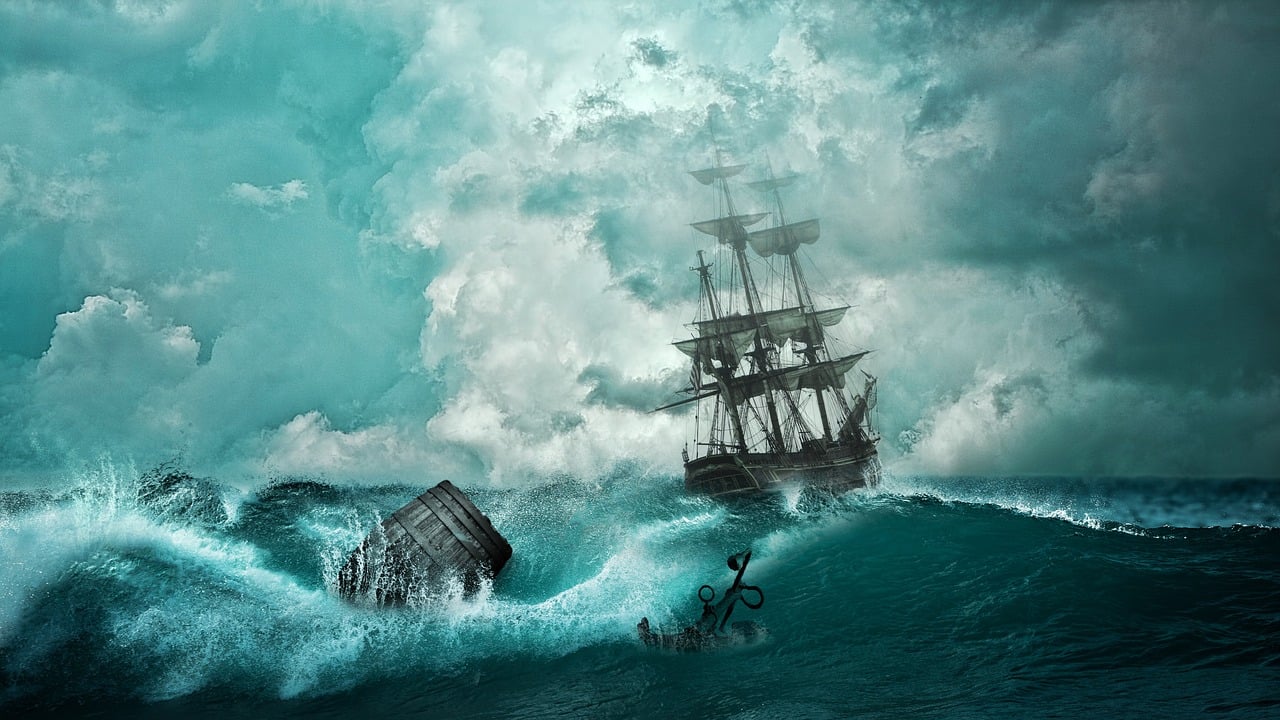
With overly high hopes, I went to see the movie version of Killers of the Flower Moon directed by Martin Scorsese and starring Leonardo DiCaprio and Robert DeNiro. Every reader knows the excitement of watching their favorite book on screen. I looked forward to watching the members of the Osage community reckon with the murder of their members and the heartbreaking betrayal when they discover the culprits were married to Osage daughters. I know movies seldom live up to expectations, and unfortunately, the movie version of my favorite book was particularly disappointing. In the book, the narrative centered on the distraught Osage women, but the movie chose to focus on the male killers. In doing so, my beloved book was turned into a sick love story. Even more frustrating was that the audience immediately learns the identity of the killers, so the mystery that propelled the book was lost.
End of the spoilers
Ye can come back aboard
As if the universe wanted to give me a reversal of my disappointment in with Killers of the Flower Moon, my favorite movie in 2023 prompted me to read the book it was based on. I went to see the movie Oppenheimer (twice) before reading American Prometheus, The Triumph and Tragedy of J. Robert Oppenheimer, written by Kai Bird and Martin J. Sherwin. The book is the perfect companion to the movie Oppenheimer directed by Christopher Noland and staring Cillian Murphy and Robert Downey, Jr. The book fleshes out some details without veering away from the basic theme of the movie. Oppenheimer was a moral genius. Any other time in history his genius might have been used to create safe renewable energy but in the era of Hitler, it was used for destruction. He was both the hero and villain of his own story, and the details in the book only enrich the time, place, and people. The authors keep their voices low as they tell the story of Dr. Oppenheimer, allowing the reader to decide how history should regard him.
The biography of J. Robert Oppenheimer as well as my own research into the nearby North Anna Nuclear Power Plant directed me to my next nonfiction: Chernobyl, The History of A Nuclear Catastrophe, by Serhii Plokhy. The author dives deep into the cultural as well as the engineering failures that created the Chernobyl disaster. Chernobyl wasn’t a widget factory in which if a line employee noticed something amiss and just shrugged it off there was no harm done. With an industrial site as complex and dangerous as a nuclear power plant, transparency and communication are essential, but neither existed at the Chernobyl power plant near Kiev, Ukraine. In the inflexible hierarchy created by the Soviet Union, no one dared point out a mistake for fear that drawing attention would land him in prison or worse. “Keep your head down” was the motto of the Soviet Union in April 1986. Say nothing. The Chernobyl nuclear disaster occurred in 1986, shortly after Mikhail Gorbachev became leader of the Soviet Union. The disaster had a direct impact on faith in the government and accelerated the collapse of the Soviet Union and Ukraine’s understandable mistrust of Moscow.
The newspapers in 2023 were full of articles about the war in Ukraine. The Chernobyl book brought home why Ukraine has felt betrayed by Moscow in the waning years of the Soviet Union but I wanted to learn more about the history of Russia and the Soviet Union. What better place to start than with the man who ruled the Soviet Union for half of its existence?
My journey into Soviet history began with Stalin, Volume One, Paradoxes of Power, 1878 – 1928, by Stephen Kotkin. What a fascinating enigma. A dark-haired Georgian born in obscurity, Ioseb Besarionis dze Jughashvili (he’d change his name to Joseph Vissarionovich Stalin) had to agree to study for the priesthood (Russian Orthodox) to receive any advanced education at all. He was a soft-spoken, relatively small man with a pockmarked face who walked with a limp. The brutality of the Tsar seemed to leave all Russians callous to the suffering of others and eager to make their lives minutely better. Lenin arrived on the doorstep of World War One and gave Russians a glimpse of life without the Tsar. His stirring speeches gave Russians a taste of delicious idealism. Lenin read Karl Marx the way Thomas Jefferson read John Locke – as true believers. Lenin’s death sent the nascent Soviet Union into the famous power struggle between Stalin and Trotsky. So famous, in fact, that it was satirized in the George Orwell classic Animal Farm with brutish Napoleon representing Stalin and thoughtful Snowball representing Trotsky. But Orwell fails to capture the political acumen of Stalin. He failed to capture Stalin’s initial openness and his devotion to Lenin and fellow communists. He failed to capture Stalin, the adroit politician who remembered names and birthdays and gathered loyal followers.
It took a full month for me to read the first volume of Stephen Kotkin’s Stalin biography but my interest in Soviet history wasn’t satiated. I was delighted when I learned that Kotkin had written a sequel. Like all my favorite nonfiction authors. Kotkin balanced the human story with historical detail.
Stalin, Volume 2, Waiting for Hitler, 1929-1941, also by Stephen Kotkin is the Stalin era that most of the world knows: the purges, the paranoia, and the mass graves. In his detailed biography, Kotkin gives the reader insight into Stalin’s rise to dictator and the chilling impact of his decisions on Russia and the world. Only Adolf Hitler could take the world’s eyes off the horrors of Stalin. While Hitler aimed his death camps at specific groups, Stalin was an equal opportunity murderer. Men and women from the highest levels of the Communist Party all the way down to the starving beggars of Ukraine and Georgia would fall into his mass graves. His insistence on the destruction of the peasant economy and replacing it with collectivization pitted neighbors against neighbors as poor peasants saw opportunities to take the wealth of slightly less poverty-stricken peasants. The standard byproduct of dictatorship is paranoia, and Stalin’s paranoia created the Great Terror that murdered millions and purged the Soviet Union of its most educated and experienced. The Great Terror came about largely because of Stalin’s cold and ruthless contempt for everything in Russia that existed before he ascended to power. The youth left alive were easier to mold into Stalin’s image.
Stephen Kotkin hasn’t completed Stalin Volume 3 but I look forward to its publication. He offers a complete and complex biography of Stalin and of the times he lived. Volume 2 devotes considerable time to the rise of Hitler and Stalin’s finagling to split Poland and stay out of World War Two. As I wait for Volume 3, I can’t help but compare the Russian Revolution to the American Revolution. What if Stalin hadn’t become a dictator? What might have the Soviet Union become? America flirted with monarchy when George Washington was elected President, with the army at his command. Washington could have easily become King of the United States. He didn’t. He resisted what so many others couldn’t – the siren call of power. Instead, Washington was the first to usher in the peaceful transfer of power in the United States. Stalin had to die for there to be a transfer of power in the Soviet Union and by then the precedent of cruel dictatorship was set. Considering what could have been in the Soviet Union is almost as heartbreaking as learning about what was.
I checked out one of the many Great Courses audiobooks from the local library, this one entitled From Yao to Mao: 5000 Years of Chinese History, presented by Professor Kenneth J. Hammond of New Mexico State University. Dr. Hammond’s lecture briefly touched on pre-history of China, including Peking Man (Homo erectus pekinensis) but the majority of the lectures were devoted to the eons of dynasties. The final lectures illuminated the western and Japanese mistreatment of China and the subsequent rise of Mao. Between Stalin, Hitler, and Mao, it’s amazing humanity survived.
Anyone who had read Ron Chernow’s biography of Alexander Hamilton should also read Thomas Jefferson, The Art of Power by Jon Meacham. Jefferson and Hamilton were two sides of the same coin. Both were completely devoted to the creation and defense of the United States, although their ideas on governing were vastly different. Both men devoured books, but while Hamilton was a famously flashy orator, Jefferson was a shy speaker. Jefferson saw Hamilton as dangerously enamored of the British system and public debt, while Hamilton saw Jefferson as an advocate of states’ rights at the expense of the federal government. Neither turned out to be true. Hamilton would never betray America to the British, and Jefferson expanded the national boundaries more than any other president in American history. Compared to Hamilton, Jefferson was born with a silver spoon in his mouth, but his life wasn’t without heartache. On her deathbed, his young wife asked him never to remarry, and he never did. Other than his wife, his most famous and perhaps his constant love interest was his wife’s enslaved half-sister, Sally Hemings. And by all accounts (including those of John and Abigail Adams), Hemings was both brilliant and beautiful. According to Mr. Meacham, when Jefferson went to Paris as the US Ambassador of France, he brought Hemings’ older brother James with him as his personal chef. A few years later, sixteen-year-old Hemings accompanied Jefferson’s daughter to Paris. Hemings lived with Jefferson in Paris for several years, and under French law, both Sally and her brother James could have petitioned for their freedom. Why didn’t they? That begs the question: what would they have done had they stayed in France? Their mother and siblings were in Virginia. They had no one to turn to in France, nowhere to live. Moreover, the French Revolution was beginning. The guillotines were chopping, and death filled the streets. Hemings took this opportunity to negotiate a deal with Jefferson. She would return with him to the United States if he promised to free her children when they turned 21.
There was more to Thomas Jefferson than his complicated relationship with Sally Hemings just as there was more to Alexander Hamilton than his tragic duel with Aaron Burr. I encourage everyone to take the time to read about both of these remarkable men.

I came away from my year of nonfiction with a new depth of knowledge and a renewed admiration for the authors who tackled these riveting subjects. I discovered there are many ways authors communicate their intentions as they write. In The Soul of an Octopus, Sy Montgomery’s journey of discovery let readers come close to this magician of the sea. The strong opinions held by Ukrainian Serhil Plokhy, the author of Chernobyl, The History of A Nuclear Catastrophe, ring loud and clear even though he is barely mentioned in the book. In the biographies of the famous and infamous – Hamilton, Jefferson, Oppenheimer, and Stalin – most readers already have strong opinions about these men before opening the books. 1
Ultimately, whether the authors include themselves in the narrative seems to depend on the subject matter. Unfamiliar subjects need more guidance from the author to provide the reader with a full understanding and satisfying reading experience.
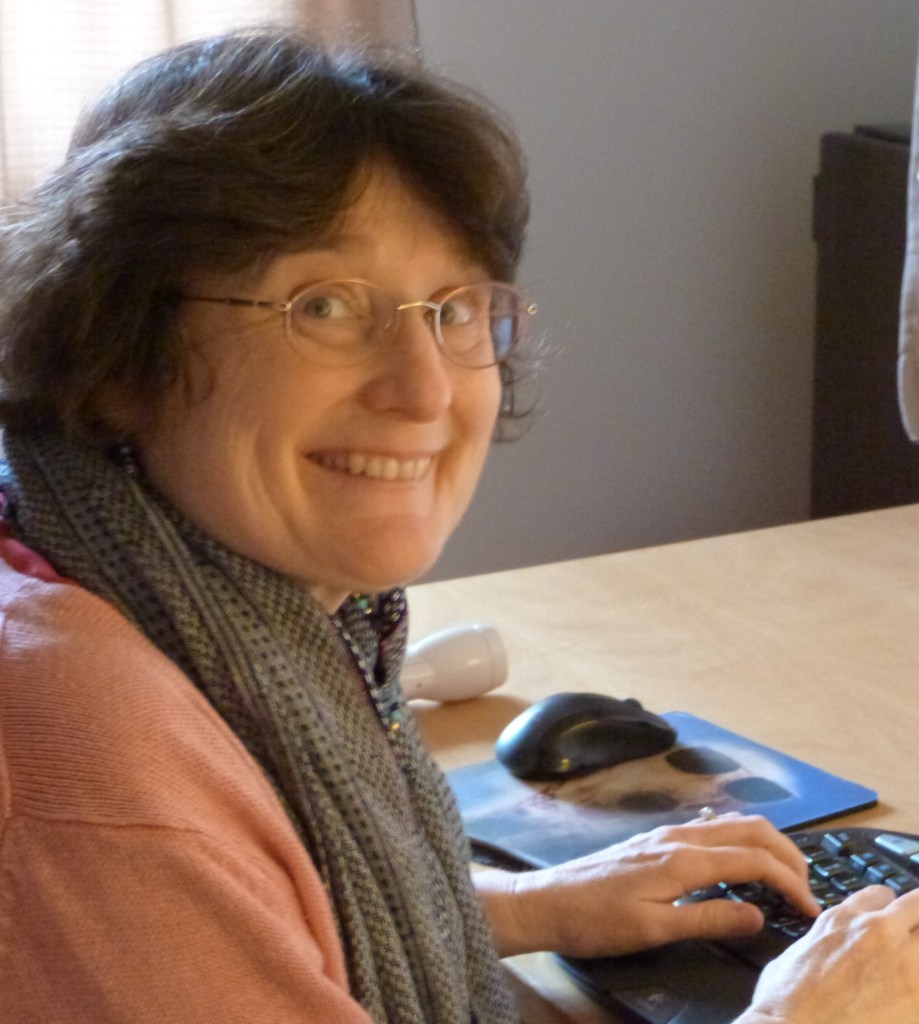
- Image of woman at table created by Carolyn O’Neal using Dall E

The Library of Virginia in Richmond celebrates two-hundred years of service this year. The on-line access to databases and eBooks offered by the library has been invaluable to my research. Newspaper articles provide facts and opinions from multiple points of view, the foundation of my narrative nonfiction.

If newspaper articles do the heavy lifting for my research about the discovery of the earthquake fault under the North Anna Nuclear Power Plant, the heart of this story comes from talking to the people who were there: interviewing people by phone or in person who knew the participants or saw the geology. I’ve had opportunities to speak to professional geologists who visited the North Anna. I’ve spoken friends of Dr. Funkhouser and to Mr. Moss’s daughter.
But arguably the most insightful interview I’ve ever conducted came about because two wonderful people shared stories about Doc Funkhouser with their daughter. They told her about the brilliant and colorful geology professor they knew in the early 1970s.
A few months ago, I received a message from a young woman who told me her parents knew both Dr. Funkhouser and the man convicted of murdering him. I immediately scheduled a lunch meeting with the young woman and her parents. The meeting was a windfall for my research. Both parents were well informed on the issues surrounding nuclear energy and had fabulously detailed memories of Doc and his murderer. Here’s the kicker. These wonderful people might never have seen my blog posts about North Anna or Dr. Funkhouser without their daughter. And their daughter wouldn’t have realized the significance of what she’d stumbled upon had they not told her stories of their youth.
Tell your stories! Share your history! Facts and opinion only go far in bringing the past to life. We need to hear it from the people who were there!

Categories
Beta Readers Wanted
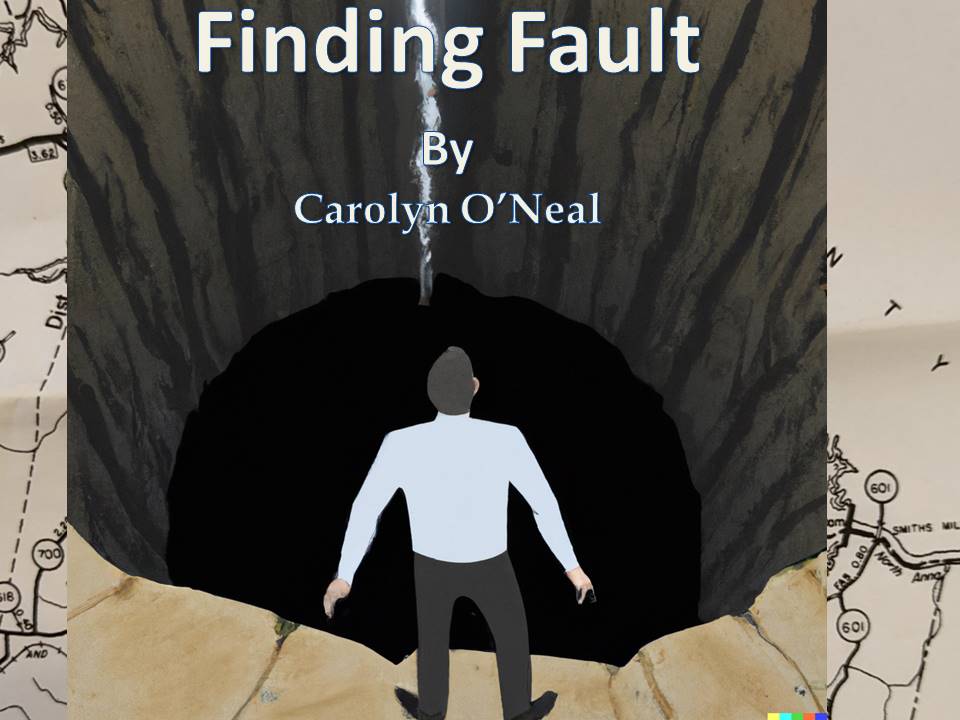
After years of research. After running chapter after chapter through the critiques at BACCA Literary. After switching back and forth between Microsoft Word and Scrivener. After all of that the first draft of my narrative nonfiction about John W. Funkhouser, H. Spurgeon Moss, June Allen and the discovery of the earthquake fault running under the North Anna Nuclear Power Plant in Louisa County, Virginia is finally finished.
Tentatively entitled Finding Fault, the manuscript is currently in the hands of my Alpha reader and hopefully will soon be in the hands of several Beta readers.

What is an Alpha reader and what is a Beta reader?
According to Reedsy.com, an Alpha reader is the first person who reads and provides feedback on the completed manuscript. Alphas are often spouses or close friends — in my case the Alpha reader is my husband.
In contrast, a Beta reader is the author’s first test audience. You might say they are quality control at the earliest stage of the publishing process. Beta readers are not professional editors and usually read manuscripts for free. They aren’t friends or relatives, but they are people who have an interest in the genre or subject matter. They aren’t expected to polish the manuscript, yet they play an important role in helping the author improve her work by pointing out errors, plot holes, inconsistencies, or unclear passages. Often authors give Beta readers a few questions to help them provide feedback on the manuscript.
Here are a few suggestions for a nonfiction manuscript:
Does each scene flow naturally into the next?
Did you feel there were any areas that skipped over information?
What’s your favorite part and why?
Did you have a least favorite part? What is it and why?
K.M. Weiland of the Helping Writers Become Authors website suggests setting ground rules to guide the Beta reader:
1. Be Very Clear on what you are asking your Beta readers to do.
Do you want them to simply read the book over and offer a general opinion at the end such as whether they like or dislike the manuscript?
Do you want them to offer a running commentary on what works and what doesn’t?
Do you want them to note typos?
It is also incumbent upon the author to be clear about their wishes.
Nothing is worse for a Beta reader than spending weeks thoroughly editing a piece only to realize the author was hoping for something more lightweight.

2. How to Mark Suggested Changes
Discuss the best way for the Beta reader to mark suggested changes in your manuscript. Track Changes is a good option as long as both parties have access to Microsoft Word. Another option is to put the manuscript into a Google Doc. Ask the Beta reader what works best for them.
3. Agree on a Reasonable Deadline
This one is important for both the author and the Beta reader. Depending on the length of the manuscript (mine is currently about 70,000 words) and the depth of the edit, Beta reading can represent a significant time investment. Together the author and Beta reader should realistically assess how much time the Beta reader can put into the project. Set a date for the Beta reader to return manuscript with any mark ups or suggestions for the author. Be reasonable and flexible.
Bottom Line: Remember that most Beta readers are doing this because they love reading and are interested in the subject of your manuscript. Thank them for whatever contribution they make to your publishing process.

Interested in being a Beta reader for Finding Fault manuscript? Leave a reply below and I’ll get back to you.
The wonders and threats of Artificial Intelligence have been part of the public imagination since the very first science fiction stories. HAL from 2001: A Space Odyssey to DATA on Star Trek: The Next Generation
I had a chance to play around with DALL·E 2, the internet program that creates “original, realistic images and art from a text description. It can combine concepts, attributes, and styles.
DALL·E 2 has learned the relationship between images and the text used to describe them. It uses a process called ‘diffusion,’ which starts with a pattern of random dots and gradually alters that pattern towards an image when it recognizes specific aspects of that image.”
Here’s the link to DALL·E 2 :

Sign up is free.
After you have an account and login


I typed in the command “Impressionistic painting of a female author writing on a wooden desk in a field of crimson clover with rainbow overhead”
Here’s what DALL·E 2 produced:

Impressive!
Will A.I. replace artists? Musicians? Can a program write the great American novel? Is any creative endeavor safe from A.I.?


Only time will tell.
A few more of my Dall E creations for your enjoyment.


Categories
Embrace Rejection

Here it is, mid-October, and many young people are struggling with their first semester of college. Struggling an dare I say, panicking. The drop/add deadline has passed. Students are sure they won’t make an ‘A’ in all of their classes. They are terrified that one or two bad grades will ruin their GPA. Will ruin their career. Will ruin their lives….

Instead of destroying your health, happiness, and sanity chasing the perfect grade, I suggest you embrace one or two bad grades
– even failures –
They are learning opportunities!
Embrace rejection.
What seems like catastrophe can actually be freeing.
Back when I started college I had the notion that I should become a nurse. Why? I don’t know. There were no nurses in my family, but I figured that’s what women do. They become nurses. As I recall, my older brother told me I wasn’t smart enough to become a doctor so I should become a nurse. (Hey, give him a break, it was the ’70s!)
I had done quite well in high school. Honor roll. Golden tassel. My first summer after graduating from high school, I wanted to get a jump on academics so I took a college statistics class. I passed. More than passed, I got an ‘A’. I liked statistics. I thought it was pretty interesting. I thought “if this is nursing, this is going to be great.” The next semester I took the usual bachelor degree first year classes: English, history, whatever. All A’s.
I struggled with biology. Probably because I don’t have the best memory and never took Latin. But I passed and finished they year with a good GPA.
The next year was hell. I was thrown into hospital situations. I worked with a mentally ill veteran who didn’t act mentally ill until he started talking about being stalked by the Pope. Working the maternity rotation is why I waited until my mid-30s before my son was born. All that screaming! All that yuck!
I watched an experienced nurse insert a urine catheter into a female patient and tell me it was easier on male patients. I never wanted to find out.
I gave shots during my pediatric rotation. I was terrible at it. That poor kid. Traumatized for life, no doubt. And forget drawing blood. I could never draw blood. I was terrible at everything. I even got fussed at while helping a kid brush his teeth. That’s how awkward I was.

But the final straw – the nail on the coffin, as it were – was when they sent me off to do community nursing. This was before GPS. Before cell phones. I have a terrible sense of direction and I hated those huge road maps they sold at gas stations. They were too big and folded in weird ways. The patient I was sent to visit lived on the other side of the Hampton Roads Bridge Tunnel in Newport News. My task was simple. Drive to her home and check on her status. She was an elderly diabetic with a recent amputation. I was supposed to examine the amputation site and report my findings.
I got lost. Of course. My inner self saying “you don’t want to go there.” Hours later, I finally arrived and the patient tells me that the school had been calling and calling, wondering where I was. I talked to the lady and I never inspected her amputation site. I just ask her how she is doing. She said fine and I left as quickly as I could.
The next day the head of the nursing department called me in to her office. “You don’t have your heart in this, do you?”
“Absolutely not.”
I hated yuck. Don’t get me wrong, I’m fine with dirt but not fine with vomit. Or poop. Or blood. Or puss. I thanked the head of the department and never looked back. I switched majors and ended up a computer programmer.
Now I keep bees and I write and I am eternally grateful to the head of the nursing department for being honest and rejecting me because I didn’t have the courage to say “I’m quitting.”


My research of Virginia in the 1960s and 1970s almost entirely depends on local newspapers. I am investigating the impact of the discovery of an earthquake fault under the North Anna Nuclear Power Plant in central Virginia on the man who discovered it, on local farmers who lost their land to the project, and on the nuclear power industry in the United States.
Nothing beyond the most meager facts about the power plant in rural Louisa County, Virginia can be found on Wikipedia. Nothing can be found on Twitter or Facebook or any of the plethora of social media sites that have materialized faster than lawsuits in our endlessly litigious world.
That’s why I am extremely grateful to Louisa County’s own local newspaper, The Central Virginian, for not only articles about the origins of the North Anna Nuclear Power Plant but also their vivid photos that capture the enormous scale and impact of the project.

Archives of The Central Virginian aren’t online, at least not for the years I was investigating, 1968 to 1975. I called the Louisa County Public Library and learned that the library had The Central Virginian newspapers neatly organized by year, bound in thick books, and stored in their easily accessible stacks. They aren’t on microfilm like The Daily Progress, the Charlottesville local newspaper. I actually had to open the large bound books and inspect page after page of The Central Virginian to find what I needed. I’d take a photo of the article or image and email it to myself. Once home, I transcribed the article or copied the image for use in my research.
As my research grew, I developed a fondness to certain reporters who took the time to interview the property owners affected by the construction of the nuclear power plant. I felt like I shared a common interest with these reporters, especially one particular reporter who worked for the larger regional newspaper, The Richmond Times-Dispatch. Jean Purcell worked the Louisa County beat for the Richmond Times-Dispatch and dug deep into the lives of the people who lived there. Farmers and teachers and politicians, she interviewed them all. She reported on the announcement of the nuclear power plant construction, on the people that lost their farms to the project, and the controversies surrounding the discovery of the earthquake fault under the power plant site. Then, all of a sudden, her articles stopped. I was heartbroken. I had lost a wise and dependable friend. I searched for her name on the web and discovered she’d retired and became involved with other activities. Ms. Purcell has since passed but I was able to find one of her children on Facebook and send them a message to tell them how much I greatly admired their mother’s reporting.
The demise of local and regional newspapers is a huge loss for current society and future historians. Too many of us get our news from TV pundits, Twitter provocateurs, or Facebook friends. Where will future historians go to discover the small current events that ripple out and change history?
Categories
The Witchcraft of Older Women

Today is Sunday.
Regardless of what day you’re reading this on I’m writing it on a Sunday. I know it’s Sunday because I just took my alendronate sodium pill. That’s what my husband calls my “bone pill.” I have osteoporosis. I take my “bone pill” once a week, first thing in the morning. I’m not supposed to eat for 30 minutes after taking the pill and I’m not supposed to lie down. I usually take my dog for a walk.

I’m not even that old, but as Indiana Jones said, “It’s not the years, honey, it’s the mileage.”
I’m a cancer survivor and a brain aneurysm survivor so it’s not too surprising I need a pill to keep my skeleton from crumbling under me. It’s just one of the pills I take. Most of them are vitamins. I tend to forget whether I’ve taken them or not so now I have the truest badge of old age – a multi-day pill container.

I’ll blame it on writing. Writers, just like all creative people, lose track of time. And days. And weeks. And years. So now I have a pill container to help me keep track, but I still couldn’t tell you how long I’ve been working on my latest writing project. Four years? Five years? I can’t remember. Maybe I need a multi-year pill container for my writing projects.
The last time my writing group met we talked about how history and the media- books, movies, even YouTube – have stereotyped older women. The witch, the crone, the “Karen.” These are women who society sees as troublesome. They are past their usefulness and a menace to society. At least they’re not burned at the stake anymore.
Fortunately today’s older women have role models that help us reject and defy these negative stereotypes: Ruth Bader Ginsburg, Angela Merkel, Katherine Johnson.

But I wonder how these ancient stereotypes – dare I say archetypes – began? Why is the witch old and ugly? Why is the crone thin and grey? Why is the “Karen” hated more than the worst criminals?
According to scientists there are only three mammal species that experience menopause. Humans, killer whales and pilot whales.

These three intelligent species share more than menopause. They share close relationships with family and friends, with children and grandchildren. But it’s their relatively long lifespan that really sets them apart. Post-menopausal females teach and nurture the next generation. Since no more energy need be spent on having babies, they can use their time and energy on their daughters’ offspring. The older women have forfeited their ability to reproduce so they can help their grandchildren survive. This is known as the ‘grandmother hypotheses.’ (source NPR)
Consider how antiquity looked at the life changes a woman goes through:
The young girl is bright and inquisitive. She is daring and can outrun most of the boys. She is often stronger and bigger that the boys. She can fight them easily and chase them away. Then…

The boys are bigger than her. The same boys who use to chase her and lose now can chase her and win. Life is so unfair. The boys are gaining ground, moving ahead, exploring the world.
Consider the new mother. She can’t spend her time philosophizing. She can’t spend her time exploring. Every waking moment must be spent on one thing: the baby. How to take care of it, how to keep it alive. Keep it healthy. Protect it, make it strong. Make sure it has all its needs. The new mother can seem dull witted because she is sleep deprived. She has one obsession, her child.
Here is where the Grandmother Hypothesis blooms. Who steps in to let the young mother sleep? Who loves her baby as much as she does? Who can help her raise this young individual to become a healthy member of society? Because what is a civilization without children who have been protected and nurtured and trained and taught by their mothers, grandmothers, aunts, and sisters?

Finally, after many years of toil, she no longer needs to run away from boys because they are no long chasing her. Her children are grown and her skin and hair shows her age.
But something magical overcomes her. She no longer has to prepare for her monthly cycle (I won’t go into what menstruation was like before the conveniences of modern sanitation) and she can do whatever she wants without worry of pregnancy or monthly pain. That must have seen like magic. She can hike a mountain or swim a lake anytime.
But most of all….
She finally has time to think. She has time to philosophize and seek the wisdom of the universe. Menopause gives her freedom and throughout the history of mankind, including right now in the Ukraine, freedom is a radical idea.


The date was Wednesday, March 20, 1974. The place was the Louisa County Courthouse. The event was a hearing to determine whether the geologic fault running beneath the nuclear reactors at the North Anna nuclear power plant was safe. The existence of a fault wasn’t in question. Neither was whether Vepco purposely hid the existence of the fault from the AEC and from the public for three years. At issue was the age of the fault and the likelihood that it was currently active (or could be reactivated) and could jeopardize the four proposed nuclear reactors enough to flood the surrounding cities, towns, and farms with radiation.
The three-man Atomic Energy Commission Safety and Licensing Board had set up the hearing in Louisa County to listen to testimony from Vepco personnel, paid experts, upset landowners, and concerned scientists. Neither Chairman John B. Farmokides nor the other two men on the board, R. B. Briggs, a nuclear safety engineer from Oak Ridge National Laboratory, and Lester Kornblith, Jr. an Atomic Energy Commission engineer, had any idea the hearing would go on for twelve long days when Chairman Farmokides called the hearing to order. (The Central Virginian, April 6, 1974, AEC Panel Concludes Twelve Day Hearing)
Most of those testifying were male. All three board members were male. All the Vepco personnel as well as their subcontractors were male. All the lawyers representing the AEC, Vepco, the state of Virginia, and the North Anna Environmental Coalition were male. It’s possible that on some days the only woman in the entire Courthouse was June Allen. Forty-two year old June Allen most embodied the North Anna Environmental Coalition yet it’s more than likely every man in the room thought she would soon give up. They probably thought she’d return to cooking or cleaning or whatever middle-aged women from Charlottesville did in 1974. What could one lone woman and a handful of cock-eyed environmentalists do to halt Vepco’s plans to build one of the largest nuclear power plant in the world? How could this middle-aged schoolmarm stand up to the combined might of the Atomic Energy Commission and largest taxpaying corporation in the state?
What neither Vepco nor the Atomic Energy Commission knew was that June Allen had never been content to watch injustice from the sidelines. She wasn’t about to scurry back to Charlottesville. What neither Vepco nor the Atomic Energy Commission knew was that June Allen had a history of advocating for the most vulnerable members of society against the most intractable foes.
Uphill battles & seemingly lost causes didn’t discourage June Allen. They spurred her on.

In the 1960 United States census, over one fifth of the population was living below the poverty line. In 1962, social critic Michael Harrington estimated there were between 40,000,000 and 50,000,000 relatively invisible poor people: Unskilled workers, migrant farm workers, minorities, people for whom work was sporadic, demeaning, and demoralizing. They were without adequate housing, education, and medical care. (American Social Policy in the 1960’s and 1970’s, by Jerry D. Marx, Ph.D., M.S.W., University of New Hampshire) Civil rights leader, Martin Luther King, Jr., explaining the cause of the 1965 riots in the Watts section of Los Angeles, focused on the poor in a land of plenty:
“I believe what happened in Los Angeles was of grave national significance. What we witnessed in the Watts area was the beginning of a stirring of a deprived people in a society who had been by-passed by the progress of the previous decade. I would minimize the racial significance and point to the fact that these were the rumblings of discontent from the ‘have-nots’ within the midst of an affluent society.”
(On 17 August 1965, Martin Luther King arrived in Los Angeles in the aftermath of the riots. His experiences over the next several days reinforced his growing conviction that the Southern Christian Leadership Conference (SCLC) should move north and lead a movement to address the growing problems facing black people in the nation’s urban areas. The Martin Luther King, Jr. Research and Education Institute, Stanford University)
In January 1964, President Lyndon Johnson declared “unconditional war” on poverty. As Johnson put it in his 1964 State of the Union address, “Our aim is not only to relieve the symptoms of poverty, but to cure it and, above all, to prevent it.” His efforts resulted in the Food Stamp Act of 1964, the Economic Opportunity Act of 1964 (which established the Job Corps, the VISTA program, the federal work-study program and a number of other initiatives), and, most importantly to millions of disadvantaged children, the Elementary and Secondary Education Act. (Washington Post, January 8, 2014, Everything you need to know about the war on poverty By Dylan Matthews)
Title I of the Elementary and Secondary Education Act was created to distribute federal funds to school districts that had a high percentage of students from low-income families. It was designed to close the skills gap in reading, writing, and mathematics between children from low-income households who attend urban or rural school systems and children from the middle-class who attend suburban school systems. Title III of the Elementary and Secondary Education Act supported special education and became the basis of the Education of the Handicapped Act. (Elementary and Secondary Education Act of 1965 by Catherine A. Paul) School districts all over the country rushed to find educators and administrators capable of implementing the massive intricacies of the Elementary and Secondary Education Act.
In January 1966, June Allen became the first fulltime coordinator of Albemarle County’s Elementary and Secondary Education Act programs making her one of President Johnson’s unsung heroes of his war on poverty. Born in 1932, June Stone Allen was a native New Englander. She was Phi Beta Kappa from the University of Vermont. She had a Master’s Degree in Music Education from the University of Arizona and graduate work in English at Harvard. Before moving to Albemarle County, she taught high school English in Phoenix and Tucson, Arizona. She came to Charlottesville in 1963 when her husband, Dr. Phillip Allen, joined the University of Virginia medical school faculty. Before being recruited to implement President Johnson’s Elementary and Secondary Education Act in Albemarle County, Mrs. Allen taught music at the Trinity Program in Charlottesville and at Head Start. In 1965 she taped “Patterns in Music,” a series of fifth-grade music lessons for WCVE, the Richmond educational television station.
As the first fulltime coordinator of Albemarle County’s Elementary and Secondary Education Act programs, June Allen started several of Title I and Title III programs including “Summer Skills,” “Greenwood Grows,” “Prime Time,” and “Candid Classroom,” but it was in the two language programs she designed that her gifts as an educator shined: “Language Lift” and “SP-EAR”
“Language Lift” was designed to stimulate oral language and reasoning ability. The premise for this combination was that both were essential for success in reading, especially for disadvantaged children. The program was widely admired and was recognized by the Office of Education as “outstanding.” (There was no mention in the source article of whether the “Office of Education” was a local, statewide, or federal Department of Education.) Two reporters from the Charlottesville newspaper The Daily Progress won prizes in writing for their pieces about the “Language Lift” program.
Like “Language Lift,” the “SP-EAR” program was a joint effort between the city of Charlottesville and Albemarle County. “SP-EAR” focused on the “hearing handicapped and the speech impaired” with particular attention on oral language.
In 2021, Albemarle County has Title I programs in 6 elementary schools. Funds support reading and math instruction through teachers, teaching assistants, instructional materials, professional development, and program support for over 300 students in the county. (From Albemarle County Schools website https://www.k12albemarle.org/our-departments/instruction/title-i)
After years of fighting in President Johnson’s war on poverty, taking on Vepco must not have seemed nearly as daunting. A month before the Atomic Energy Commission’s Safety and Licensing Board hearing began, Richmond Times Dispatch reporter Jean Purcell interviewed June Allen. This same insightful reporter had interviewed Louisa County High School Councilor Mr. H. Spurgeon Moss as rising waters from the dammed North Anna River threatened to cut across his driveway and strand him in his home. As with her article about Mr. Moss, reporter Jean Purcell saw the David versus Goliath battle shaping up as another dedicated educator tangled with Vepco and their billion dollar nuclear power plant. Modern eyes may read Jean Purcell’s description of June Allen in the February, 1974 interview as too flowery, even condescending, but in 1974, one professional woman interviewing another professional woman was certainly a rarity in Virginia and perhaps a rarity throughout the world:
“Willowy and gentle, a poet and a musician, June Allen’s interest had been largely in the fields of music and language arts, and in developing language teaching techniques for disadvantaged children.
But she can be aggressive without being abrasive, courteous without taking on the qualities of a Uriah Heep. Her birth and upbringing in a puritanical environment in New England have fused in her a strong streak of what she considers the rightness of things.
Membership in Phi Beta Kappa attests her academic achievements. As a friend said of her recently, “I never cease to be amazed by her basic intelligence, her articulation and her smoothness.”
All those qualities have been useful—more than that, necessary—in her work with the North Anna Environmental Coalition to block construction of the power plant as it is now planned.
In preparation for a March 20 [1974] hearing on the safety of the North Anna site in light of the geologic fault, Mrs. Allen and others in the coalition are hard at work.
‘I think it is a matter of survival. I genuinely do. We are developing something that has the power to destroy us,’ she said.”
(Richmond Times Dispatch, February 25, 1974, Atomic Power Plant Foe is an Unlikely Adversary by Jean Purcell)
June Allen and the North Anna Environmental Coalition had reason to distrust Vepco. They had reason to be wary of the Atomic Energy Commission as the hearings began. Far too many voices echoed the sentiment that the AEC had already decided to support Vepco long before the hearings began. Rumors rippled through the Courthouse that the AEC would give Vepco permission to continue building the North Anna nuclear power plant regardless of what was uncovered regarding the earthquake fault under the nuclear reactors.
Author’s Note: I’ve found very few articles about June Allen and nothing on her life after leaving Virginia (other than her obituary). If you knew June Allen or any member of the North Anna Environmental Coalition, please leave a message below. I’d like to learn more.
Albemarle County, Virginia, is located about thirty miles west of Louisa County (site of the North Anna Nuclear Power Plant.) In the middle of the 726 square-mile county is Charlottesville and the University of Virginia. Albemarle County is where President Thomas Jefferson built his famous mansion Monticello, and President James Monroe built his less famous mansion Highland.
Headline image of two workmen atop the North Anna Dam courtesy of The Central Virginian Newspaper
Categories
Putting the pieces together

My sister is an excellent quilter. She knows everything about quilting, from presser foots* to Prairie points**. In her sewing room are drawers of needles and sewing machine equipment, organizers full of measuring rulers of every shape and size (straight, triangle, curved), and bookcases of quilting books and magazines.
And fabric.
Lots and lots of fabric. She has fabric with tight patterns of flora and fauna. She has fabric with large panels of complete images. Majestic mountains, smiling sunrises, slumbering moonbeams. She has fabric in every imaginable color and hue. Go to her “green” drawer and she can find anything she might need to add a touch of nature to a quilt. Shamrocks, leaves, frogs. The same with her yellow, red, and blue drawers. She and I often visit fabric stores to add to her collection. Cottonwood in Charlottesville is my favorite fabric store. She’s partial to Patchwork Plus in Dayton.

Recently, she’s begun teaching me how to quilt.
She began by giving me a task that made me comfortable with the tools of quilting. The sewing machine, the iron, and the rotary cutter (a sharp, round blade attached to a handle, looks like a pizza cutter).

Putting together the pieces of a story isn’t very different from putting together the pieces of a quilt. The best way to start is with a strong and thoughtful mentor. I began my work as a serious writer by taking a Creative Writing Class at Writer House in Charlottesville. My teacher was David Ronka. Like my sister, he was both patient and instructive.
After you find your mentor, gather your tools and build up a supply of the bits and pieces to create your story. Characters, setting, plot. Beginning, middle, and end. The basic framework and the personal touches. You’re not going to use all the bits and pieces. Some will be thrown out. Some bits will be tucked away for a later project. Patience, creativity, and love.
Especially love.
Just like with quilting, if you don’t love the project you are working on, if it doesn’t give you both satisfaction and challenge, you’ll give up before it’s finished. Find the love.

Definitions:
* presser foots: The removable sewing machine accessory that holds fabric in place against the machine bed and accommodates the needle. A variety of presser feet styles are available for most machines.
** Prairie points: Folded fabric triangles used as a quilt border or embellishment.

