
2023 was my year to explore nonfiction. I didn’t follow any particular map to my exploration – I just read whatever struck my fancy. Since I’ve been working on a nonfiction book about the discovery of an earthquake fault under a nuclear power plant, I was curious to see how other authors tackled scientific, historical, and emotional subjects. Some of the authors were objective and presented only the facts. By not injecting their opinions, they let readers draw their own conclusions. Others included their opinions and even their morality into their prose, swaying readers to see the author’s point of view. Some authors wrote about their methodology of research while others left those details to the footnotes. Here are some of the nonfiction books I enjoyed and a few thoughts about their stories and how they were presented. I highly recommend all of them:
Ron Chernow’s biography, Alexander Hamilton, should be required reading for all Americans, especially for those who saw Hamilton: An American Musical by Lin-Manuel Miranda. I saw the musical on the Disney Channel and found it enlightening, albeit a tad one-sided. While George Washington is praised for his insight and leadership, Jefferson and Madison are slightly shortchanged. After reading Chernow’s in-depth examination, the wonder isn’t that Alexander Hamilton was shot by Aaron Burr, but rather that he ever existed at all. To rise from the lowest of births to the right-hand man of George Washington while still in his twenties is a rags-to-riches story beyond anything Hans Christian Andersen could dream up. Chernow injects little of himself into this biography, letting the book sway readers and form their own opinions about Alexander Hamilton.
The Bomber Mafia by Malcolm Gladwell: It’s difficult to be objective about the bombing of civilians, and Gladwell doesn’t try to shield readers from the horrors. In The Bomber Mafia, Gladwell takes a close look at the small band of geniuses and moralists who challenged the Allied military strategy of mass bombing in World War II. Labeled the “Bomber Mafia,” they invented and proposed precision bombing techniques to save civilian lives. Sadly, their ideas were too farfetched (too ahead of their time) to be used in the 1940s. The deadliest night of World War II wasn’t the atomic bombing of Hiroshima or Nagasaki; it was the mass aerial bombing of Tokyo. Had the Bomber Mafia proposals been used, many lives in Tokyo might have been saved. Malcolm Gladwell is always a lively and relatable author who brings you right into his research and opinions. He doesn’t hold back on his feelings. He definitely gives his take on the 20th century tragedy of mass bombing.
The Soul of an Octopus by Sy Montgomery: This beautiful and spellbinding book should come with a warning to anyone who enjoys eating octopus because after reading Sy Montgomery’s “biography” of some of her octopus friends, you’ll never be able to eat these brilliant invertebrates again. For me, after reading The Soul of an Octopus, eating octopus or even squid feels akin to cannibalism. They have personalities, dreams, and hopes. They remember friends and can even warn their human companion of impending illness just by touch. Montgomery is the lifeblood of the narrative as she describes what it’s like to be touched and befriended by an octopus. She is an advocate for environmentalism and especially for marine life. There’s no objectivity here, and the results are perfect.
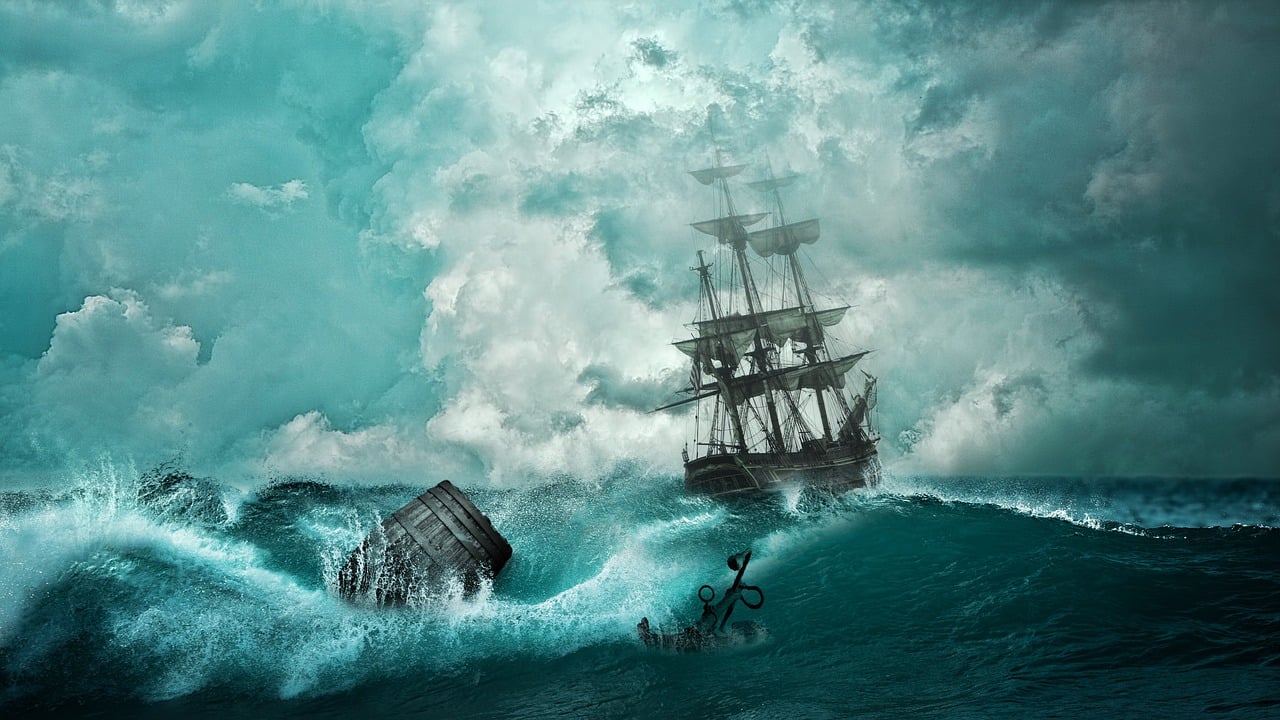
The Wager by David Grann is another book that should come with a warning. About halfway into the nonfiction, there is a visceral description of the disease scurvy. I promptly put oranges on my shopping list and took an extra Vitamin C. The story of the shipwreck of the British warship Wager not only tells of the bravery and foolishness of world exploration during the age of sails and wooden ships, but it also goes into how the shipwreck affected the British Royal Navy. Grann’s previous nonfiction is arguably my favorite book, Killers of the Flower Moon, which I read several years ago. As with Killers of the Flower Moon, Grann added a chapter or two about how he came upon the story of The Wager and about his research.
Avast yet matey!
Before ye sail any further let me warn ye!
There Be SPOILERS ahead!
Skip ahead if ye haven’t read Killers of the Flower Moon
With overly high hopes, I went to see the movie version of Killers of the Flower Moon directed by Martin Scorsese and starring Leonardo DiCaprio and Robert DeNiro. Every reader knows the excitement of watching their favorite book on screen. I looked forward to watching the members of the Osage community reckon with the murder of their members and the heartbreaking betrayal when they discover the culprits were married to Osage daughters. I know movies seldom live up to expectations, and unfortunately, the movie version of my favorite book was particularly disappointing. In the book, the narrative centered on the distraught Osage women, but the movie chose to focus on the male killers. In doing so, my beloved book was turned into a sick love story. Even more frustrating was that the audience immediately learns the identity of the killers, so the mystery that propelled the book was lost.
End of the spoilers
Ye can come back aboard
As if the universe wanted to give me a reversal of my disappointment in with Killers of the Flower Moon, my favorite movie in 2023 prompted me to read the book it was based on. I went to see the movie Oppenheimer (twice) before reading American Prometheus, The Triumph and Tragedy of J. Robert Oppenheimer, written by Kai Bird and Martin J. Sherwin. The book is the perfect companion to the movie Oppenheimer directed by Christopher Noland and staring Cillian Murphy and Robert Downey, Jr. The book fleshes out some details without veering away from the basic theme of the movie. Oppenheimer was a moral genius. Any other time in history his genius might have been used to create safe renewable energy but in the era of Hitler, it was used for destruction. He was both the hero and villain of his own story, and the details in the book only enrich the time, place, and people. The authors keep their voices low as they tell the story of Dr. Oppenheimer, allowing the reader to decide how history should regard him.
The biography of J. Robert Oppenheimer as well as my own research into the nearby North Anna Nuclear Power Plant directed me to my next nonfiction: Chernobyl, The History of A Nuclear Catastrophe, by Serhii Plokhy. The author dives deep into the cultural as well as the engineering failures that created the Chernobyl disaster. Chernobyl wasn’t a widget factory in which if a line employee noticed something amiss and just shrugged it off there was no harm done. With an industrial site as complex and dangerous as a nuclear power plant, transparency and communication are essential, but neither existed at the Chernobyl power plant near Kiev, Ukraine. In the inflexible hierarchy created by the Soviet Union, no one dared point out a mistake for fear that drawing attention would land him in prison or worse. “Keep your head down” was the motto of the Soviet Union in April 1986. Say nothing. The Chernobyl nuclear disaster occurred in 1986, shortly after Mikhail Gorbachev became leader of the Soviet Union. The disaster had a direct impact on faith in the government and accelerated the collapse of the Soviet Union and Ukraine’s understandable mistrust of Moscow.
The newspapers in 2023 were full of articles about the war in Ukraine. The Chernobyl book brought home why Ukraine has felt betrayed by Moscow in the waning years of the Soviet Union but I wanted to learn more about the history of Russia and the Soviet Union. What better place to start than with the man who ruled the Soviet Union for half of its existence?
My journey into Soviet history began with Stalin, Volume One, Paradoxes of Power, 1878 – 1928, by Stephen Kotkin. What a fascinating enigma. A dark-haired Georgian born in obscurity, Ioseb Besarionis dze Jughashvili (he’d change his name to Joseph Vissarionovich Stalin) had to agree to study for the priesthood (Russian Orthodox) to receive any advanced education at all. He was a soft-spoken, relatively small man with a pockmarked face who walked with a limp. The brutality of the Tsar seemed to leave all Russians callous to the suffering of others and eager to make their lives minutely better. Lenin arrived on the doorstep of World War One and gave Russians a glimpse of life without the Tsar. His stirring speeches gave Russians a taste of delicious idealism. Lenin read Karl Marx the way Thomas Jefferson read John Locke – as true believers. Lenin’s death sent the nascent Soviet Union into the famous power struggle between Stalin and Trotsky. So famous, in fact, that it was satirized in the George Orwell classic Animal Farm with brutish Napoleon representing Stalin and thoughtful Snowball representing Trotsky. But Orwell fails to capture the political acumen of Stalin. He failed to capture Stalin’s initial openness and his devotion to Lenin and fellow communists. He failed to capture Stalin, the adroit politician who remembered names and birthdays and gathered loyal followers.
It took a full month for me to read the first volume of Stephen Kotkin’s Stalin biography but my interest in Soviet history wasn’t satiated. I was delighted when I learned that Kotkin had written a sequel. Like all my favorite nonfiction authors. Kotkin balanced the human story with historical detail.
Stalin, Volume 2, Waiting for Hitler, 1929-1941, also by Stephen Kotkin is the Stalin era that most of the world knows: the purges, the paranoia, and the mass graves. In his detailed biography, Kotkin gives the reader insight into Stalin’s rise to dictator and the chilling impact of his decisions on Russia and the world. Only Adolf Hitler could take the world’s eyes off the horrors of Stalin. While Hitler aimed his death camps at specific groups, Stalin was an equal opportunity murderer. Men and women from the highest levels of the Communist Party all the way down to the starving beggars of Ukraine and Georgia would fall into his mass graves. His insistence on the destruction of the peasant economy and replacing it with collectivization pitted neighbors against neighbors as poor peasants saw opportunities to take the wealth of slightly less poverty-stricken peasants. The standard byproduct of dictatorship is paranoia, and Stalin’s paranoia created the Great Terror that murdered millions and purged the Soviet Union of its most educated and experienced. The Great Terror came about largely because of Stalin’s cold and ruthless contempt for everything in Russia that existed before he ascended to power. The youth left alive were easier to mold into Stalin’s image.
Stephen Kotkin hasn’t completed Stalin Volume 3 but I look forward to its publication. He offers a complete and complex biography of Stalin and of the times he lived. Volume 2 devotes considerable time to the rise of Hitler and Stalin’s finagling to split Poland and stay out of World War Two. As I wait for Volume 3, I can’t help but compare the Russian Revolution to the American Revolution. What if Stalin hadn’t become a dictator? What might have the Soviet Union become? America flirted with monarchy when George Washington was elected President, with the army at his command. Washington could have easily become King of the United States. He didn’t. He resisted what so many others couldn’t – the siren call of power. Instead, Washington was the first to usher in the peaceful transfer of power in the United States. Stalin had to die for there to be a transfer of power in the Soviet Union and by then the precedent of cruel dictatorship was set. Considering what could have been in the Soviet Union is almost as heartbreaking as learning about what was.
I checked out one of the many Great Courses audiobooks from the local library, this one entitled From Yao to Mao: 5000 Years of Chinese History, presented by Professor Kenneth J. Hammond of New Mexico State University. Dr. Hammond’s lecture briefly touched on pre-history of China, including Peking Man (Homo erectus pekinensis) but the majority of the lectures were devoted to the eons of dynasties. The final lectures illuminated the western and Japanese mistreatment of China and the subsequent rise of Mao. Between Stalin, Hitler, and Mao, it’s amazing humanity survived.
Anyone who had read Ron Chernow’s biography of Alexander Hamilton should also read Thomas Jefferson, The Art of Power by Jon Meacham. Jefferson and Hamilton were two sides of the same coin. Both were completely devoted to the creation and defense of the United States, although their ideas on governing were vastly different. Both men devoured books, but while Hamilton was a famously flashy orator, Jefferson was a shy speaker. Jefferson saw Hamilton as dangerously enamored of the British system and public debt, while Hamilton saw Jefferson as an advocate of states’ rights at the expense of the federal government. Neither turned out to be true. Hamilton would never betray America to the British, and Jefferson expanded the national boundaries more than any other president in American history. Compared to Hamilton, Jefferson was born with a silver spoon in his mouth, but his life wasn’t without heartache. On her deathbed, his young wife asked him never to remarry, and he never did. Other than his wife, his most famous and perhaps his constant love interest was his wife’s enslaved half-sister, Sally Hemings. And by all accounts (including those of John and Abigail Adams), Hemings was both brilliant and beautiful. According to Mr. Meacham, when Jefferson went to Paris as the US Ambassador of France, he brought Hemings’ older brother James with him as his personal chef. A few years later, sixteen-year-old Hemings accompanied Jefferson’s daughter to Paris. Hemings lived with Jefferson in Paris for several years, and under French law, both Sally and her brother James could have petitioned for their freedom. Why didn’t they? That begs the question: what would they have done had they stayed in France? Their mother and siblings were in Virginia. They had no one to turn to in France, nowhere to live. Moreover, the French Revolution was beginning. The guillotines were chopping, and death filled the streets. Hemings took this opportunity to negotiate a deal with Jefferson. She would return with him to the United States if he promised to free her children when they turned 21.
There was more to Thomas Jefferson than his complicated relationship with Sally Hemings just as there was more to Alexander Hamilton than his tragic duel with Aaron Burr. I encourage everyone to take the time to read about both of these remarkable men.

I came away from my year of nonfiction with a new depth of knowledge and a renewed admiration for the authors who tackled these riveting subjects. I discovered there are many ways authors communicate their intentions as they write. In The Soul of an Octopus, Sy Montgomery’s journey of discovery let readers come close to this magician of the sea. The strong opinions held by Ukrainian Serhil Plokhy, the author of Chernobyl, The History of A Nuclear Catastrophe, ring loud and clear even though he is barely mentioned in the book. In the biographies of the famous and infamous – Hamilton, Jefferson, Oppenheimer, and Stalin – most readers already have strong opinions about these men before opening the books. 1
Ultimately, whether the authors include themselves in the narrative seems to depend on the subject matter. Unfamiliar subjects need more guidance from the author to provide the reader with a full understanding and satisfying reading experience.
- Image of woman at table created by Carolyn O’Neal using Dall E

 BACCA Literary